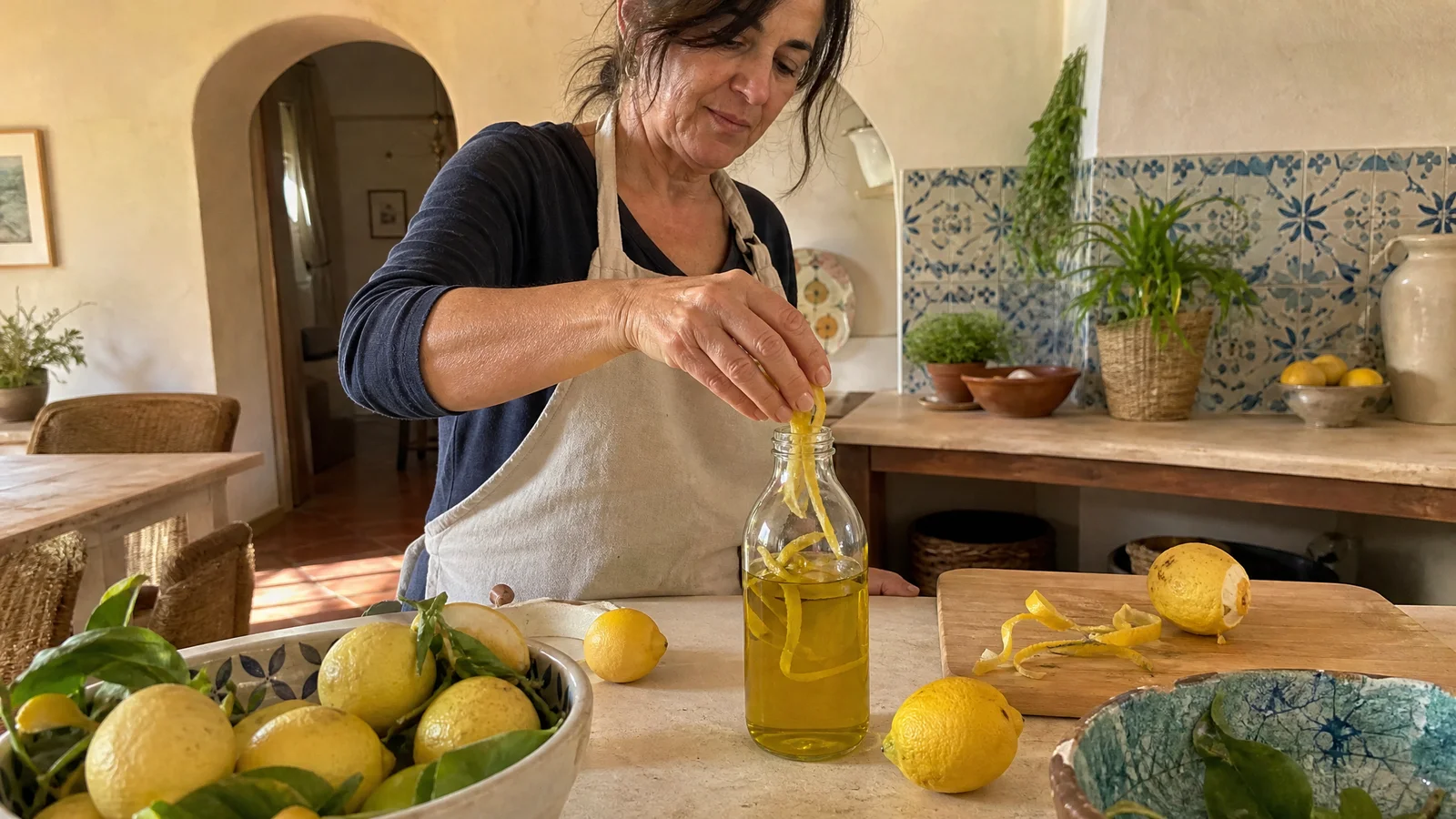
Lemon Oil vs Lemon Eucalyptus Oil: Which Is Which?
Picture two bottles on a shelf, both with "lemon" in big letters. One holds oil pressed from the rind of a lemon. The other holds oil steamed out of the leaves of a eucalyptus tree. They share a name and a citrusy impression, and very little else.
Organic Lemon Essential Oil
Our own Organic Lemon Essential Oil, in sizes from 0.5 oz to bulk.
From $15.99
Shop Now →Same word, different plants
This mix-up is easy to make because the shelf layout works against you. Bottles are grouped by smell, not by plant, so lemon, lemon eucalyptus and lemongrass often sit within arm's reach of one another, each with a bright, citrusy word on the front.
"Lemon" on a label tells you about a scent, not a plant. Our oil is Citrus limon, cold-pressed from the peel. Lemon eucalyptus oil comes from the leaves of a tree that the 2025 study we read calls Eucalyptus citriodora (other literature files it under Corymbia citriodora). When a listing gives no Latin name, it has not told you which bottle you are buying, so that is the first thing we look for.
Pressed rind versus steamed leaf
The two are obtained in completely different ways. ISO 855:2003 describes lemon oil as "obtained by expression", meaning squeezed or scraped out of the peel rather than heated. One producer's process, described by the European Food Safety Authority, scarifies the fruit surface, rinses the released oil off with water, filters the suspension and spins it in a centrifuge (EFSA). Lemon eucalyptus oil is a leaf distillate. In an Algerian laboratory study, shade-dried leaves from a botanical garden were hydrodistilled in a Clevenger apparatus and gave 3.45% oil by weight, a lab figure rather than a commercial yield (Chikhi-Chorfi and colleagues, 2025).
Where the lemon smell comes from
Here is the part we find most fun. Cold-pressed lemon oil leans on limonene: across ten commercial batches analysed by EFSA it averaged 64.8% of the oil, with beta-pinene and gamma-terpinene filling in behind it. The eucalyptus leaf oil in that Algerian sample was built on citronellal (58.0%), with isopulegol and citronellol next. Two entirely different chemical backbones, and both land in the "lemony" part of the nose. That is also why one cannot stand in for the other in a formula: they carry different molecules, and no single sample shows what every lemon eucalyptus oil contains. Our guide to reading a GC-MS report shows how to spot which backbone you are holding.
Why the name mix-up matters most for repellents
People often meet lemon eucalyptus through insect repellent, and that is where the confusion has real consequences. The US Environmental Protection Agency lists "Oil of Lemon Eucalyptus" among the registered skin-applied repellent ingredients and notes that it "contains pmd, but is a separately regulated pesticide chemical". The CDC advises not using products containing OLE or PMD on children under 3 (CDC). Those statements are about registered, labelled repellent products. They say nothing about a bottle of leaf essential oil, and nothing about lemon oil. We do not sell a repellent, so for protection against bites we point you to the EPA and CDC pages and to a pharmacist, and our insect repellent post walks through what the agencies say.
Open the bottle and compare
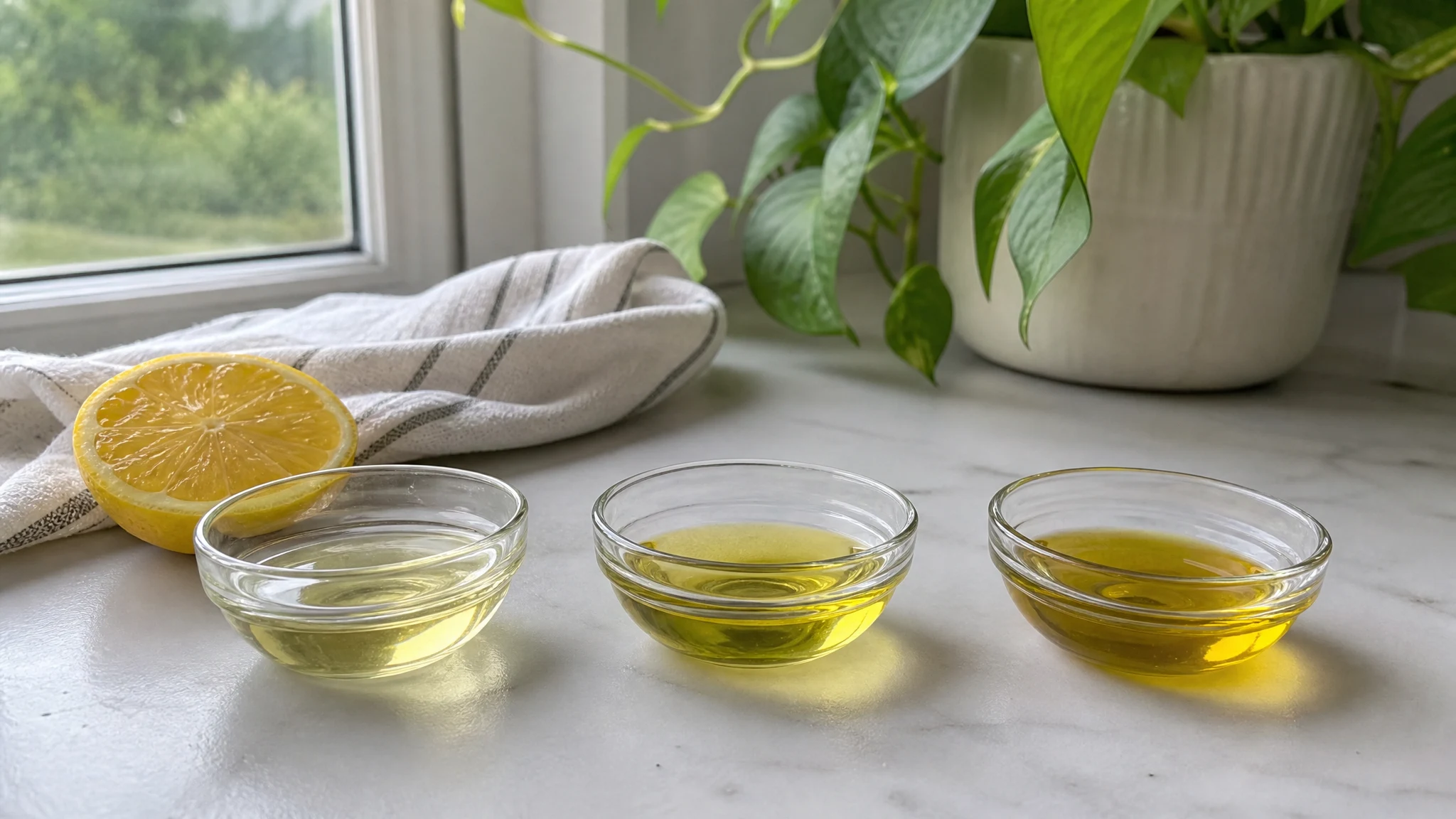
If you ever have both oils in front of you, a short side-by-side sniff teaches you more than any article. Put a drop of each on its own paper strip, label them, and smell right away. Lemon oil tends to open sparkling and sweet, like a zested peel. A leaf oil usually brings a greener, more herbal edge behind the citrus note. Smell them again after ten minutes and notice which one has faded and which one stays.
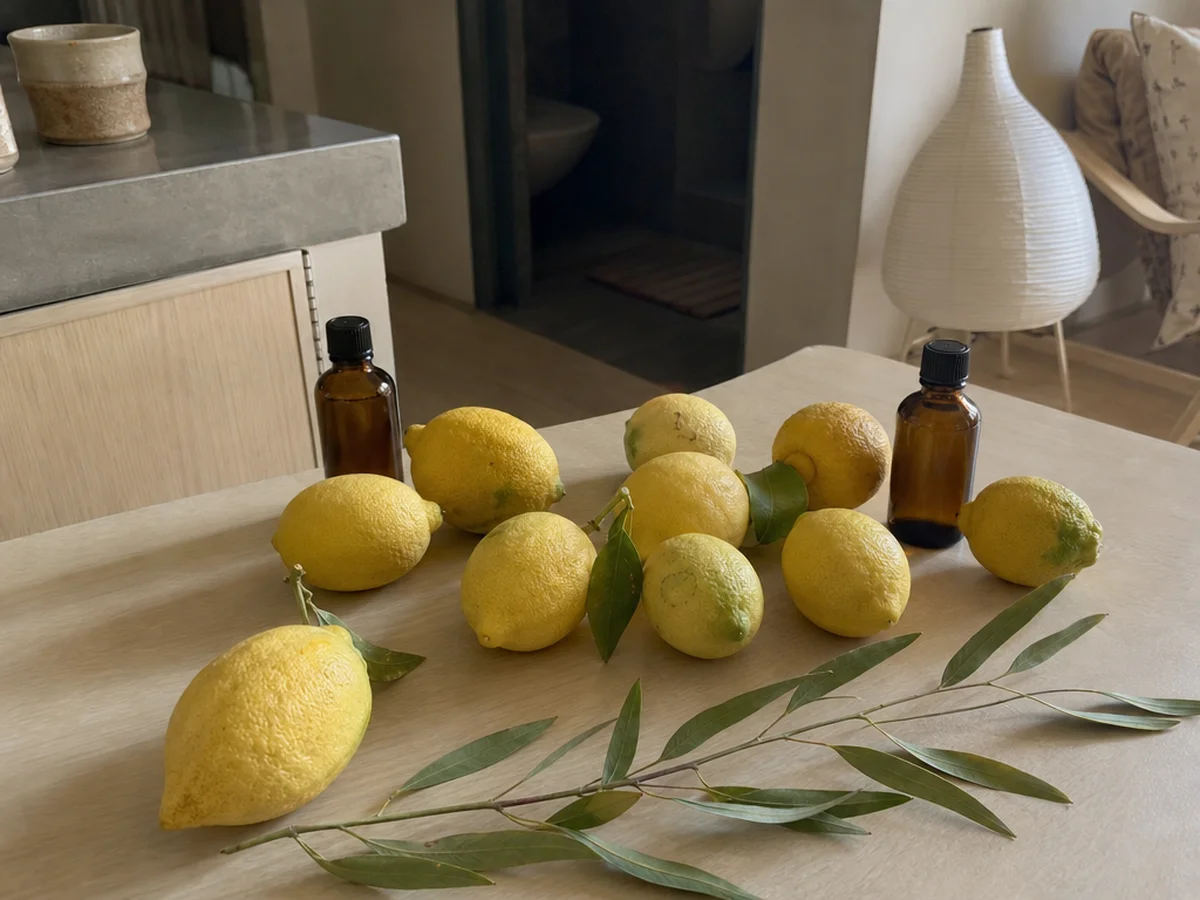
You do not need training for this. It is just a slow, curious sniff, and it makes the Latin names on the labels feel far less abstract.
What lemon oil asks of you on skin
Cold-pressed lemon is phototoxic, which is the reason for its limit. The Tisserand Institute gives the IFRA figure as 2% and calls it "the safe maximum, not a recommended amount, which might be less". It also advises keeping treated skin out of UV light for at least 12 hours after a phototoxic amount is applied (dilution and phototoxicity pages). Our own guidance is to dilute to 0.5% to 2% in a carrier oil, patch test first and avoid sun on freshly treated skin. We would start at the lower end. Details are in our skin guide.
Reading a listing quickly
When you scroll through a product page, look for three things before you look at the photo: the Latin name, the plant part and the process. Put your finger on the screen if you have to. Pretty pictures of lemons appear on every one of these bottles, whether the oil inside came from a fruit or a leaf, so the photo tells you nothing about what is inside.
A quick way to pick the right bottle
- You want the sparkle of a sliced lemon in a diffuser blend, a soap or a diluted body oil: that is peel oil, Citrus limon.
- You want a lemon eucalyptus leaf oil: check for the Latin name and ask for the GC report on the lot. We do not sell it.
- You are weighing other lemon-scented oils: our post on lemongrass and lemon balm sorts out that trio.
Whichever you choose, read the Latin name, the plant part and the process before the word "lemon", and you will know what you are holding.
When in doubt, ask the seller to confirm the Latin name before you order. A good answer comes back in a sentence or two, and it saves you from a bottle you did not mean to buy.
Organic Lemon Essential Oil
Organic Lemon Essential Oil from our own shop, in sizes from 0.5 oz to bulk.
From $15.99
Shop Now →Sources & Further Reading
- ISO 855:2003 - Oil of lemon [Citrus limon (L.) Burm. f.], obtained by expression. ISO
- EFSA Panel on Additives and Products or Substances used in Animal Feed, 2021. Safety and efficacy of feed additives consisting of expressed lemon oil and its fractions from Citrus limon (L.) Osbeck and of lime oil from Citrus aurantiifolia (Christm.) Swingle for use in all animal species (FEFANA asbl). EFSA Journal, via PubMed Central
- Chikhi-Chorfi N et al., 2025. Chemical Composition and Insecticidal Activity of Essential Oils from Origanum floribundum and Eucalyptus citriodora Against the Louse Bovicola limbatus. Molecules. PubMed Central
- US EPA. Skin-Applied Repellent Ingredients. epa.gov
- CDC. Preventing Mosquito Bites. cdc.gov
- Tisserand Institute. Dilution for essential oils. tisserandinstitute.org
- Tisserand Institute. Phototoxicity: essential oils, sun and safety. tisserandinstitute.org