
Lemon Oil as an Insect Repellent: What EPA and CDC Say
Three different materials carry the word "lemon" in the repellent aisle: oil of lemon eucalyptus (EPA-registered and named by CDC), lemongrass oil (on EPA's minimum-risk exemption list), and lemon oil pressed from Citrus limon peel, which is neither. Ours is the third, and we make no repellent claim for it. If the goal is protection from ticks or mosquitoes, CDC's advice is to choose a product with an EPA registration number, and the rest of this piece shows why lemon peel oil does not fit that description.
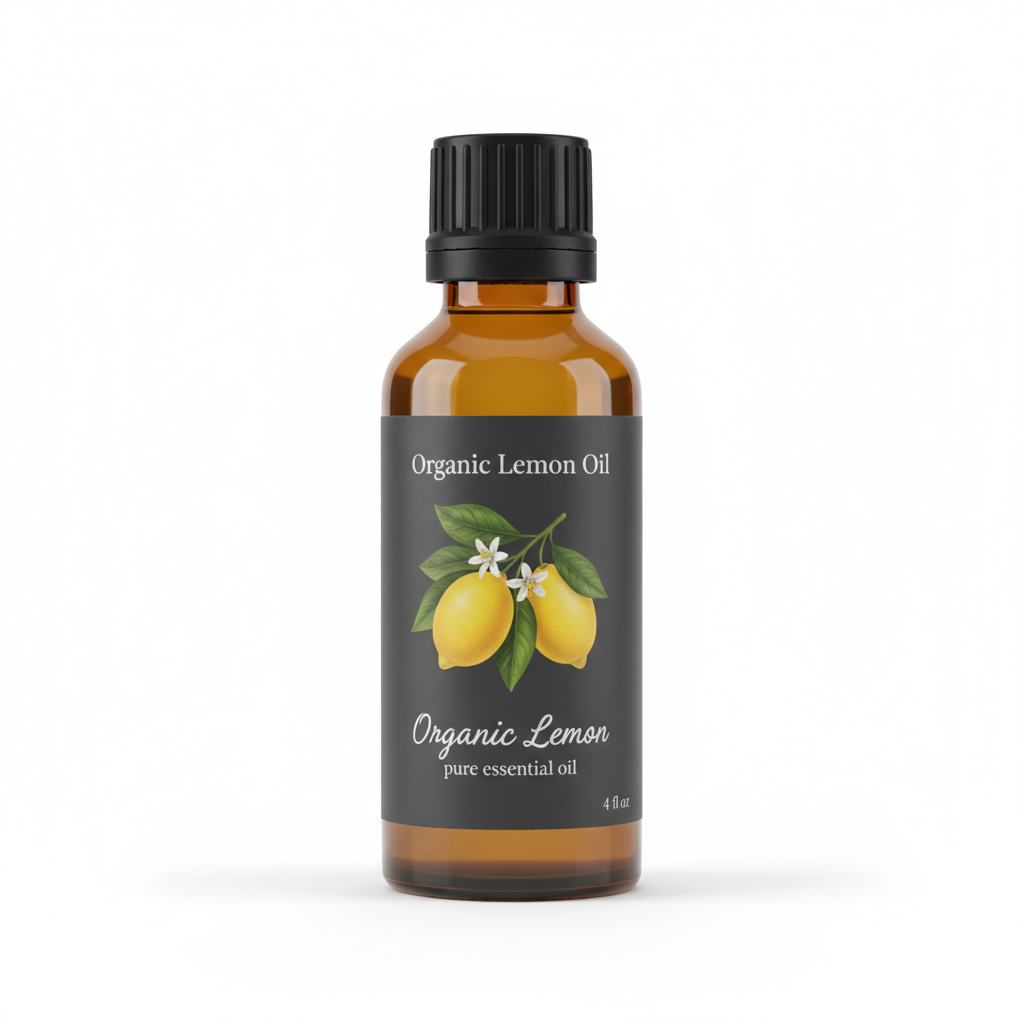
Organic Lemon Essential Oil
Our own Organic Lemon Essential Oil, in sizes from 0.5 oz to bulk.
From $15.99
Shop Now →Which "lemon" is on the label
The three materials differ in species, in plant part and in regulatory status. The table uses only what the cited pages state.
| Material | What the authority page says |
|---|---|
| Oil of lemon eucalyptus (Corymbia citriodora; PMD is its active component) | CDC lists it among six repellent active ingredients, with para-menthane-diol (PMD) listed separately (CDC, mosquito prevention page). EPA's skin-applied ingredient list shows it as containing PMD "but is a separately regulated pesticide chemical," with 6 products listed (EPA, updated January 23, 2026). |
| Lemongrass oil (Cymbopogon, a grass) | Named in Table 1 of the minimum-risk exemption in 40 CFR 152.25(f), CAS 8007-02-1 (eCFR, version dated 2026-01-01). |
| Lemon oil (Citrus limon peel) | The text of that section as retrieved contains no lemon oil and no limonene, in the active-ingredient table or anywhere else in it. |
Oil of lemon eucalyptus is the one to keep separate in your head. Maia and Moore's 2011 review of plant repellents describes PMD as the by-product left after distilling lemon eucalyptus oil, and says it protected "over several hours" while the essential oil itself "is repellent for around one hour" (Maia and Moore, Malaria Journal, 2011). Our side-by-side of the two bottles is in Lemon Oil vs Lemon Eucalyptus Oil.
What EPA's minimum-risk list says, exactly
Section 152.25(f) exempts products from FIFRA registration if every listed condition is met, and its Table 1 lists the permitted active ingredients. Reading the table as retrieved, the entries that sound closest to our subject are castor oil, cedarwood oil, cinnamon oil, citric acid, citronella oil, clove oil, geraniol, geranium oil, lemongrass oil, peppermint oil, rosemary oil, spearmint oil and thyme oil. "Lemon oil" is not among them. The inert-ingredient table (Table 2) lists citrus meal, citrus pectin and citrus pulp, which are not the peel oil.
The conditions matter as much as the list. Condition (ii) says the product "must not bear claims either to control or mitigate microorganisms that pose a threat to human health" or "claims to control insects or rodents carrying specific diseases, including, but not limited to ticks that carry Lyme disease." EPA's conditions page gives the practical wording: a label may say "controls ticks" but not "controls ticks that carry Lyme disease," and it adds that "EPA does not review exempted products" (EPA, conditions page, updated August 31, 2026). Compare that with a registered repellent: EPA says the registration number "means the company provided EPA with technical information on the safety of the product and its effectiveness against mosquitoes and/or ticks" (EPA, repellent search page). CDC puts the consequence plainly: "We do not know the effectiveness of non-EPA registered insect repellents, including some natural repellents."
Reasoning from the exemption's wording: a product that makes a pest-control claim and is neither registered nor made only from listed ingredients is outside the exemption. How that applies to a particular label is a question for a pesticide regulatory consultant or a product-safety attorney, not for a shop.
A sentence that appears to disagree
A 2024 review of citrus-based repellents says EPA "has officially approved only a small number of plants" and that "citronella, lemon, and eucalyptus oils are among these" (Fernando et al., Journal of Toxicology, 2024). The sentence does not say which lemon material it means or cite a regulation. The regulatory text above lists lemongrass oil and no lemon oil, and "lemon" in the review may refer to lemon eucalyptus or lemongrass. For what is actually exempt, the regulation controls. Separately, the NIH PubChem record for d-limonene, quoting its HSDB entry, says d-limonene "is registered for pesticide use in the USA" and tells readers to consult authorities for current approved uses (PubChem, CID 440917). That describes limonene as an isolated chemical in registered products, not a lemon oil on a shop shelf.
What the lab work reports, and what it cannot tell you
The Fernando review tabulates percentage repellency from many citrus studies and uses a six-class scale in which 80.1 to 100% counts as "high repellency." Three rows concern lemon peel oil, as the review lists them (the underlying papers were not read for this article):
| Insect | Dose as tabulated | Repellency |
|---|---|---|
| Anopheles stephensi (a malaria mosquito) | 1% | 92.63% |
| Periplaneta americana (American cockroach) | 10 µL | 92.6% |
| Callosobruchus maculatus (a stored-bean weevil) | 7 µL | 36.66% |
These are laboratory figures. The table as read does not give the method, the duration, the carrier, or whether any skin was involved, and no row is a human trial against ticks. A 92% result against one species in one assay and a 37% result against another show how much the answer depends on insect and set-up. The review's own Aedes row, for lime peel and similar fruit oils at 0.33 µL/cm², shows high figures too, which is the point: laboratory repellency is common among citrus oils and says little about a person outdoors.
The duration problem is documented. Maia and Moore write that plant oils' active ingredients "tend to be highly volatile," so they work "for a short period after application" and then "rapidly evaporate leaving the user unprotected," with PMD the stated exception. They also write that repellents containing only essential oils, without an active ingredient such as DEET, should not be recommended for use in disease-endemic areas. Reasoning from the one-hour figure they give for lemon eucalyptus essential oil (a different oil), an eight-hour day in tick habitat would mean eight re-applications of any short-lived oil, each one on sun-exposed skin.
For household ants, the searches for this article turned up no study of lemon oil that could be read in full, so none is reported here. A persistent infestation is a job for a licensed pest-control operator.
The sun problem is specific to this oil
Cold-pressed lemon oil is phototoxic, and repellents are worn outdoors. IFRA's standard for lemon oil cold pressed (2020, Amendment 49, compiled in the 51st Amendment, January 2024) is set for phototoxicity and allows 2.0% in finished products for Categories 1 to 6, 7B, 8, 10B and 11B, with no restriction for 7A, 9, 10A, 11A and 12. It also says that if the furocoumarin level is unknown, the restriction applies as written (IFRA Standards, 51st Amendment). IFRA's guidance names a skin-applied insect repellent as the product type that drives the exposure assumption for Category 5, the leave-on face and body category (IFRA Guidance, Table 6). The Tisserand Institute's dilution chart likewise says lemon oil "should be used at no more than 2%," and its phototoxicity page advises keeping treated skin out of UV for at least 12 hours (Tisserand Institute, dilution chart; phototoxicity page).
The arithmetic: 2% of one ounce of carrier is about 0.59 ml, roughly 12 drops at 20 drops per ml, the top of our own 0.5% to 2% skin copy. The authorities' ceiling and our copy agree, so there is no conflict to resolve. Our recommendation is narrower than the ceiling. Do not make a bug spray from this oil. Even at 2%, the exposure the authorities assume is skin in sun, and a bottle of repellent invites exactly that. Our copy also says to avoid sun on freshly applied areas, keep the oil from eyes, children and pets, and never to take it internally; the pet side is covered in the cats and dogs guide, and the general rules are in Lemon Oil Safety Basics.
Children raise a separate point on the oil that does work. CDC says "Do not use products containing OLE or PMD on children under 3 years old." EPA, on its safe-use page (updated November 10, 2025), says "some oil of lemon eucalyptus products should not be used on children under the age of three" and that products with oil of lemon eucalyptus as the sole active ingredient at 30% or less carry no under-three restriction (EPA, safe use). The two statements differ in scope. Read the label of the product in your hand and ask a pediatrician about a child under three.
What to do instead
Use the order CDC gives. Pick a repellent with an EPA registration number and one of the listed active ingredients; CDC's tick page also recommends treating boots, clothing and gear with 0.5% permethrin and doing a full-body check after time outdoors, "including your own backyard" (CDC, preventing tick bites, August 28, 2024). CDC's Lyme disease page says to seek medical attention for symptoms after a recent tick bite or time in a Lyme area, and lists fever, chills and fatigue as early signs that "may occur in the absence of rash," with early signs appearing 3 to 30 days after a bite (CDC, Lyme disease signs and symptoms, May 15, 2024). A rash, swelling or burning where any plant oil was applied is a reason to stop using it and ask a physician or pharmacist.
Our oil belongs in a different job: a bright citrus scent in a room or on cleaning cloths, as in the cleaning guide. If you want a question answered that is not here, the FAQ is the next stop.
Organic Lemon Essential Oil
Organic Lemon Essential Oil from our own shop, in sizes from 0.5 oz to bulk.
From $15.99
Shop Now →Sources & Further Reading
- eCFR, 2026. 40 CFR 152.25, exemptions for pesticides of a character not requiring FIFRA regulation (version dated 2026-01-01). ecfr.gov/152.25
- EPA, 2026. Conditions of minimum risk pesticides. epa.gov/minimum-risk-pesticides
- EPA, 2026. Skin-applied repellent ingredients; Find the insect repellent that is right for you; Using insect repellents safely and effectively. epa.gov/insect-repellents
- CDC, 2024 to 2025. Mosquito prevention; Preventing tick bites; Lyme disease signs and symptoms. cdc.gov/mosquitoes
- Maia MF, Moore SJ, 2011. Plant-based insect repellents: a review of their efficacy, development and testing. Malaria Journal 10(Suppl 1):S11. doi.org/10.1186/1475-2875-10-S1-S11
- Fernando SSST et al., 2024. Citrus-based bio-insect repellents: a review on historical and emerging trends in utilizing phytochemicals of citrus plants. Journal of Toxicology. doi.org/10.1155/jt/6179226
- IFRA, 2024. IFRA Standards, 51st Amendment, and Guidance for the use of IFRA Standards. ifrafragrance.org/51st-amendment
- Tisserand Institute. Essential oil dilution chart; Phototoxicity. tisserandinstitute.org
- NIH PubChem. D-Limonene, CID 440917 (includes HSDB excerpts). pubchem.ncbi.nlm.nih.gov/440917