Buying Organic Lemon Oil: 5 Questions Worth Asking
The smartest thing you can do before buying organic lemon oil from anyone, including us, is send a short email. A product page shows what a seller chose to print. A written answer shows what the seller will stand behind. Here are the five questions we would ask, and why each one earns its place.
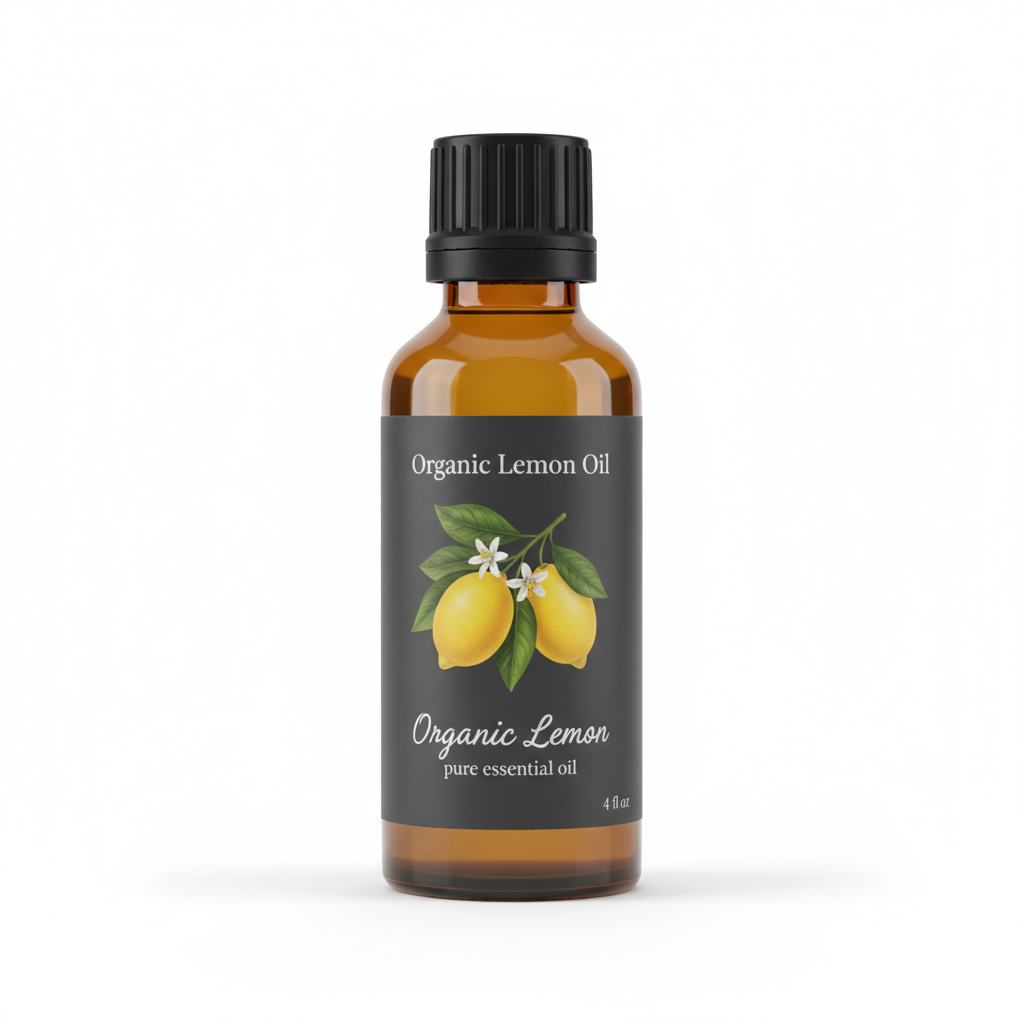
Organic Lemon Essential Oil
Our own Organic Lemon Essential Oil, in sizes from 0.5 oz to bulk.
From $15.99
Shop Now →1. What exactly is the oil?
Ask for three things: the botanical name, the plant part and the process. For lemon that reads Citrus limon, peel, expressed (cold-pressed). ISO 855:2003 is titled "Oil of lemon [Citrus limon (L.) Burm. f.], obtained by expression", so those words are the standard vocabulary. The process word is more than decoration. The Tisserand Institute reports that a distilled lemon oil had 22 times less bergapten and 930 times less citropten than an expressed one, so pressed and distilled lemon follow different sun rules (Tisserand Institute). Ours is cold-pressed from the peel of Citrus limon and sold neat. We do not offer a distilled or furocoumarin-free lemon.
2. What does "organic" rest on?
Ask which certifier, which certificate number, and whether the certificate covers the operation that handles this oil. Under US rules, a certificate of organic operation must be generated from the Organic Integrity Database, and certification continues until it is surrendered, suspended or revoked (7 CFR Part 205). In practice that means a real certificate is something a seller can name and a buyer can look up. We describe our oil as organic, and if organic status is the reason you are buying, ask us in writing for the certificate before you order. We would say the same to you about any bottle.
3. What paperwork exists for the lot I would receive?
A certificate of analysis is only as useful as what it contains. The one we publish is a single page for one batch, and it lists appearance, smell, relative density (0.849 against a printed range of 0.840 to 0.855), refractive index (1.474 against 1.473 to 1.477) and optical rotation (+67.80 degrees against +57.0 to +78.0). If you need a GC-MS composition report, ask us in writing before ordering.
It helps to know what a fuller report shows. The European Food Safety Authority reported, for ten commercial batches of cold-pressed lemon oil, limonene averaging 64.8% of the oil, beta-pinene 13.3% and gamma-terpinene 9.04% (EFSA). Our GC-MS reading guide explains those peaks, and physical constants alone cannot show them.
4. How fresh is it, and how is it stored?
Limonene is lovely, and it also reacts with air. In a 1992 study, air-exposed limonene caused skin sensitisation in guinea pigs while unexposed limonene did not (Karlberg and colleagues). In people, a six-country patch-test study of 2,900 dermatitis patients found 5.2% positive reactions to oxidised limonene at 3.0% in petrolatum (Bråred Christensson and colleagues, 2013). Those tests were on limonene itself, and on people already being seen for dermatitis, so they are a reason to value fresh oil rather than a statement about any bottle. In plain terms: ask for the date on the lot, and keep your bottle capped, cool and out of light. Our post on storing lemon oil has the details.
5. What will you use it for?
The answer decides how much paperwork you need. A closet sachet asks less of a seller than a leave-on product you plan to sell. For skin, our guidance is to dilute to 0.5% to 2% in a carrier oil and patch test first. The Tisserand Institute gives the IFRA limit for lemon as 2%, "the safe maximum, not a recommended amount, which might be less", and suggests 0.2% to 1% for sensitive skin and 0.5% to 1.2% for the face (Tisserand Institute). We would start at the low end and treat 2% as a ceiling, never a goal.
Making the email easy to answer
Keep the message short and friendly. Put the five questions in a numbered list, say what you plan to make, and mention roughly how much you expect to order. A seller who reads a clear message can give a clear reply, while a vague message tends to get a vague one back. Ask for the answers in writing, so you have something to look at again when the bottle turns up.
When the reply arrives, read it slowly. You are looking for specifics: a name, a number, a date. "Certified and tested" tells you very little, while a certificate number, a stated process and a date on the lot tell you a great deal. It is perfectly fine to ask a follow-up if something is still unclear, and a good seller will be glad you did.
When the bottle arrives
Open it and take a moment with it. Lemon oil should look thin and pale yellow, and it should smell like a freshly scored peel, bright and zesty. Check that the cap seals well, then label the bottle with the date you first opened it and put it somewhere cool and dark. Small habits like these cost nothing, and they protect everything you went to the trouble of asking about.
Two things a label cannot prove
Grade words such as "pure" or "medical" are not defined by any standard we read, so they cannot be verified. Price on its own cannot prove what is in a bottle either, and our price guide explains why. A country name is not a lot-level analysis, which is the point of our origins post.
Put all five questions in one message and keep the answers. A reply with a certificate number and a lot-specific report has told you something a page could not. You can send yours through our contact page, and our wholesale page explains how to order a sample bottle to evaluate in your own product.
A little patience up front is what makes the rest of the project fun. Ask good questions, keep the replies, and then enjoy that bright lemon scent when it finally reaches your workbench.
Organic Lemon Essential Oil
Organic Lemon Essential Oil from our own shop, in sizes from 0.5 oz to bulk.
From $15.99
Shop Now →Sources & Further Reading
- ISO 855:2003 - Oil of lemon [Citrus limon (L.) Burm. f.], obtained by expression. ISO
- Tisserand Institute. Phototoxicity: essential oils, sun and safety. tisserandinstitute.org
- Tisserand Institute. Dilution for essential oils. tisserandinstitute.org
- Electronic Code of Federal Regulations, Title 7, Part 205: National Organic Program. ecfr.gov
- EFSA Panel on Additives and Products or Substances used in Animal Feed, 2021. Safety and efficacy of feed additives consisting of expressed lemon oil and its fractions from Citrus limon (L.) Osbeck and of lime oil from Citrus aurantiifolia (Christm.) Swingle for use in all animal species (FEFANA asbl). EFSA Journal, via PubMed Central
- Karlberg AT, Magnusson K, Nilsson U, 1992. Air oxidation of d-limonene (the citrus solvent) creates potent allergens. Contact Dermatitis 26:332-340. Europe PMC
- Bråred Christensson J et al., 2013. An international multicentre study on the allergenic activity of air-oxidized R-limonene. Contact Dermatitis 68:214-223. Europe PMC