What Is Organic Lemon Oil? The Complete Guide to Cold-Pressed Citrus Limon
Key Takeaways
- Organic lemon oil is cold-pressed from the outer peel of Citrus limon fruit, not from the juice or the leaves.
- Cold pressing preserves the full aromatic profile that steam distillation partially alters, making pressed lemon oil the standard for fragrance and cosmetic use.
- "Organic" certification means the fruit was grown without synthetic pesticides or fertilizers, which matters especially because the peel concentrates whatever is on the skin of the fruit.
- The dominant constituent is d-limonene, which gives lemon oil its characteristic bright, citrus scent and makes it a popular ingredient in skincare and home fragrance.
- Cold-pressed lemon oil is phototoxic. It should never be applied to skin before sun or UV exposure without proper dilution guidance and timing precautions.
- Quality varies enormously between suppliers. Knowing how to read a label and what questions to ask can protect both your skin and your budget.
What Is Lemon Oil, Exactly?
Lemon oil is a concentrated aromatic extract obtained from the outer rind of the lemon fruit, Citrus limon. That bright yellow peel you instinctively bring to your nose when you zest a lemon? The tiny spray of moisture that mists your fingers? That is lemon oil in its most natural form. The commercial product is simply a purified, standardized version of what the fruit naturally produces in the tiny sacs embedded in its peel.
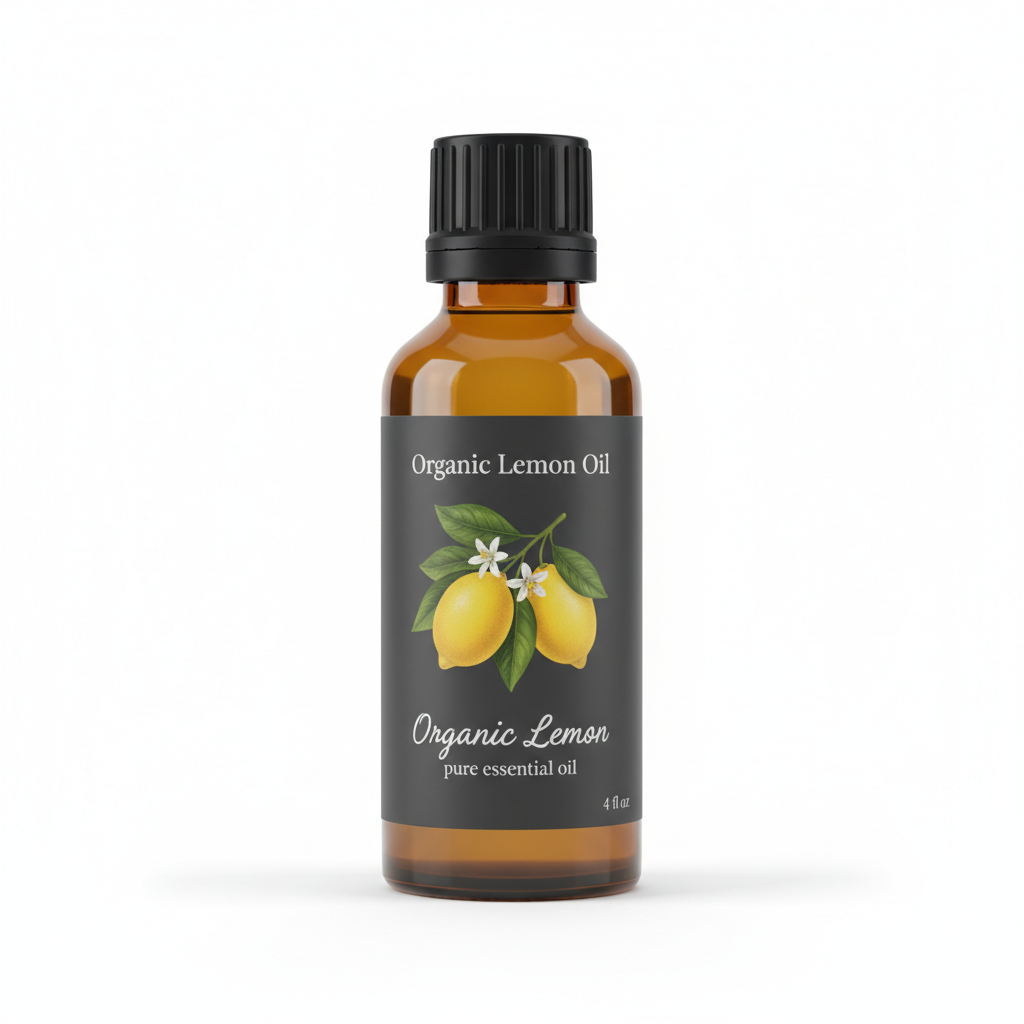
Organic Lemon Essential Oil
Our own Organic Lemon Essential Oil, in sizes from 0.5 oz to bulk.
From $15.99
Shop Now →It is worth being clear about what lemon oil is not. It is not lemon juice. It is not a citric acid solution. It is not the same as lemon verbena oil or lemongrass oil, both of which come from completely different plant families and carry quite different scent profiles. True lemon essential oil comes specifically from Citrus limon peel, period.
The oil is held in glands called oil sacs (or secretory cavities) distributed throughout the flavedo, which is the outermost, colored portion of the peel. These sacs rupture when pressure is applied, releasing the volatile aromatic compounds inside. Cold pressing is designed to capture this release efficiently and with minimal heat, preserving the integrity of those compounds as closely as possible to their natural state.
A Brief Botanical Background
Citrus limon belongs to the Rutaceae family, a large family of flowering plants that includes oranges, grapefruits, limes, and bergamot. The lemon is believed to have originated somewhere in South or Southeast Asia and has been cultivated across the Mediterranean for centuries. Today, the major producing regions for lemon oil include Italy (especially Sicily), Argentina, the United States (California), and Spain. Each growing region imparts subtle differences in the oil's aromatic character, a phenomenon sometimes called terroir in the botanical world.
The Latin species name limon is about as straightforward as botanical nomenclature gets. When you see "Citrus limon" on a label, you can be confident you are looking at true lemon, not a hybrid or a related species being sold under a similar name. This matters because some suppliers substitute cheaper citrus oils, particularly expressed lime oil or blended citrus fractions, for genuine lemon oil. Always check the full Latin name.
Expressed vs. Essential: A Note on Terminology
You will sometimes see cold-pressed lemon oil labeled as an "expressed oil" rather than an "essential oil." Technically, this distinction matters to purists and aromatherapy organizations. Essential oils, in the strictest sense, are obtained through steam distillation or dry distillation. Expressed oils are obtained through mechanical pressure without heat. Because most lemon oil sold for aromatic and cosmetic use is cold-pressed rather than distilled, labeling it an "expressed oil" or "expressed citrus oil" is technically more accurate.
In everyday usage, the terms are often used interchangeably, and most retailers, including organic suppliers, simply call it lemon essential oil for clarity and searchability. For practical purposes, the key thing to understand is the extraction method, not the terminology debate. Ask how the oil was made, not just what it is called.
Cold-Pressed vs. Steam-Distilled: Why the Difference Matters
If you have spent any time researching how lemon oil is made, you have likely encountered both cold-pressed and steam-distilled versions. The difference is significant, and knowing which you are buying directly affects how the oil smells, how it performs, and how you can use it safely.
How Cold Pressing Works
Modern cold pressing uses a process called ecuelle a piquer (historically) or, more commonly today, centrifugal or rasping extraction. Whole lemons or their peels are fed into a machine that punctures and abrades the surface of the rind, rupturing the oil sacs. Water is used to flush the released oil away from the peel material. The resulting oil-and-water emulsion is then separated, typically by centrifugation, to isolate the pure oil.
The word "cold" is slightly misleading. The process does generate some heat from friction, but temperatures are kept well below those used in steam distillation, typically under 50 degrees Celsius. This matters because many of the volatile aromatic compounds in lemon peel are heat-sensitive. Keeping temperatures low helps preserve their natural proportions and nuances.
How Steam Distillation Differs
Steam distillation pushes steam through plant material. The steam carries volatile compounds with it, and when the steam cools and condenses, it separates into water (the hydrosol) and oil. This works beautifully for many botanicals. For citrus peels, it presents a problem.
The high heat of steam distillation causes some of the lighter, more delicate aromatic compounds in lemon peel to break down or evaporate entirely. What you get is a lemon oil with a somewhat flatter, less complex scent. It tends to smell slightly more "cooked" than cold-pressed oil, with less of the bright, sparkling top-note quality that makes fresh lemon so recognizable.
There is one significant practical advantage to steam-distilled lemon oil: it is not phototoxic. The compounds responsible for photosensitivity, primarily furocoumarins and certain bergapten-related molecules, are too heavy to travel with steam. They remain behind in the spent plant material. So if your primary need is a skin-safe lemon-scented oil for use in products that will be applied before sun exposure, steam-distilled or furocoumarin-free versions are worth considering. More on photosensitivity in the safety section below.
Which Is Better?
Neither is universally superior. They serve different purposes. For aromatic use, diffusing, home fragrance, and formulations where the skin will not be exposed to sunlight, cold-pressed organic lemon oil is widely considered the gold standard. Its scent is more vivid, more true to the fruit, and more complex. For leave-on skincare products used by people who spend time outdoors, a steam-distilled or furocoumarin-free version offers a safer profile.
What "Organic" Actually Means for Lemon Oil
The word "organic" appears on a remarkable number of essential oil labels. Not all of them earn it. Understanding what organic certification actually requires helps you sort genuine quality from marketing language.
Certification Bodies and Standards
In the United States, the USDA National Organic Program (NOP) governs organic certification for agricultural products. For an oil to carry the USDA Organic seal, the lemons used to produce it must have been grown without synthetic pesticides, synthetic fertilizers, genetically modified organisms, or sewage sludge. The farm must have been managed organically for at least three years before certification, and the entire supply chain, from farm to processor to the final packager, must be certified.
European organic certification operates under EU Regulation 2018/848, with similar principles but some differences in specific permitted inputs. Many high-quality Italian and Spanish lemon oils carry both EU organic certification and USDA NOP recognition, since producers in those regions often export to both markets. Look for certification numbers on the label, not just the word "organic" in the product name.
Why Organic Matters More for Peel Oils
Here is something worth understanding clearly: conventional lemon farming uses pesticides. Lemons are sprayed repeatedly throughout the growing season for a variety of common agricultural reasons. When you squeeze lemon juice, you are working primarily with the interior of the fruit, which has relatively less direct pesticide contact (though some systemic pesticides do move through the plant).
Cold-pressed lemon oil is made entirely from the peel. The peel is the part of the fruit in direct contact with everything applied to the outside of the fruit during cultivation. Oil sacs in the peel can concentrate lipophilic (fat-soluble) compounds, which is exactly the category many agricultural chemicals fall into. Choosing organic is not just a philosophical preference when it comes to cold-pressed peel oils. It is a meaningful quality consideration.
"Natural" Is Not the Same as Organic
"Natural" has no regulated definition in the United States for cosmetic or aromatic products. A supplier can call an oil natural without any third-party verification whatsoever. Similarly, "wildcrafted" and "pure" carry no standardized meaning in this context. If you see these words without accompanying certification details, ask the supplier directly for documentation. Reputable brands are always willing to share their certifications.
Inside the Bottle: The Chemistry of Citrus Limon
You do not need a chemistry degree to appreciate what makes lemon oil work the way it does. But a basic familiarity with its key constituents helps you make smarter decisions about quality, storage, and use.
d-Limonene: The Star Constituent
Cold-pressed lemon oil is overwhelmingly composed of d-limonene, typically between 60 and 80 percent of the total composition depending on the specific cultivar, growing region, and harvest timing. D-limonene is a cyclic terpene and is responsible for the primary bright, citrus character of lemon oil's scent. It is also one of the most abundant naturally occurring terpenes in the plant kingdom, found in the peel of virtually every citrus fruit.
D-limonene is what gives lemon oil much of its effectiveness as a natural cleaning and degreasing agent in home and surface care products. It is also widely used as a fragrance ingredient in cosmetics, personal care products, and household goods. Some research has examined its properties, though no definitive conclusions about specific health benefits have been established through clinical evidence for the typical concentrations used in aromatic products.
Supporting Constituents
Beyond d-limonene, cold-pressed lemon oil contains a fascinating supporting cast of aromatic compounds. Proportions vary by origin, harvest date, and production method, but a typical gas chromatography (GC) analysis of quality Citrus limon expressed oil might show the following:
| Constituent | Typical Range (%) | Aromatic Character |
|---|---|---|
| d-Limonene | 60 - 80% | Bright, classic citrus, slightly sweet |
| beta-Pinene | 7 - 16% | Woody, green, piney undertone |
| gamma-Terpinene | 3 - 11% | Citrusy, slightly herbaceous |
| alpha-Pinene | 1 - 4% | Fresh, resinous, piney |
| Sabinene | 1 - 3% | Warm, spicy, slightly woody |
| Linalool | 0.1 - 0.5% | Soft, floral, gently sweet |
| Geranial / Neral (Citral) | 0.5 - 3% | Sharp lemon, slightly floral |
| Furocoumarins (incl. bergapten) | Trace amounts | No significant scent; responsible for photosensitivity |
The citral content (geranial plus neral) is worth highlighting even though it appears in small percentages. Citral contributes a sharp, almost tart lemon quality that distinguishes true Citrus limon from other citrus oils. Lemongrass oil, by comparison, can be 70 to 80 percent citral, which gives it a much more intense, almost medicinal lemon scent. The complexity of lemon oil comes precisely from having many constituents in careful proportional balance, not from any single dominant molecule.
Why Oxidation Is a Real Concern
D-limonene oxidizes readily when exposed to air, light, and heat. Oxidized limonene is a known skin sensitizer and can cause contact reactions in some individuals, particularly with repeated exposure. This is not a reason to avoid lemon oil, but it is a strong reason to store it properly (in a dark, cool place with a tightly sealed cap) and to replace it before it goes rancid.
A fresh, high-quality cold-pressed lemon oil has a clean, bright, sparkling scent. If your oil smells flat, slightly soapy, or has a plasticky edge to it, those can be signs of oxidation. Cold-pressed citrus oils typically have a shelf life of 12 to 24 months when stored correctly. Some suppliers now add a small percentage of vitamin E (tocopherol) as a natural antioxidant to extend shelf life. If your oil contains this, it will be listed on the label.
Scent Profile and Sensory Character
One of the most common questions people ask before buying lemon oil is, simply, what does it smell like? The short answer is: like a freshly zested lemon, but amplified. The longer answer is more interesting and useful if you plan to blend or use it in formulation.
For a detailed exploration of the aromatic nuances, including how lemon oil compares to other citrus oils and how its scent evolves over time, see our guide on what lemon essential oil actually smells like.
Top, Middle, and Base Note Behavior
In perfumery, notes refer to how quickly a fragrance component evaporates and how it is perceived over time. Cold-pressed lemon oil is primarily a top note. Its lighter constituents, particularly d-limonene, evaporate quickly. You will notice lemon most intensely in the first few minutes of diffusion or application. This is why lemon is such a popular addition to blends: it provides an immediate bright opening that makes the whole composition feel fresh and energized.
Because lemon oil evaporates quickly, it does not linger on its own. In diffusion blends, pairing it with a middle note (such as lavender or rosemary) and a base note (such as cedarwood or vetiver) helps the lemon quality feel more present throughout the blend's life on a scent strip or in the air.
Variations by Origin
Sicilian lemon oil, often considered a benchmark for quality, tends to be particularly bright and sweet, with a well-developed citrus character and clean finish. Argentine lemon oil is typically more robust and slightly greener in profile, reflecting differences in climate and cultivar. California lemon oil is clean and reliable, though it can be more variable depending on the specific farm and season.
None of these is objectively better. They are different expressions of the same plant, shaped by soil, climate, altitude, and agricultural practice. If you are using lemon oil primarily for diffusion and home fragrance, Sicilian-origin oil is often favored for its rounded, classic profile. For cleaning formulations where the aromatic character matters less than the solvent properties of d-limonene, Argentine oil is perfectly suitable and often more economically priced.
How People Use Organic Lemon Oil
Organic lemon oil is one of the most versatile single-ingredient botanicals in the aromatic and natural cosmetic space. Its applications span from personal care routines to home atmosphere to DIY formulation. Here is a structured overview of how people incorporate it into daily life.
For a more expansive list of practical ideas, our article on 25 bright uses for lemon oil in the home goes into considerable detail on specific recipes and approaches.
Aromatic and Atmospheric Uses
Diffusing is the most popular way to use lemon oil. A few drops in an ultrasonic or nebulizing diffuser fills a room with a clean, uplifting citrus scent that many people associate with freshness and clarity. Lemon oil works particularly well in morning routines, kitchen spaces, and home offices where a bright atmosphere is welcome.
Common diffusion blends include lemon with peppermint, lemon with eucalyptus (for a clean, crisp environment), and lemon with lavender (for a softer, balanced citrus-floral note). Lemon also pairs beautifully with conifer oils like fir needle or pine for a forest-meets-citrus atmosphere that feels both clean and grounded.
Beyond diffusers, lemon oil can be used in reed diffusers (diluted in a suitable carrier base), added to unscented candles at the appropriate usage rate, or blended into linen sprays. A simple linen spray can be made by combining a few drops of lemon oil with distilled water and a small amount of polysorbate 20 or alcohol to help the oil disperse. Shake before each use.
Personal Care and Cosmetic Applications
Lemon oil is a popular addition to a wide range of personal care formulations. Its bright scent makes it an appealing ingredient in everything from body scrubs to face mists to shampoos. However, it is critical to understand the photosensitivity issue before applying any cold-pressed lemon oil product to skin (detailed in the safety section below).
In rinse-off products (products you wash off), the photosensitivity concern is significantly reduced, since the oil does not remain on the skin long enough to cause a phototoxic response. This makes cold-pressed lemon oil more suitable for use in cleansers, scrubs, and shampoos than in leave-on moisturizers or serums intended for daytime use.
In leave-on products meant for nighttime use only, cold-pressed lemon oil can be incorporated at low usage rates, typically 0.2 to 1 percent of the total formula, depending on the product type and the specific skin the product is intended for. Always conduct a patch test with any new formulation containing citrus oil.
Nail and Cuticle Care
Lemon oil is a longtime favorite in nail care routines. Added to a nourishing carrier like jojoba oil or sweet almond oil, a drop or two of lemon oil creates a brightening cuticle oil that smells lovely and may help support the appearance of healthy-looking nails and surrounding skin. A typical dilution for this purpose is around 1 to 2 percent, meaning 1 to 2 drops of lemon oil per teaspoon of carrier oil.
Hair Care
A small amount of lemon oil added to a neutral shampoo or scalp rinse is a popular choice for those looking to support a fresh-feeling scalp. Some people add 1 to 2 drops per ounce of shampoo. Because shampoo is a rinse-off product, the photosensitivity concern is less prominent here, though it is still worth rinsing thoroughly and not applying to skin immediately before extended sun exposure.
Home Cleaning Formulations
D-limonene, the primary constituent of lemon oil, is an effective natural solvent and degreaser. This makes lemon oil a popular addition to DIY cleaning products: all-purpose sprays, wood polish blends, dishwashing soaps, and surface cleaners. These applications are not the focus of cosmetic use, but they represent a significant portion of how people actually use lemon oil at home, and organic lemon oil performs just as well as conventional versions in these applications.
A simple all-purpose surface spray can be made by combining water, white vinegar, a dispersant such as castile soap, and 10 to 15 drops of lemon oil per cup of liquid. Note that vinegar and castile soap should not be combined directly (they neutralize each other); use one or the other, not both.
Blending with Other Oils
Lemon oil blends harmoniously with an unusually wide range of other aromatics. Top-note companions include other citrus oils (bergamot, sweet orange, grapefruit) and peppermint. Middle-note companions include lavender, geranium, ylang ylang, and clary sage. Base-note companions include cedarwood, frankincense, sandalwood, and vetiver. It also works well in spice-forward blends with ginger, black pepper, or cardamom.
Safety Essentials: What Every Buyer Should Know
Organic lemon oil is a wonderful ingredient, but it is not without safety considerations. These are not reasons to avoid it. They are reasons to use it thoughtfully. Our dedicated guide on lemon oil safety, photosensitivity, dilution, and use around children covers these topics in full detail. Here is a concise overview.
Photosensitivity: The Most Important Safety Point
Cold-pressed lemon oil is phototoxic. This is the single most important safety fact to understand about this oil. Furocoumarins present in the expressed oil can react with ultraviolet light and cause a phototoxic skin response, which may range from darkening and discoloration to significant irritation on sun-exposed skin. This is not an allergic response. It is a predictable photochemical reaction.
The practical rule is straightforward: do not apply cold-pressed lemon oil (or products containing it at significant concentrations) to skin that will be exposed to sunlight or UV light, including tanning beds, within 12 to 18 hours. If you apply a lemon oil-containing product in the evening and stay indoors overnight, the risk is negligible for most people. If you apply it in the morning before going outside, the risk is real.
Steam-distilled lemon oil and furocoumarin-free (FCF) lemon oil do not carry this risk. If you need a lemon-scented product for daytime skin use, seek out one of those versions specifically.
Dilution Guidelines
Lemon oil, like all essential oils, should never be applied undiluted (neat) to skin. The industry standard guidance from organizations like the International Fragrance Association (IFRA) and the National Association for Holistic Aromatherapy (NAHA) provides recommended maximum usage rates for different product types and application sites.
As a general reference point, a 1 percent dilution equals approximately 6 drops of essential oil per ounce (30 ml) of carrier. For most adult skin applications, dilutions of 1 to 2 percent are appropriate starting points. For facial products, staying at or below 0.5 to 1 percent is a reasonable approach. Always err on the lower side when starting with a new oil.
Children and Sensitive Populations
Essential oil use around young children requires additional caution. Many aromatherapy organizations recommend avoiding topical use of citrus oils on children under 2 years of age, and using very low dilutions for older children. Always consult a qualified healthcare provider before using any essential oil product on or around infants and young children.
Individuals with sensitive skin or a history of skin reactions should patch test all new products before full use. Apply a small amount of the diluted product to the inner forearm, wait 24 hours, and check for any reaction before broader application.
Pregnant and nursing individuals should consult their healthcare provider before using essential oil products. This is a standard precaution, not an indication that lemon oil is specifically dangerous during pregnancy, but individual circumstances vary.
Pets and Lemon Oil
The picture with pets is more complex than it might initially seem. For cat and dog owners in particular, citrus oils warrant careful consideration. Our guide on whether lemon oil is safe for cats and dogs walks through the current thinking in detail. The short version: diffusion in well-ventilated spaces where pets can leave the room is generally considered lower-risk than direct topical application, but the topic genuinely deserves more than a paragraph. Read before use if you have animals in your home.
Skin Sensitization and Oxidation
As discussed in the chemistry section, oxidized lemon oil is more likely to cause skin sensitization than fresh oil. This means proper storage and timely use genuinely matter for safety, not just for scent quality. Keep your lemon oil in a sealed dark glass bottle, store it away from heat, and use it within the recommended shelf life. If the scent has changed noticeably from when you first opened the bottle, that is worth paying attention to.
Buying Guide: Reading Labels and Choosing Quality
The organic lemon oil market includes genuine high-quality products and a fair number of disappointing ones. Learning to read labels carefully is the single most useful skill you can develop as a buyer.
What a Good Label Should Tell You
A trustworthy lemon oil label should include, at minimum:
- Botanical name: Citrus limon (not just "lemon oil" or "citrus oil")
- Plant part used: Peel (sometimes listed as "rind" or "fruit peel")
- Extraction method: Cold-pressed, expressed, or steam-distilled
- Origin country: Italy, Argentina, USA, Spain, or similar
- Certification details: Certification body and certificate number for organic claims
- Lot number: For traceability
- Best-before or fill date: To assess freshness
Labels that say only "100% pure lemon oil" or "natural lemon essential oil" without any of the above details are not necessarily bad, but they give you nothing to verify. Quality suppliers want you to know the details because the details are good.
GC/MS Testing: The Transparency Standard
Gas chromatography/mass spectrometry (GC/MS) testing analyzes the chemical constituents of an oil and verifies that its composition matches what is expected for genuine Citrus limon expressed oil. It can also detect adulteration, such as the addition of synthetic limonene or other citrus fractions used to extend a more expensive oil.
The best suppliers make GC/MS reports available for each batch of oil they sell. Some post them on their website by lot number. Others will email them on request. If a supplier is unwilling to provide GC/MS documentation for their oil, that is worth noting. It does not automatically mean the oil is poor quality, but it reduces your ability to verify their claims.
Price as a Quality Signal
Lemon oil is one of the more affordable essential oils because lemons are grown at scale and the pressing process is relatively efficient. However, there is still a floor below which a genuinely organic, traceable, properly tested oil cannot be produced profitably. If the price seems too low to be real, it probably is not real organic lemon oil in any meaningful sense.
As a rough reference: organic cold-pressed lemon oil from reputable suppliers typically retails at a higher price per ounce than conventional versions, reflecting the certification costs and the higher price of certified organic fruit. Large price disparities between similar-seeming products are usually a signal worth investigating before purchasing.
Packaging Matters
Lemon oil should always be packaged in dark glass, amber or cobalt blue. Clear glass or plastic containers accelerate oxidation and degradation. A supplier who uses clear glass or plastic for essential oils is either uninformed or cutting corners on packaging costs. Neither is a reassuring sign for a product where shelf stability and purity matter.
Bottle sizes for home use typically range from 5 ml to 30 ml. For most personal and aromatic uses, a 10 to 15 ml bottle is practical. Lemon oil does oxidize faster than many other oils once opened, so buying in a size you will use within 12 months is wiser than buying in bulk if you are a casual user.
Questions to Ask Your Supplier
- Can you provide the GC/MS report for this batch?
- What is the country of origin for this specific lot?
- What certifying body issued your organic certification, and can I see the certificate?
- Is this cold-pressed or steam-distilled?
- What is the fill date or best-before date for this product?
A reputable supplier will be glad to answer all of these questions. Hesitation or vague responses are informative in their own right.
Frequently Asked Questions
For a deeper dive into the most common questions people ask about lemon oil, visit our lemon essential oil FAQ. Below are answers to the questions that come up most often in the context of this guide.
Is cold-pressed lemon oil the same as lemon extract?
No. Lemon extract, the kind used in baking and cooking, is typically made by macerating lemon peel in alcohol. It contains some of the same aromatic compounds as lemon oil but at much lower concentration and in a very different carrier base. Lemon extract is food-grade and intended for ingestion. Cold-pressed lemon oil is a concentrated aromatic ingredient intended for aromatic, cosmetic, and surface-care use. They are related products but not interchangeable.
Can I use lemon oil in cooking?
Some essential oils are marketed as food-grade or "GRAS" (Generally Recognized as Safe by the FDA) for use as flavoring agents at appropriate concentrations. Certain lemon oils are used by trained professionals in culinary applications in very small amounts. However, general aromatic-grade essential oils are not formulated or tested for ingestion, and the concentrations involved in typical aromatic use are quite different from what is appropriate for flavor use. We focus exclusively on aromatic and cosmetic applications in this guide. Consult a qualified culinary professional or registered dietitian for any questions about food use.
How is organic lemon oil different from regular lemon oil in practice?
The scent of a high-quality organic cold-pressed lemon oil is often described as cleaner, rounder, and more true-to-fruit than conventional versions. Whether this is entirely due to the organic growing methods or partly reflects the generally higher quality standards maintained by organic-certified producers is difficult to isolate. What is clear is that the certified organic designation provides a verifiable chain of custody that conventional oils do not, which matters if sourcing transparency and agricultural practices are important to you.
Does lemon oil expire?
Yes. Cold-pressed lemon oil typically remains at its best quality for 12 to 24 months from the fill date when stored correctly. Signs of degradation include a flat, soapy, or plasticky scent quality, or a noticeably different color (very pale or cloudy). Oxidized lemon oil can be a skin sensitizer and is not appropriate for use in skincare formulations. When in doubt, replace it.
What is the difference between lemon oil and bergamot oil?
Both are cold-pressed citrus peel oils from the Rutaceae family, but they come from different fruits. Bergamot oil is pressed from Citrus bergamia, a pear-shaped citrus fruit primarily grown in Calabria, Italy. Its scent is quite different from lemon: more floral, slightly tea-like, and with a spicy warmth that lemon lacks. Like lemon oil, bergamot oil is phototoxic in its expressed form, though bergapten-free (BF) versions are widely available. They can be blended together beautifully but are not substitutes for each other in formulation.
Can I make my own lemon oil at home?
You can make a lemon-infused oil at home by macerating lemon peel in a carrier oil like jojoba or sunflower oil. This will give you a gently lemon-scented oil but it is not the same as cold-pressed lemon essential oil. Home maceration produces a much more dilute product with a different aromatic profile and no reliable way to standardize its quality or constituent levels. It can be a lovely simple ingredient for DIY projects, but it should not be confused with properly produced essential oil.
Where can I learn more about how lemon oil is produced?
Our dedicated article on how lemon oil is made through cold pressing covers the full production process in detail, from harvest timing to centrifugation to quality testing. It is a good companion read to this guide if you want to understand the full supply chain.
Putting It All Together
Organic cold-pressed lemon oil is one of the most genuinely useful single botanicals in the natural product space. Its scent is universally appealing, its versatility across aromatic, cosmetic, and household applications is hard to match, and when sourced thoughtfully, it represents good value for a product with real horticultural depth behind it.
The learning curve for using it well is not steep. Understand the photosensitivity issue and work within it. Dilute appropriately for any skin application. Store your bottle correctly and use it while it is fresh. Buy from suppliers who can show you their certifications and testing documentation.
Done right, a good bottle of organic lemon oil becomes one of those reliable ingredients that earns a permanent spot on your shelf, used a little at a time across many different routines, and missed immediately the moment it runs out.