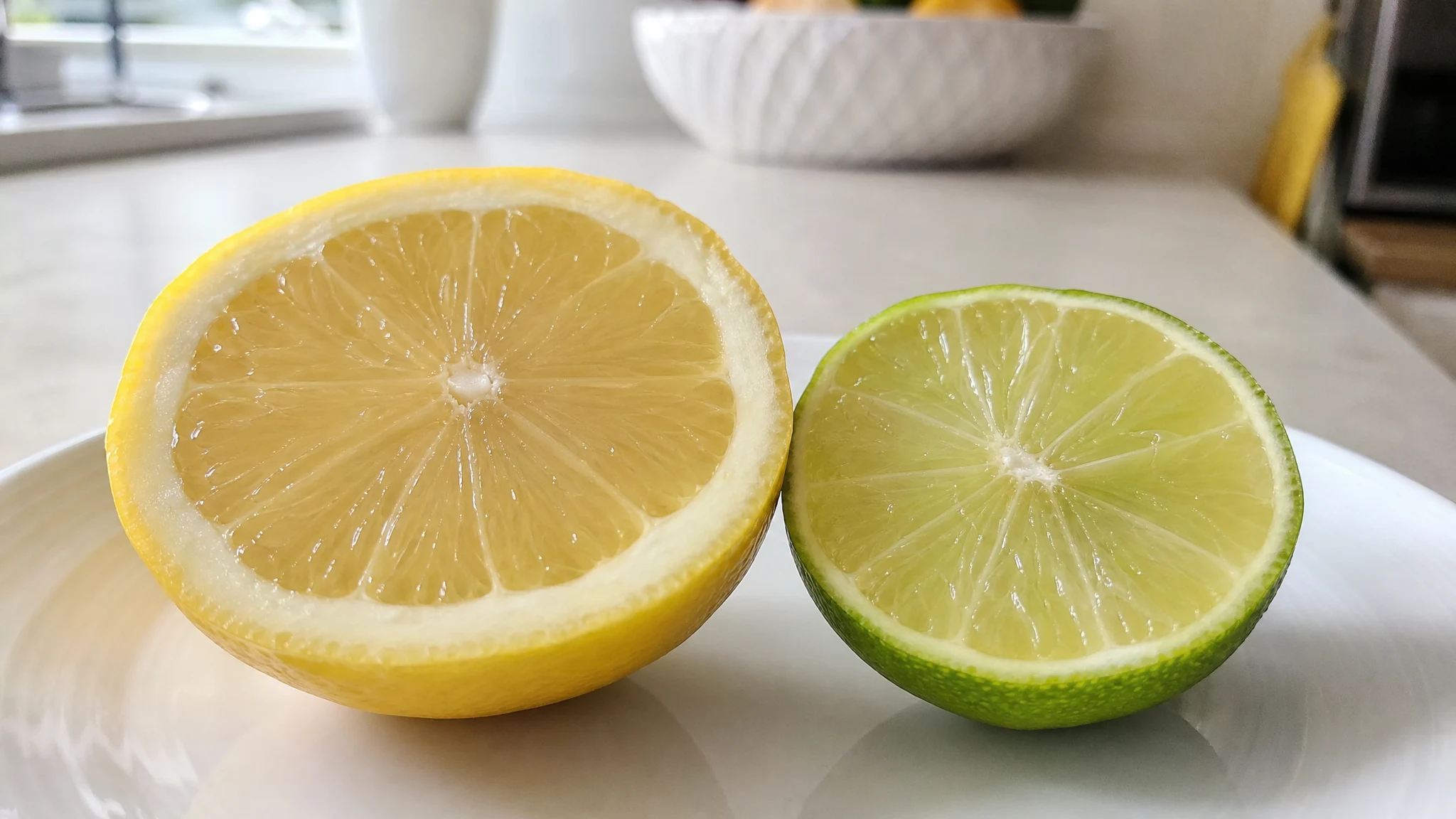
Lemon vs Lime Essential Oil: Process, Limits and Labels
The difference that matters between lemon and lime essential oil is not the fruit, it is the process word on the label. Lime oil is usually steam-distilled, lemon oil is usually cold-pressed, and the two processes carry the phototoxic furocoumarins into the bottle in very different amounts. We sell one oil, cold-pressed lemon, and no lime, so this comparison is built from standards and published analyses, with no scent verdicts.
Organic Lemon Essential Oil
Our own Organic Lemon Essential Oil, in sizes from 0.5 oz to bulk.
From $15.99
Shop Now →Start with how the oil was made
ISO 855:2003 is titled "Oil of lemon [Citrus limon (L.) Burm. f.], obtained by expression," and the ISO catalogue page says it specifies characteristics of that oil to help assess quality (ISO, 2003). The lime standard on the same catalogue is a different process entirely: ISO 3519:2005 is "Oil of lime distilled, Mexican type (Citrus aurantifolia (Christm.) Swingle)" (ISO, 2005). The European Food Safety Authority's feed-additive opinion describes lime oil as obtained by steam distillation, not cold expression (EFSA FEEDAP Panel, 2021). So a bottle labelled "lime" can be the distilled oil, which is the oil EFSA describes, or an expressed (cold-pressed) oil, and the two are regulated differently.
Two sources that look like they disagree
EFSA, quoting an earlier review, states "Lime oil is not phototoxic." The International Fragrance Association (IFRA) lists "Lime oil expressed" among its phototoxic restricted oils, with a limit of 0.70% in the finished product for leave-on categories (IFRA Standards, 51st Amendment, 2024). They are describing different materials. IFRA's title says expressed, and it has no phototoxicity standard for distilled lime, while EFSA's opinion concerns the distilled oil. The measured numbers keep the line from being clean, though. EFSA found bergapten (5-methoxypsoralen) at 4.12 to 8.32 mg/kg in five distilled lime batches, and the Tisserand Institute reports 0.0003% bergapten in distilled lime, which is 3 mg/kg (Tisserand, undated). Distilled lime is low in bergapten, not zero, and two analyses of it differ by a factor of about 1.4 to 2.8.
The side-by-side
| Cold-pressed lemon | Distilled lime | Expressed lime | |
|---|---|---|---|
| Plant | Citrus limon | Citrus aurantiifolia (ISO 3519 type) | Key lime (C. aurantiifolia) or Persian lime (C. latifolia) |
| IFRA limit, leave-on finished product | 2.0% | no standard | 0.70% |
| Bergapten, mg/kg of oil (EFSA) | 23.6 (10-batch average) | 4.12 to 8.32 (5 batches) | not found in the sources fetched |
| Limonene, % of GC area | 64.8 mean (61.2 to 66.7) | 35.7 to 38.1 by GC-MS; 46.8 to 47.4 by GC-FID | higher in Persian than Key (qualitative) |
| Other leading compounds | beta-pinene 13.3, gamma-terpinene 9.04 | gamma-terpinene 14.5, terpinolene 9.89, alpha-terpineol 9.49 | Persian: more gamma-terpinene and esters, less beta-pinene than Key |
Read the limonene row with the EFSA caveat: its Panel noted that GC-MS underestimated d-limonene in the lime oil, which is why the GC-FID figure is given beside it. Lime's profile is not lemon's profile with the volume turned down. Distilled lime is built on gamma-terpinene, terpinolene and alpha-terpineol; cold-pressed lemon is built on limonene and beta-pinene. For how to read such a table, see how to read a GC-MS report for lemon oil.
Lime is not one plant either
A 2016 genetic study of 133 accessions concluded that citron was the male parent of the main lime and lemon groups; Key lime (C. aurantiifolia) belongs to the group that combined citron with C. micrantha or close papeda species, while Persian lime (C. latifolia) is triploid and arose from a lemon ovule fertilized by a diploid gamete of C. aurantiifolia (Curk et al., Annals of Botany, 2016). In plain terms, the Persian lime has lemon in its ancestry. The oils differ too: an analysis of cold-pressed Key lime types A and B and Persian lime found the Persian oil higher in limonene, gamma-terpinene and esters and lower in beta-pinene, and found oxypeucedanin, a furocoumarin, almost absent in cold-pressed Key lime type A but present in type B and in Persian lime oil (Bonaccorsi et al., 2011). So "lime oil" on a label should be followed by a species and a process, and a supplier who gives only one of them has not said enough.
What swapping lime into a lemon recipe does to the limit
Our own safety copy gives 0.5% to 2% in a carrier for the cold-pressed lemon oil, roughly 3 to 12 drops per ounce, and says to avoid sun on freshly applied areas. The IFRA ceiling for cold-pressed lemon is 2.0%, the same as the top of that range, and the Tisserand Institute states the same 2% figure for lemon (Tisserand, undated). Expressed lime is capped at 0.70%. At about 591 drops to the ounce, 0.70% is about 4 drops per ounce, against about 12 for lemon at its ceiling. A reader who copies our lemon dilution and substitutes expressed lime would exceed IFRA's figure at anything above roughly 4 drops. These are ceilings for the oil in a finished leave-on product, set for fragrance formulation, not targets and not a statement that any amount is free of risk.
IFRA also adds the furocoumarin oils together: each oil's percentage is expressed as a share of its own limit and the shares must total no more than 100. Say a product holds lemon at 1.0% (50% of 2.0) and expressed lime at 0.35% (50% of 0.70): that is already at 100. IFRA applies the oil's limit where the furocoumarin level of the oil is unknown. Our oil is sold with a COA that carries no furocoumarin figure, so the per-oil limit is the working number, and for the face our recommendation is to stay at or below 1.2%: the Tisserand Institute's generic range for facial cosmetics and deodorants is 0.5 to 1.2%, and its range for sensitive or impaired skin is 0.2 to 1%, both lower than the top of our copy.
Label checks before buying any lime oil
- Process: distilled or expressed. If the label says only "lime," ask.
- Species: aurantiifolia or latifolia, because composition and furocoumarin content differ.
- Furocoumarin data: ask for a bergapten figure and the method, in writing. Neither IFRA's limit for expressed lime nor EFSA's distilled figures substitute for a figure on your lot.
- Lot and date: limonene-rich oils oxidize, and IFRA's specification for limonene-containing materials sets a peroxide value under 20 millimoles per litre because the hydroperoxides are "potent sensitizers."
Lime oil, solubilizers and carrier oils are not ours: buy them from an aromatherapy or soap-making supply shop, and for a skin product beyond a personal patch-tested blend, a cosmetic safety assessor or product-safety attorney is the right professional, not a seller. We make no claim for lemon oil beyond its listing: a bright, zesty citrus oil for diffusers, soap and candle work, home fragrance and diluted skin use, not to be taken internally, and kept from eyes, children and pets. Details on what blends with it are in the pairing guide, the full citrus table is in citrus oils compared, the safety basics are in lemon oil safety basics, and the lemony look-alikes are sorted in lemon oil versus lemongrass and lemon balm.
If you are choosing between the two for a leave-on product, the choice is mostly arithmetic: lemon allows about three times the lime figure, and neither number is a recommendation to use that much.
Organic Lemon Essential Oil
Organic Lemon Essential Oil from our own shop, in sizes from 0.5 oz to bulk.
From $15.99
Shop Now →Sources & Further Reading
- ISO, 2003. ISO 855:2003 Oil of lemon (Citrus limon) obtained by expression, catalogue page. committee.iso.org/standard/32042.html
- ISO, 2005. ISO 3519:2005 Oil of lime distilled, Mexican type, catalogue page. committee.iso.org/standard/37623.html
- EFSA FEEDAP Panel, 2021. Safety and efficacy of feed additives consisting of expressed lemon oil and of lime oil from Citrus aurantiifolia. EFSA Journal 19(4):e06548. pmc.ncbi.nlm.nih.gov/articles/PMC8085978
- IFRA, 2024. IFRA Standards, 51st Amendment (Lemon oil cold pressed; Lime oil expressed; Citrus oils and other furocoumarins; Limonene). ifrafragrance.org 51st Amendment
- Tisserand R. Phototoxicity: essential oils, sun and safety. Tisserand Institute, undated. tisserandinstitute.org/phototoxicity
- Tisserand R. Dilution for essential oils. Tisserand Institute, undated. tisserandinstitute.org/dilution-essential-oils
- Curk F, Ollitrault F, Garcia-Lor A, Luro F, Navarro L, Ollitrault P, 2016. Phylogenetic origin of limes and lemons revealed by cytoplasmic and nuclear markers. Annals of Botany 117(4):565-583. doi 10.1093/aob/mcw005
- Bonaccorsi IL, Dugo P, Mondello L, Sciarrone D, Dugo G, Haro Guzman L, 2011. Analytical characterization of industrial essential oils from fruits and leaves of C. aurantifolia and C. latifolia. iris.unime.it/handle/11570/1980821