How to Read a GC-MS Report for Lemon Oil
A GC-MS report lists the volatile compounds in an oil and gives each one a percentage, and for lemon oil the table is easy to read wrongly in three ways: the percentages are shares of peak area, not weight; the table leaves out the heavy waxes and furocoumarins that make cold-pressed lemon phototoxic; and a clean-looking table does not by itself show that nothing was added. This post walks through a lemon report line by line using the ranges one European Food Safety Authority opinion published, so a table that lands in your inbox can be checked against something. The COA we publish for our oil contains no GC-MS, and the last section says what to ask for.
Organic Lemon Essential Oil
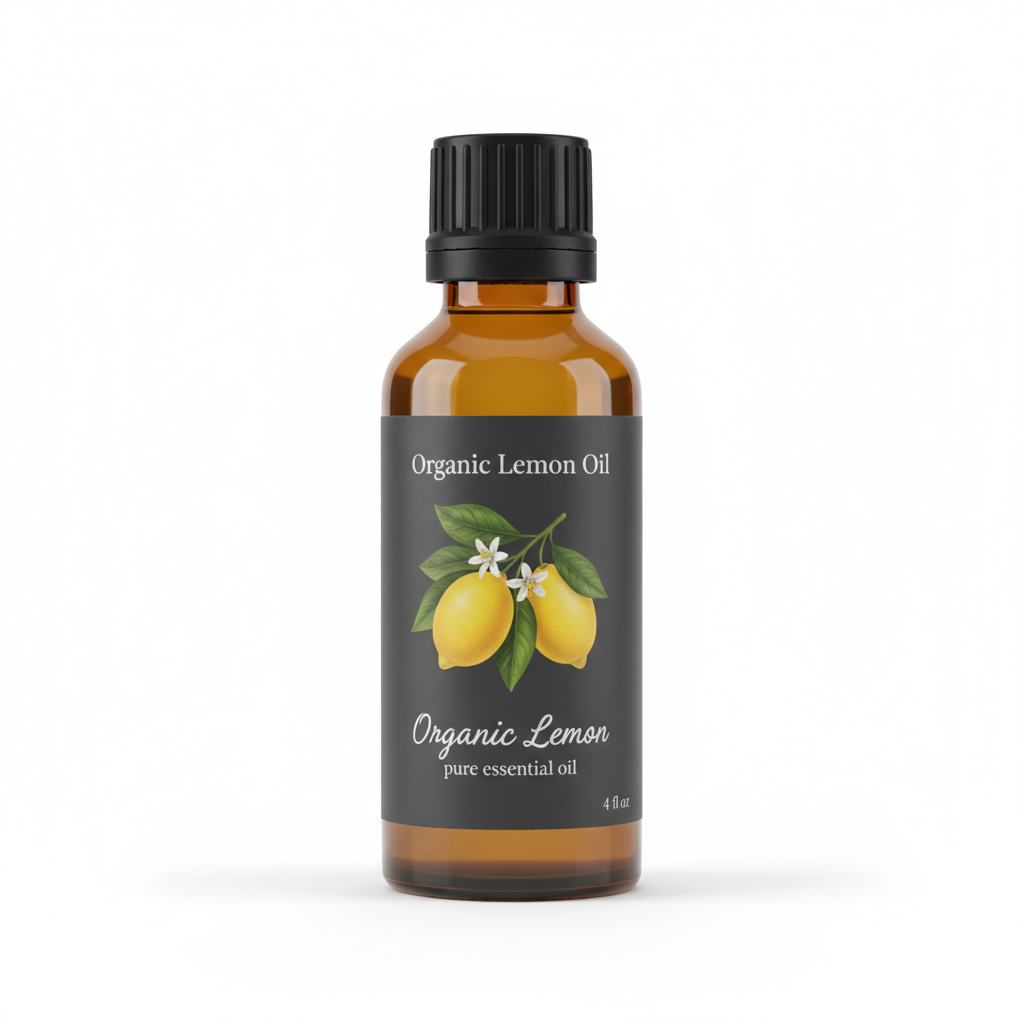
Our own Organic Lemon Essential Oil, in sizes from 0.5 oz to bulk.
From $15.99
Shop Now →Three documents that get mixed up
A certificate of analysis (COA) is a supplier's statement of what was measured on a batch, and it can be as short as three physical readings or as long as a chromatogram. A GC-MS report is a single analytical result: the oil is vaporized, its components are separated in a column, and a mass spectrometer identifies each as it exits. A safety data sheet (SDS) is a third document with sixteen fixed sections, from identification and hazards (sections 1 and 2) to composition (section 3), physical properties (section 9) and toxicology (section 11) (29 CFR 1910.1200(g)(2)). Ingredient disclosure in section 3 is not a composition test of your lot. If you want a lemon oil's terpene profile, ask for the GC-MS by name.
The batch on our published COA (LEMFBACLARO001A) lists the botanical name Citrus limon, peel as the part used, cold pressed, and three measured values against stated standards: relative density at 20 C of 0.849 (standard 0.840 to 0.855), refractive index of 1.474 (1.473 to 1.477) and optical rotation of +67.80 degrees (+57.0 to +78.0). Those three numbers sit inside their windows, but the optical rotation window is 21 degrees wide and the refractive index window is 0.004 wide, so they cannot tell you how much limonene, citral or anything else is in the bottle. The COA has no GC-MS, no constituent percentage, no bergapten figure and no residue panel.
Read the header before the peaks
Before any percentage, find the lot number (it has to match the bottle you hold), the date, the laboratory, the column and temperature program, and the detector. A retention time means nothing without the column and program, and a table without a lot number describes some oil, not yours. A report missing these is a claim, not a measurement.
A lemon table, line by line
Retention data back up the mass spectrum because isomers fragment alike. A National Institute of Standards and Technology evaluation of 505 essential-oil components says retention data combined with mass spectrometry give "a nearly unambiguous identification of isomers, which is difficult using mass spectra alone" (Babushok, Linstrom and Zenkevich, 2011). Beta-pinene and sabinene are the lemon example: both are C10H16, and NIST's average retention indices on a slightly polar 5%-phenyl column are 977.7 and 973.0, a gap of 4.7 index units. If a report's index for a peak named sabinene reads 978, the name deserves a question.
For what the percentages should look like, the best public yardstick found is the European Food Safety Authority's feed-additive opinion on expressed lemon oil, which analysed 10 batches (five Mediterranean, five from outside the EU) by GC-MS and reported shares of GC peak area, against a specification "based on ISO 855:2003, adapted to % GC area" (EFSA FEEDAP Panel, 2021). The ISO catalogue page for that standard states only that it "specifies certain characteristics of the oil of lemon" to help assess quality and that it was last reviewed and confirmed in 2025 (ISO 855:2003); the limits themselves sit behind the paywall, so the EFSA table is what can be quoted.
| Compound | Average retention index (5%-phenyl) | EFSA specification (% area) | Mean of 10 batches | Range across batches |
|---|---|---|---|---|
| alpha-Pinene | 936.1 | 1.3 to 3.0 | 2.74 | 2.23 to 3.63 |
| Sabinene | 973.0 | 0.3 to 3.0 | 2.21 | 1.41 to 2.65 |
| beta-Pinene | 977.7 | 9 to 18 | 13.3 | 11.0 to 16.8 |
| Myrcene | 989.2 | none | 1.53 | 1.25 to 2.14 |
| d-Limonene | 1029.5 | 60 to 73 | 64.8 | 61.2 to 66.7 |
| gamma-Terpinene | 1059.7 | 6 to 12 | 9.04 | 7.66 to 11.5 |
| Neral | 1242.1 | 0.1 to 1.8 | 0.87 | 0.39 to 1.43 |
| Geranial | 1270.3 | 0.1 to 2.0 | 1.30 | 0.65 to 2.08 |
The seven specified compounds together averaged 94.2% of area (92.4 to 95.5), and up to 88 constituents were detected, 71 of them identified. Three things to take from the table. First, limonene is the headline but it moves: 61.2 to 66.7% across ten batches is a 5.5-point spread, which on one ounce of oil (about 25.1 g at the 0.849 density on our COA) is 15.4 to 16.7 g, a difference of about 1.4 g between batches that all met the specification. A 3-point gap in limonene between two reports is therefore within the spread of one specification. Second, citral (neral plus geranial) averaged 2.17% of area, so it is a minor line. Third, a lemon table is judged by the whole pattern, not by one number: an oil with limonene at 66% and beta-pinene at 3% fits the specification in one line and fails it in another.
Area percent is not weight percent
The table is a share of detector response. In a study comparing common reporting practices, Cicchetti, Merle and Chaintreau found that MS results without response factors "exhibited a lack of accuracy and reproducibility" and that flame-ionization results were better but "still unsatisfactory" (Flavour and Fragrance Journal, 2008). The EFSA dossier shows the same problem in a different oil: for distilled lime, GC-MS gave limonene at 35.7 to 38.1% of area while GC-FID gave 46.8 to 47.4%, and the Panel noted that GC-MS underestimated d-limonene. For lemon, there is also material the table never sees: the non-volatile residue was 1.8 to 3.6% of the oil by weight. Reasoning from that, and assuming equal response for every volatile, a limonene line of 64.8% of volatiles would be about 62.5 to 63.6% of the whole oil, and the rest of the table scales the same way. Read a limonene figure to the nearest point, not the nearest tenth.
Can the table show an added fraction?
Partly, and only with the right markers. One instrument vendor's white paper states that a delta-3-carene to camphene ratio above 0.13 "typically" points to possible addition of cheaper orange oil, and four of the seven lemon oils it examined exceeded that threshold; the same paper cautions that there are "other methods of adulteration" (SepSolve Analytical, White Paper 037, 2020). That is a vendor's demonstration on seven oils of unknown origin, not a validated pass mark. Chiral analysis goes further: the Messina group notes that citrus oils have characteristic enantiomer ratios (more than 95% of limonene is the (+) form) and that "significant deviations" reveal fraudulent additions, but also that components with a strong enantiomeric excess "may be selected by other sources", which is why isotope-ratio methods were added (Cucinotta et al., 2023). A routine GC-MS table has neither a chiral nor an isotope dimension. If authenticity is the question, ask whether either was run.
What a GC-MS table does not cover
Furocoumarins are the phototoxic fraction, and EFSA measured them separately by HPLC with UV detection. Its ten-batch averages were 497.3 mg/kg bergamottin, 214.7 oxypeucedanin, 187.3 8-methoxypsoralen and 23.6 bergapten, so bergapten is one of the smaller furocoumarins in lemon oil, and a bergapten line alone does not describe the group. None of this appears in a terpene table. The International Fragrance Association (IFRA) caps cold-pressed lemon oil at 2.0% of a leave-on finished product and says that where the furocoumarin level is unknown, that oil-level cap applies (IFRA Standards, 51st Amendment, 2024). The same compilation sets a specification for limonene-rich materials: oxidation products, especially hydroperoxides, are "potent sensitizers," and the peroxide value should be under 20 millimoles per litre. That is its own titration, so a GC-MS report will not give it. A pesticide panel is likewise a separate analysis. Our own copy says cold-pressed citrus oils can raise skin's sensitivity to sunlight, and it also says "do not take internally."
What to ask for, in writing
If your use needs more than density, refractive index and rotation, ask before ordering and get the answer in writing: a GC-MS or GC-FID report that carries the lot number printed on your bottle, the column and program, whether chiral or isotope analysis was done, a furocoumarin or bergapten figure and the method, a peroxide value, and a residue panel. We do not promise a particular document, and the lot on your bottle governs, not the batch on our COA. For the chemistry itself, inside lemon oil covers limonene, quality checks before you pay covers what a buyer can check without a lab, and how to buy organic lemon oil covers certification questions. If a certificate matters to you, ask in writing for its number. Because limits differ by oil, citrus oils compared sets lemon beside lime, bergamot, grapefruit and orange.
A GC-MS table is worth asking for, and it is worth reading with its limits in mind: a ranged, lot-matched, dated report that says what was run beats a tidy table that says nothing about how.
Organic Lemon Essential Oil
Organic Lemon Essential Oil from our own shop, in sizes from 0.5 oz to bulk.
From $15.99
Shop Now →Sources & Further Reading
- Cornell Law School LII, 29 CFR 1910.1200(g)(2). Safety data sheet sections. law.cornell.edu/cfr/text/29/1910.1200
- Babushok VI, Linstrom PJ, Zenkevich IG, 2011. Retention indices for frequently reported compounds of plant essential oils. J Phys Chem Ref Data 40. nist.gov/document/jpcrd402011retpdf
- EFSA FEEDAP Panel, 2021. Safety and efficacy of feed additives consisting of expressed lemon oil and its fractions from Citrus limon and of lime oil from Citrus aurantiifolia. EFSA Journal 19(4):e06548. pmc.ncbi.nlm.nih.gov/articles/PMC8085978
- ISO, 2003 (confirmed 2025). ISO 855:2003 Oil of lemon obtained by expression, catalogue page. committee.iso.org/standard/32042.html
- Cicchetti E, Merle P, Chaintreau A, 2008. Quantitation in gas chromatography: usual practices and performances of a response factor database. Flavour Fragr J 23:450-459. hero.epa.gov/reference/8259781
- SepSolve Analytical, 2020. White Paper 037: Easy-to-learn workflows for quality control of essential oils. theanalyticalscientist.com/sepsolve_white_paper_037
- Cucinotta L, De Grazia G, Donato P, Mondello M, Sciarrone D, Mondello L, 2023. Chiral isotopic fractionation in lemon essential oil. J Chromatogr A 1710:464409. iris.unime.it/handle/11570/3292431
- IFRA, 2024. IFRA Standards, 51st Amendment (Lemon oil cold pressed; Citrus oils and other furocoumarins; Limonene). ifrafragrance.org 51st Amendment