
Inside Lemon Oil: Limonene and the Chemistry of a Sunny Scent
Crack open a fresh lemon and that bright, almost electric scent reaches you before the juice does. The molecule doing most of that work is limonene, a compound so closely tied to citrus that its name is basically synonymous with the fruit. But limonene in lemon oil is not the whole story. Cold-pressed lemon peel releases a cocktail of organic compounds, each contributing something to the aroma, the color, and the way the oil behaves in a cosmetic formula or a diffuser blend. This deep dive unpacks lemon oil chemistry one layer at a time: what the key compounds are, what research has observed about them, how to read a quality indicator, and what safety considerations every user should know before reaching for the bottle.
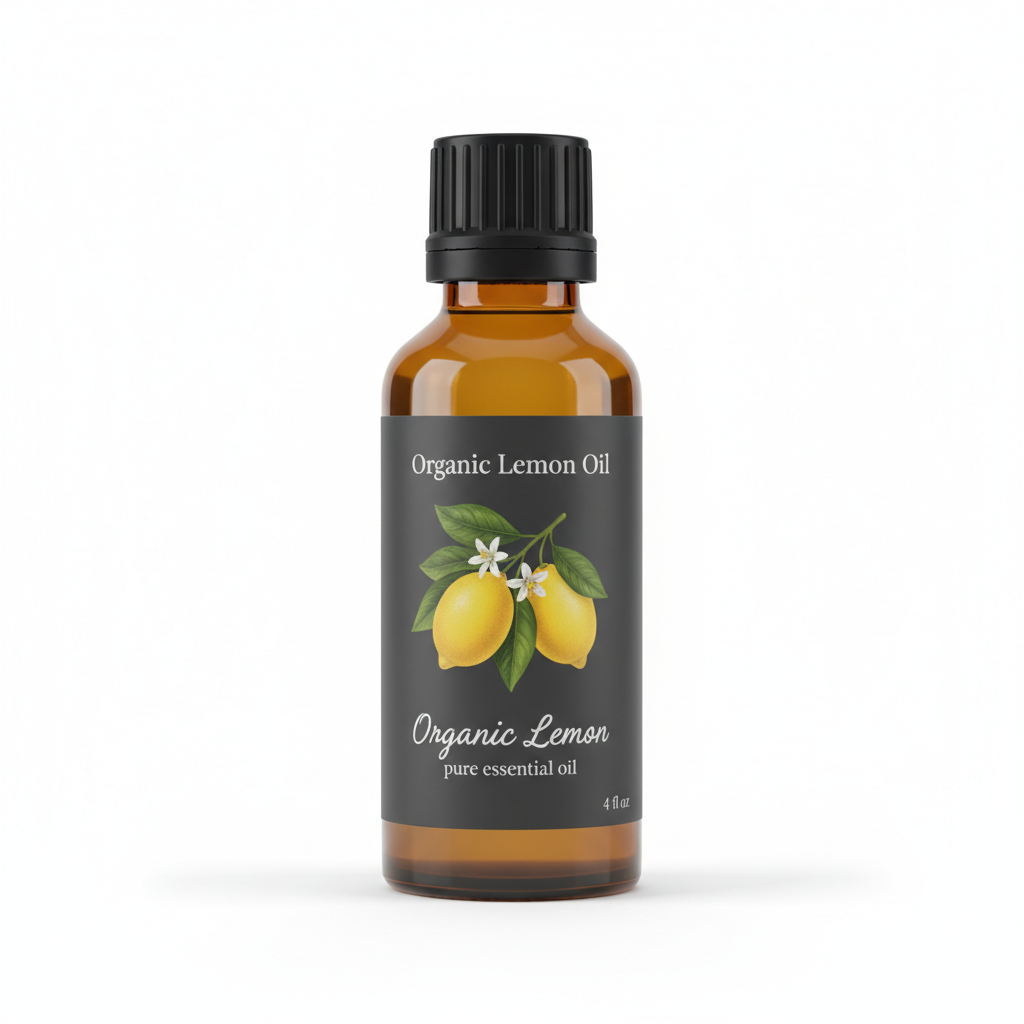
Organic Lemon Essential Oil
Our own Organic Lemon Essential Oil, in sizes from 0.5 oz to bulk.
From $15.99
Shop Now →How Lemon Oil Gets Its Chemistry
Organic cold-pressed lemon oil (sometimes labeled "expressed" or "sunshine pressed") comes from the flavedo, the outermost colored layer of the peel. Tiny oil sacs called schizogenous glands sit just beneath the surface. Cold pressing ruptures those glands mechanically, without heat, which matters enormously for chemical integrity. Heat-extracted or steam-distilled versions lose some of the more delicate, volatile top notes and can alter the relative concentrations of key compounds.
The result of a good cold press is a pale yellow to greenish-yellow liquid with a full-spectrum aromatic profile. A complete guide to cold-pressed lemon oil covers the extraction process in more detail, but the short version is this: lower processing temperatures preserve the chemistry that makes the oil genuinely smell like a lemon rather than a lemon-scented cleaning product.
The Main Cast: Lemon Oil Compounds
Limonene (55 to 75 percent)
Limonene is a cyclic monoterpene, meaning its carbon skeleton forms a single six-membered ring with a side chain. It exists in two mirror-image forms (enantiomers): d-limonene and l-limonene. Lemon peel is overwhelmingly d-limonene, which carries the bright, sweet-citrus character most people associate with the fruit. l-Limonene, found in pine and some other botanicals, smells more turpentine-like and is rarely predominant in citrus oils.
In a well-produced organic lemon oil, limonene typically accounts for 55 to 75 percent of the total composition. Gas chromatography-mass spectrometry (GC-MS) analysis published across multiple botanical chemistry studies consistently places it as the dominant compound. Because it is so volatile, limonene is what you smell first when you open the bottle. It is also, unfortunately, what oxidizes fastest when oil is exposed to air, light, or heat, which is why storage conditions matter so much for maintaining authentic lemon oil chemistry.
Beta-Pinene (around 8 to 12 percent)
Beta-pinene is another monoterpene, this one with a bicyclic (two-ring) structure. It contributes a slightly woody, fresh pine undertone that keeps lemon oil from smelling flat or one-dimensional. In perfumery, beta-pinene is valued as a bridge note because it helps citrus top notes transition gracefully to mid and base notes in a blend. Organic lemon oils tend to show beta-pinene concentrations in the 8 to 12 percent range, though this varies by cultivar and growing region.
Gamma-Terpinene (6 to 10 percent)
Gamma-terpinene is a monocyclic monoterpene with a slightly herbal, warm quality. It rounds out the sharper edges of limonene and adds depth. Research published in the journal Molecules has observed that terpinene isomers interact in ways that may influence how an oil smells overall, though the exact mechanisms in complex mixtures are still being studied.
Alpha-Pinene (2 to 4 percent)
The alpha form of pinene shares structural similarities with beta-pinene but contributes a slightly more camphoraceous, forested quality. Together, the two pinenes give lemon oil a subtle backbone that differentiates a whole-peel cold-pressed oil from a synthetic limonene reconstruction.
Sabinene (1 to 3 percent)
Sabinene is a bicyclic monoterpene with a warm, spicy nuance. It appears in smaller quantities but shows up reliably in authentic lemon oil GC-MS profiles. Its presence (or absence) is one marker analysts use to distinguish genuine cold-pressed oil from adulterated products.
Citral: Neral and Geranial (0.5 to 2 percent)
Citral is actually two closely related aldehydes: neral (cis-citral) and geranial (trans-citral), collectively called citral. Together they represent a small but disproportionately important fraction of lemon oil chemistry. Even at under 2 percent, citral has a powerful, intensely lemony character that punches well above its weight in aromatic terms. It is also the compound most closely associated with known sensitization potential in citrus oils, which becomes relevant in the safety section below.
Linalool (trace to 1 percent)
Linalool is a floral monoterpenol found in lavender, coriander, and dozens of other botanicals. In lemon oil it appears in trace amounts, but it contributes a soft, slightly floral lift that prevents the oil from smelling purely astringent. Its presence is one reason lemon oil blends so naturally with lavender and other floral oils in cosmetic and diffuser applications.
What Research Has Observed
A fair amount of laboratory and observational research has examined the individual compounds found in lemon oil, particularly limonene. It is worth being precise about what that research actually says, because the findings are often misrepresented online.
Studies on d-limonene have observed that it interacts with biological systems in various ways, particularly in cell-based and animal models. Some research suggests it may play a role in how cells respond to certain stressors, though this work is largely preliminary and has not been replicated consistently in human clinical settings. A 2017 review in the journal BioMed Research International noted that monoterpenes as a class show interesting biological activity in laboratory conditions, while also cautioning that in vitro results do not translate automatically to in vivo outcomes in humans.
Separate research on citral has observed that this aldehyde fraction influences sensory perception significantly. Studies in olfactory science suggest that even fractional changes in citral concentration shift how humans perceive the overall citrus character of a blend, which has practical implications for perfumers and formulators working with lemon oil compounds.
Research on lemon oil's aromatic properties in environmental psychology contexts has observed that participants in rooms diffused with citrus scents sometimes report feeling more alert or focused. These are self-reported, subjective outcomes. They suggest a possible relationship between scent environment and perceived mood, but they do not establish a medical or pharmacological mechanism. Framing matters: scent can shape atmosphere; that is meaningfully different from a clinical claim.
For a more experiential take on how the scent profile translates in practice, the article exploring what lemon essential oil smells like covers the aromatic layers in detail.
Safety Profile and Contraindications
Lemon oil is widely used and generally considered safe within established cosmetic and aromatic guidelines. That said, several specific considerations are important, and overlooking them creates real risk.
Phototoxicity
Cold-pressed lemon oil contains furanocoumarins, particularly bergapten and other psoralen-type compounds. These molecules react with ultraviolet light in ways that can cause significant skin darkening, irritation, or burns when oil is applied to skin before sun or UV lamp exposure. This is called phototoxicity, and it is the most important safety consideration for topical lemon oil use.
The International Fragrance Association (IFRA) recommends a maximum usage level of 2 percent of cold-pressed lemon oil in leave-on products applied to areas likely to be exposed to UV. For rinse-off products (shampoos, cleansers), the threshold is higher because contact time is short. Steam-distilled or furanocoumarin-free (FCF) versions of lemon oil are available for formulators who need to avoid phototoxicity risk entirely. If you are formulating a leave-on serum, lotion, or body oil that clients will wear outdoors, this distinction is not optional.
Skin Sensitization and Patch Testing
Citral, mentioned above as a key aromatic aldehyde, is a recognized sensitizer in some individuals. The European Union's Scientific Committee on Consumer Safety (SCCS) has flagged citral as requiring labeling in cosmetic products above certain thresholds. People with known citrus sensitivities should patch test before using any lemon oil product on a larger skin area. Apply a small diluted amount (1 percent in a carrier oil) to the inner forearm, leave for 24 hours, and watch for redness, itching, or swelling before proceeding.
Oxidized limonene is also worth noting. As lemon oil ages and limonene oxidizes (a process accelerated by air, heat, and light), the oxidation byproducts have a higher sensitization potential than fresh limonene. This is a practical reason to store lemon oil in dark glass, tightly capped, away from heat, and to replace bottles within 12 months of opening.
Dilution Guidelines
The National Association for Holistic Aromatherapy (NAHA) and similar professional bodies generally recommend essential oils be diluted in a carrier oil before skin contact. For most adults, a dilution of 1 to 2 percent in a skin-safe carrier is a reasonable starting point for body application. For facial use, 0.5 to 1 percent is a more cautious range given facial skin's relative sensitivity.
- 1 percent dilution: approximately 6 drops of essential oil per 30 ml (1 oz) of carrier oil
- 2 percent dilution: approximately 12 drops of essential oil per 30 ml (1 oz) of carrier oil
Do not apply undiluted (neat) lemon oil directly to skin. Do not use near eyes or mucous membranes. Keep away from children and pets unless formulated specifically for those populations under professional guidance. Consult a qualified healthcare provider before using lemon oil if you are pregnant, nursing, or managing any ongoing health concern.
Sourcing and Quality Indicators
Understanding lemon oil chemistry makes it much easier to evaluate quality because you know what you are looking for. Here is what separates a genuinely good organic lemon oil from a mediocre or adulterated one.
Certification and Traceability
Look for USDA Organic or equivalent certification (EU Organic, JAS in Japan). Certification is not just a marketing badge; it means the growing and processing chain has been audited. Pesticide residues are a real concern with conventional lemon oil because the peel is where many agricultural chemicals concentrate. Certified organic sourcing reduces that exposure meaningfully. The best suppliers can tell you the cultivar (usually Citrus limon), the country of origin (Italy's Calabria and Sicily regions are historically prestigious for lemon oil), and the harvest season.
GC-MS Testing
A reputable supplier will provide third-party GC-MS (gas chromatography-mass spectrometry) data for each batch. This is the analytical standard for confirming that lemon oil compounds are present in expected ratios. A genuine cold-pressed lemon oil should show limonene in the 55 to 75 percent range with the supporting compounds (beta-pinene, gamma-terpinene, citral) at expected levels. If limonene is suspiciously high (above 80 percent), the oil may have been blended with synthetic d-limonene to bulk it out.
Color and Aroma
Fresh organic cold-pressed lemon oil should be pale yellow to greenish-yellow, never water-white. Water-white may indicate heavy filtration or dilution. The aroma should be complex: bright and citrusy upfront, with a slightly waxy, floral, and faintly woody dry-down. If it smells flat, one-dimensional, or aggressively sharp without any depth, those are signs the chemistry has been simplified, intentionally or through oxidation.
Packaging
UV-resistant dark glass (amber or cobalt) is the standard for a reason. Light degrades limonene. Any quality supplier ships in dark glass or recommends immediate transfer into dark glass after receipt. Plastic containers are not appropriate for essential oils; many terpenes interact with plastics over time, both degrading the oil and potentially picking up compounds from the container.
For practical applications once you have a quality bottle in hand, explore ideas in this roundup of 25 bright ideas for using lemon oil around the home.
Putting the Chemistry to Work
Limonene in lemon oil is not a single compound floating in isolation. It sits within a carefully balanced aromatic matrix where beta-pinene adds depth, gamma-terpinene adds warmth, citral sharpens the authentically lemony character, and trace compounds like linalool and sabinene keep the whole profile grounded and natural. That matrix is what cold pressing preserves and what adulteration or poor storage destroys.
Reading a GC-MS report is the closest thing to reading a fingerprint. Once you know what a genuine organic lemon oil looks like on paper, sourcing becomes less of a guessing game. Pair that knowledge with proper storage, appropriate dilution, and respect for the phototoxicity window, and lemon oil is one of the most rewarding botanicals in any aromatic or cosmetic practice.
The chemistry is the foundation. Everything useful you do with the oil flows from understanding what is actually inside the bottle.