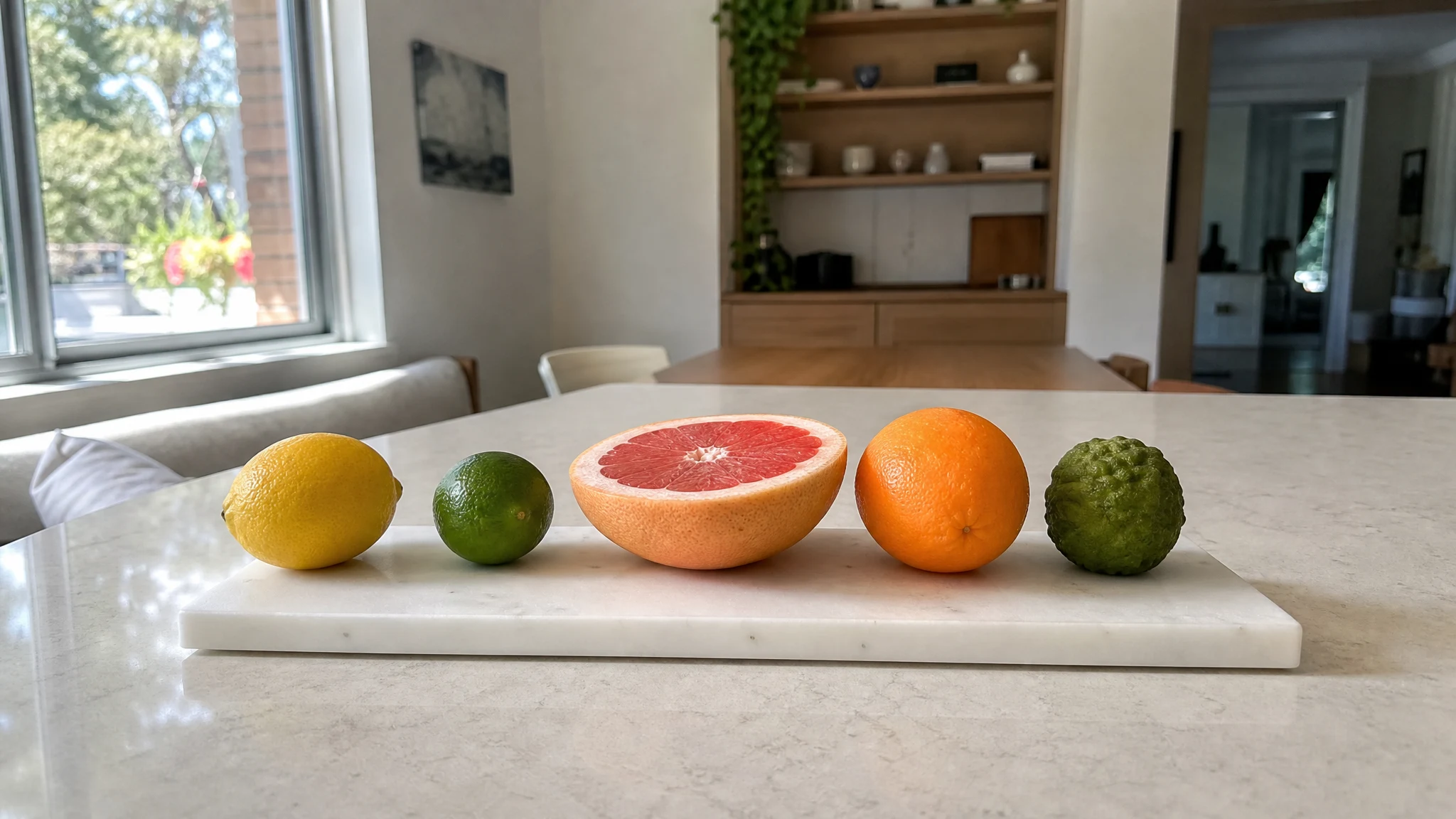
Citrus Essential Oils Compared: Limits, Process and Labels
Five of the six citrus oils in this comparison carry a published ceiling for leave-on skin products because of phototoxic furocoumarins, and the ceilings span a factor of ten, from 0.40% for expressed bergamot to 4.0% for expressed grapefruit. The sixth, sweet orange, has no such standard. We sell one of these oils, cold-pressed lemon, and none of the others, so the table below is built from the International Fragrance Association (IFRA) standards and published analyses, not from our own testing, and it ranks nothing by scent.
Organic Lemon Essential Oil
Our own Organic Lemon Essential Oil, in sizes from 0.5 oz to bulk.
From $15.99
Shop Now →The table
| Oil (plant) | IFRA ceiling, leave-on finished product | Drops per ounce of carrier at the ceiling | What a published analysis reports |
|---|---|---|---|
| Bergamot, expressed (Citrus bergamia) | 0.40% | about 2.4 | limonene 25 to 53%, linalyl acetate 15 to 40%, linalool 2 to 20% |
| Lime, expressed (C. aurantiifolia or C. latifolia) | 0.70% | about 4.1 | see the lime article; Persian vs Key lime differ |
| Bitter orange peel, expressed (C. aurantium) | 1.25% | about 7.4 | no composition figure found in the sources fetched |
| Lemon, cold pressed (C. limon) | 2.0% | about 11.8 | limonene 64.8% (61.2 to 66.7), beta-pinene 13.3%, gamma-terpinene 9.04% |
| Grapefruit, expressed (C. paradisi) | 4.0% | about 23.6 | limonene 93.47% as cited, 85.60% when non-volatiles are excluded |
| Sweet orange, expressed (C. sinensis) | no phototoxicity standard in the compilation | not applicable | limonene 92.4% (91.6 to 93.4); furocoumarins below detection in 5 batches |
The ceilings are from the IFRA Standards 51st Amendment compilation (Amendment 49, 2020 pages): each oil has its own standard, the limit is the same in leave-on categories from lips and face to body lotion and baby oil, and there is no restriction for rinse-off hair and body products, household care with mostly hand contact, or products with no skin contact (IFRA, 2024). A search of the compilation's standard titles found none for sweet orange, mandarin or distilled lime. The drops column is rough arithmetic at about 591 drops to an ounce, and droppers vary, so weigh if the number matters. Composition figures come from: EFSA FEEDAP Panel, 2021 for lemon (10 batches, GC-MS, percent of peak area); EFSA FEEDAP Panel, 2021 (sweet orange), five batches; Navarra et al., 2015 for bergamot, a review citing 1998 data; and Deng et al., 2020 for grapefruit, which quotes a 1978 study rather than reporting its own cold-pressed analysis. Different methods, years and batch counts mean the columns should be compared by order of magnitude, not by decimals.
Why the ceilings differ by tenfold
IFRA's furocoumarin standard explains the logic: the restrictions rest on the published phototoxic effects of bergapten (5-methoxypsoralen) and its dose-effect relationships, and where bergapten has been determined the total in a leave-on product on UV-exposed skin should not exceed 0.0015%, 15 ppm. Where it has not been determined, "the limits specified in the guidelines on individual oils should apply." That is why the per-oil figures exist: they are a default for an oil whose furocoumarin content is unknown. Reasoning from that, the gap between oils reflects typical furocoumarin load, so bergamot at 0.40% against grapefruit at 4.0% means the grapefruit oil is allowed ten times as much. The Tisserand Institute adds a practical window: after a phototoxic amount, keep the skin out of UV for at least 12 hours (Tisserand, undated). Our own copy for lemon is the same instruction in plainer words: avoid sun exposure on freshly applied areas.
Two materials called bergamot
Bergamot oil is made by cold-pressing the peel, and the Navarra review notes that a furocoumarin-free oil is prepared for perfumery and cosmetics by vacuum distillation of the peels. The Tisserand Institute likewise describes bergapten-free (FCF) bergamot as produced by fractional distillation and considered non-phototoxic. The consequence is plain: "bergamot" can mean two materials with different limits, and a bottle that does not say FCF or expressed has not told you which. The same logic applies to lemon. Our oil is cold-pressed, which our own page says is phototoxic, and we do not offer a furocoumarin-free lemon; that material is a separate product with a different smell, not a safer version of ours. If a recipe or a supplier mixes up the two, the limit that applies changes by a large factor. Genealogy complicates the label too: the Navarra review calls bergamot a hybrid of sour orange and lemon, and a 2016 genetic study found lemon itself came from citron combined with sour orange (Curk et al., 2016), which is why botanical names on labels matter more than common ones.
Sweet orange: the exception and what it rests on
Three separate things support treating sweet orange differently, and none is a guarantee. IFRA has no phototoxicity standard for it in the compilation. EFSA's analysis of five batches of expressed sweet orange peel oil found furocoumarins below the HPLC detection limit in all of them, with limonene at 92.4% of GC area. And the Tisserand Institute's reply on its comparison page says sweet orange is "generally thought to not be phototoxic even if expressed" (Hana Tisserand, 2022 comment). The wording is hedged, and it is an answer to a reader comment, so treat it as an informed position rather than a measurement. Absence of a phototoxicity standard does not mean absence of other limits: limonene-rich oils of every kind fall under IFRA's limonene specification, which says oxidation products, especially hydroperoxides, are "potent sensitizers" and sets a peroxide value under 20 millimoles per litre. Sweet orange is not exempt from going stale.
Blends: the sum rule, with numbers
IFRA treats the furocoumarin oils as additive: express each oil's concentration as a share of its own ceiling, and the shares must add to no more than 100. The oils named are angelica root, bergamot expressed, bitter orange expressed, cumin, grapefruit expressed, lemon cold pressed, lime expressed and rue. Sweet orange is not on the list. A worked case, arithmetic only and not a recipe we have made: 1 ounce of carrier with lemon at 1.0% (half of 2.0%, about 5.9 drops) leaves room for bergamot at 0.20% (half of 0.40%, about 1.2 drops), and the two together reach 100. Add one more drop of bergamot and the blend is over. Lemon and grapefruit are more forgiving: lemon at 1.0% plus grapefruit at 2.0% also reaches 100, at 5.9 and 11.8 drops. The shop lists bergamot and sweet orange as blend partners for lemon, and we do not sell them; our pairing guide covers the scent side, and the sum rule is the safety side of the same decision.
Where the numbers stop
IFRA's limits are for the oil in a finished consumer product, set for fragrance mixtures supplied to manufacturers, and they do not make any amount free of risk. A ceiling is not a target: the Tisserand Institute calls its lemon figure of 2% "the safe maximum, not a recommended amount, which might be less," and its generic range for facial cosmetics and deodorants is 0.5 to 1.2%, with 0.2 to 1% for sensitive or impaired skin (Tisserand, undated). Our copy gives 0.5% to 2% in a carrier with a patch test first, keeps the oil from eyes, children and pets, and says not to take it internally. Our recommendation: start at the low end, stay at or below 1.2% on the face, and never treat 2% as a starting point. Pregnancy, infants, a skin condition or medication are questions for a physician or pharmacist, not a table. For label reading, see how to buy organic lemon oil; for lemon against one other citrus oil, lemon versus lime; for the chemistry of the limonene that runs through every row, inside lemon oil; and for sunlight and dilution in more depth, lemon oil safety basics.
Before buying any of these oils, ask which process, which species and whether the oil is expressed or furocoumarin-free, and ask the seller to put the answer in writing.
Organic Lemon Essential Oil
Organic Lemon Essential Oil from our own shop, in sizes from 0.5 oz to bulk.
From $15.99
Shop Now →Sources & Further Reading
- IFRA, 2024. IFRA Standards, 51st Amendment (Bergamot oil expressed; Bitter orange peel oil expressed; Citrus oils and other furocoumarins; Grapefruit oil expressed; Lemon oil cold pressed; Lime oil expressed; Limonene). ifrafragrance.org 51st Amendment
- EFSA FEEDAP Panel, 2021. Expressed lemon oil and lime oil. EFSA Journal 19(4):e06548. pmc.ncbi.nlm.nih.gov/articles/PMC8085978
- EFSA FEEDAP Panel, 2021. Expressed sweet orange peel oil and its fractions from Citrus sinensis. EFSA Journal 19(11):e06891. pmc.ncbi.nlm.nih.gov/articles/PMC8603005
- Navarra M, Mannucci C, Delbo M, Calapai G, 2015. Citrus bergamia essential oil: from basic research to clinical application. Front Pharmacol 6:36. frontiersin.org/10.3389/fphar.2015.00036
- Deng W, Liu K, Cao S, Sun J, Zhong B, Chun J, 2020. Grapefruit essential oil prepared by molecular distillation. Molecules 25(1):217. pmc.ncbi.nlm.nih.gov/articles/PMC6982870
- Curk F, et al., 2016. Phylogenetic origin of limes and lemons revealed by cytoplasmic and nuclear markers. Annals of Botany 117(4):565-583. doi 10.1093/aob/mcw005
- Tisserand R. Phototoxicity: essential oils, sun and safety. Tisserand Institute, undated. tisserandinstitute.org/phototoxicity
- Tisserand R. Dilution for essential oils. Tisserand Institute, undated. tisserandinstitute.org/dilution-essential-oils
- Tisserand Institute. Citruses: a comparison of different oils (reader comments answered by Hana Tisserand, 2022). tisserandinstitute.org/learn-more/citruses