Lemon Oil for Hair and Scalp: What Exists and the Limits
No study the search could find has tested lemon essential oil on human hair or scalp, so there is nothing to report on hair growth, dandruff or oiliness. Flaking that persists is a question for a dermatologist, and a phototoxic oil is a poor candidate for the part line of someone who spends time outdoors. What follows is what was searched, what the nearest studies actually were, what the American Academy of Dermatology (AAD) says about dandruff, and the dilution arithmetic if someone still wants lemon scent in a hair product. We sell no hair product and make no hair claim for our oil.
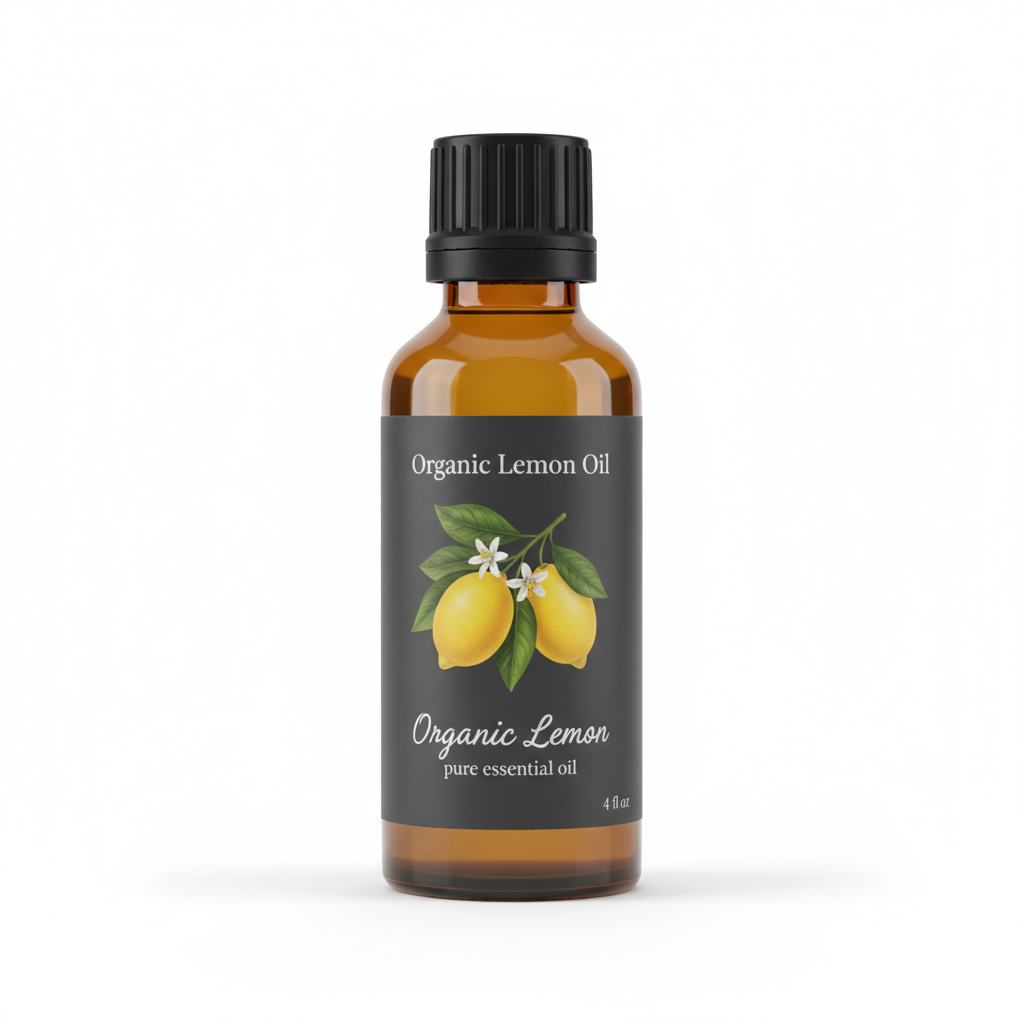
Organic Lemon Essential Oil
Our own Organic Lemon Essential Oil, in sizes from 0.5 oz to bulk.
From $15.99
Shop Now →What the search found
PubMed searches run on 28 October 2026 (title and abstract fields) returned 945 records for "lemon oil", "lemon essential oil" or "Citrus limon". Combining the two oil phrases with scalp, dandruff, alopecia or hair left 2 records. Combining "Citrus limon" with scalp, dandruff, alopecia, "hair growth" or "hair loss" left 2 records, one shared with the first search. Combining "lemon" and "essential oil" with the same scalp and hair terms left 1. None of these is a trial of lemon oil on human scalps.
| Record | Material | Subject | What it does not tell you |
|---|---|---|---|
| Aboelhadid et al., 2016, Parasitology Research | Citrus limon oil diluted in water, 20% used in vivo | Rabbits naturally infected with sarcoptic mange mites (n = 24 in three groups) | The outcome was mites and clinical signs; the abstract notes faster hair growth in treated tissue. Rabbit skin, mites, and 20% is ten times the 2.0% IFRA ceiling used below. |
| Valizadeh et al., 2019, Cells Tissues Organs | Lemon, sesame or olive oil at 33% w/w in an ointment base | Infected full-thickness wounds in rats (n = 12) | A wound-dressing study in rats. Skin appendages were examined as histology; it is not a hair study and not a use level for people. |
| Raoufimanesh et al., 2026, Applied Biochemistry and Biotechnology | Extracellular vesicles isolated from lemon (not the oil) | Human skin fibroblast cells, and an in vivo model (animal species not named in the abstract) | A different material, 147 nm vesicles at 400 µg/mL in cell culture. It reports more hair follicles in the treated animal group; it says nothing about lemon oil on a human scalp. |
The closest well-known example of an essential oil studied for hair is rosemary, not lemon. In a randomized comparison, rosemary oil (n = 50) and minoxidil 2% (n = 50) were each used for 6 months in people with androgenetic alopecia. Hair count did not change significantly at 3 months and rose significantly in both groups at 6 months, with no difference between the groups; frequencies of dry hair, greasy hair and dandruff were not significantly different from baseline, and scalp itching rose in both groups (Panahi et al., 2015, Skinmed). A trial of one oil says nothing about another oil with a different composition.
What the AAD says about flaking
The AAD's page on dandruff lists dandruff shampoos with one of these actives: zinc pyrithione, salicylic acid, sulfur, selenium sulfide, ketoconazole or coal tar, with rotation to a product with a different active if one does not help. For fine, straight or oily hair it suggests the dandruff shampoo about twice a week, and for coarse, curly or coily hair about once a week if tolerated, applied to the scalp only because the ingredients can dry the hair. If dandruff does not go away, or becomes severe, it advises seeing a board-certified dermatologist, who can check whether the flaking is something else, such as seborrheic dermatitis, psoriasis, a scalp fungal infection or eczema (AAD, dandruff and scalp care page). Lemon oil is not on that list.
The regulatory side is the same story. FDA says whether a product is a cosmetic or a drug is determined by its intended use, that an antidandruff shampoo is a cosmetic because it cleanses the hair and a drug because of its dandruff purpose, and that the principle "also holds true for essential oils" (FDA, content current as of 11 September 2024). A lemon hair product sold on a dandruff promise would be a drug claim, which is why this page frames hair use as scent only.
Limits by hair product type
The IFRA Standard for "Lemon oil cold pressed" (Amendment 49, 2020) restricts the oil because it is phototoxic. IFRA's Guidance places products in categories, and the hair-relevant ones differ sharply (IFRA Standards, 51st Amendment; IFRA Guidance).
| Product type (IFRA Guidance) | Category | Lemon oil cold pressed, maximum in finished product |
|---|---|---|
| Shampoo of all types | 9 (rinse-off) | No restriction |
| Leave-on conditioners, non-spray styling aids, dry shampoo, hair perfume | 7B (leave-on) | 2.0% |
| Hair sprays of all types | 7B | 2.0% |
Two readings follow. First, no authority figure found is lower than the top of our 0.5% to 2% copy for hair: 2.0% is the leave-on ceiling and the standard sets none for rinse-off shampoo, which matches the Tisserand Institute's statement that phototoxicity risk from a wash-off product is considered negligible (Tisserand Institute, phototoxicity). Second, the IFRA figures address phototoxicity of the oil as a fragrance ingredient. They are not a statement that a given scalp will tolerate it, they do not cover eyes, and they say nothing about benefit. The Tisserand Institute's generic ranges are 0.5% to 1.2% for facial products and 0.2% to 1% for sensitive or impaired skin (Tisserand Institute, dilution); an itchy or flaking scalp is plausibly impaired skin, so the lower end is where reasoning from those ranges points.
The arithmetic for a leave-on scalp oil
This is a calculation, not a tested recipe: nobody here has made it, and a patch test and a small batch come first. The batch on our published COA has a relative density of 0.849, so 1 ml weighs about 0.849 g, and at about 20 drops per ml one drop is about 0.042 g (droppers vary, so treat counts as approximate).
| Lemon oil share | Per 30 g of carrier oil | Per 100 g of product |
|---|---|---|
| 0.5% | 0.15 g, about 3.5 drops | 0.5 g, about 11.8 drops |
| 1% | 0.30 g, about 7 drops | 1.0 g, about 23.6 drops |
| 2% (IFRA 7B ceiling) | 0.60 g, about 14 drops | 2.0 g, about 47 drops |
Our recommendation, if lemon scent is wanted at all, is the top row: 0.5%, which is 3 to 4 drops in 30 g. Our own copy puts skin use at 0.5% to 2% with a patch test first, keeping it away from the eyes, and not taking it internally. We do not sell a carrier oil, shampoo, or conditioner; a supply shop or pharmacy has them, and a ready-made product with its own ingredient list is the better route for someone who does not want to weigh grams.
A water-based scalp "rinse" is a different problem: lemon oil floats on water, so it needs a solubilizer and a preservative, which the room spray post works through for a spray. No rinse formulation is offered here.
The sun and the part line
A leave-on oil sits on the scalp, and the part line and thinning areas are sun-exposed. DermNet describes the phototoxic reaction as furanocoumarins in contact with the skin meeting UVA, appearing 24 to 48 hours after sun exposure and sometimes leaving pigmentation that lasts years (DermNet, phytophotodermatitis). Our copy says to avoid sun exposure on freshly applied areas. Applied to the scalp, that is a reason to use a lemon-scented oil at night, or not at all, before a day outdoors. The general rules are in the safety basics post, and the limits of the evidence for everyday claims are in the benefits post.
When the scalp needs a professional, not a bottle
Per the AAD page above: flaking that persists after the steps it lists, or becomes severe, is a dermatologist visit. Redness, pain, broken skin or patchy hair loss belong in the same visit. The AAD's hair-loss page names hereditary hair loss, ringworm of the scalp, shedding after surgery, fever, chemotherapy or childbirth, tight hairstyles and alopecia areata among the causes, and says dermatologists have the tools to find the cause (AAD, why hair falls out); a scented oil addresses none of them. Anyone pregnant, nursing, or giving the product to a child should ask a physician or pharmacist first, since this page reports authorities and makes no statement about those groups.
If the aim is a hair oil that smells of lemon, 0.5% in a plain carrier is enough to smell, and the dermatologist is the person to ask if the scalp is the real problem. More on carriers is in the carrier oil guide and on skin in the skin guide.
Organic Lemon Essential Oil
Organic Lemon Essential Oil from our own shop, in sizes from 0.5 oz to bulk.
From $15.99
Shop Now →Sources & Further Reading
- IFRA, 2024. IFRA Standards, 51st Amendment (Lemon oil cold pressed). ifrafragrance.org/ifra-standards---51st-amendment.pdf
- IFRA, 2023. Guidance for the use of IFRA Standards, 51st Amendment (category product lists). ifrafragrance.org/ifra-51st-amendment-guidance.pdf
- Panahi Y, Taghizadeh M, Marzony ET, Sahebkar A, 2015. Rosemary oil vs minoxidil 2% for the treatment of androgenetic alopecia: a randomized comparative trial. Skinmed 13(1):15-21. pubmed.ncbi.nlm.nih.gov/25842469
- Aboelhadid SM et al., 2016. In vitro and in vivo effect of Citrus limon essential oil against sarcoptic mange in rabbits. Parasitology Research 115(8):3013-20. pubmed.ncbi.nlm.nih.gov/27098160
- Valizadeh A et al., 2019. Preparation and comparison of effects of different herbal oil ointments as wound-healing agents. Cells Tissues Organs 207(3-4):177-186. pubmed.ncbi.nlm.nih.gov/31775143
- Raoufimanesh F et al., 2026. Citrus limon-derived extracellular vesicles promote hair growth. Applied Biochemistry and Biotechnology 198(8):5844-5872. pubmed.ncbi.nlm.nih.gov/42090071
- American Academy of Dermatology. Why hair falls out. aad.org/hair-loss/causes/fall-out
- American Academy of Dermatology. Dandruff shampoo guidance (scalp care). aad.org/hair-scalp-care/scalp/dandruff
- FDA, 2024. Is It a Cosmetic, a Drug, or Both? (Or Is It Soap?). fda.gov/cosmetics-laws-regulations
- Tisserand Institute, undated. Dilution for essential oils. tisserandinstitute.org/dilution-essential-oils
- Tisserand Institute, undated. Phototoxicity: essential oils, sun and safety. tisserandinstitute.org/phototoxicity
- DermNet. Phytophotodermatitis. dermnetnz.org/topics/phytophotodermatitis