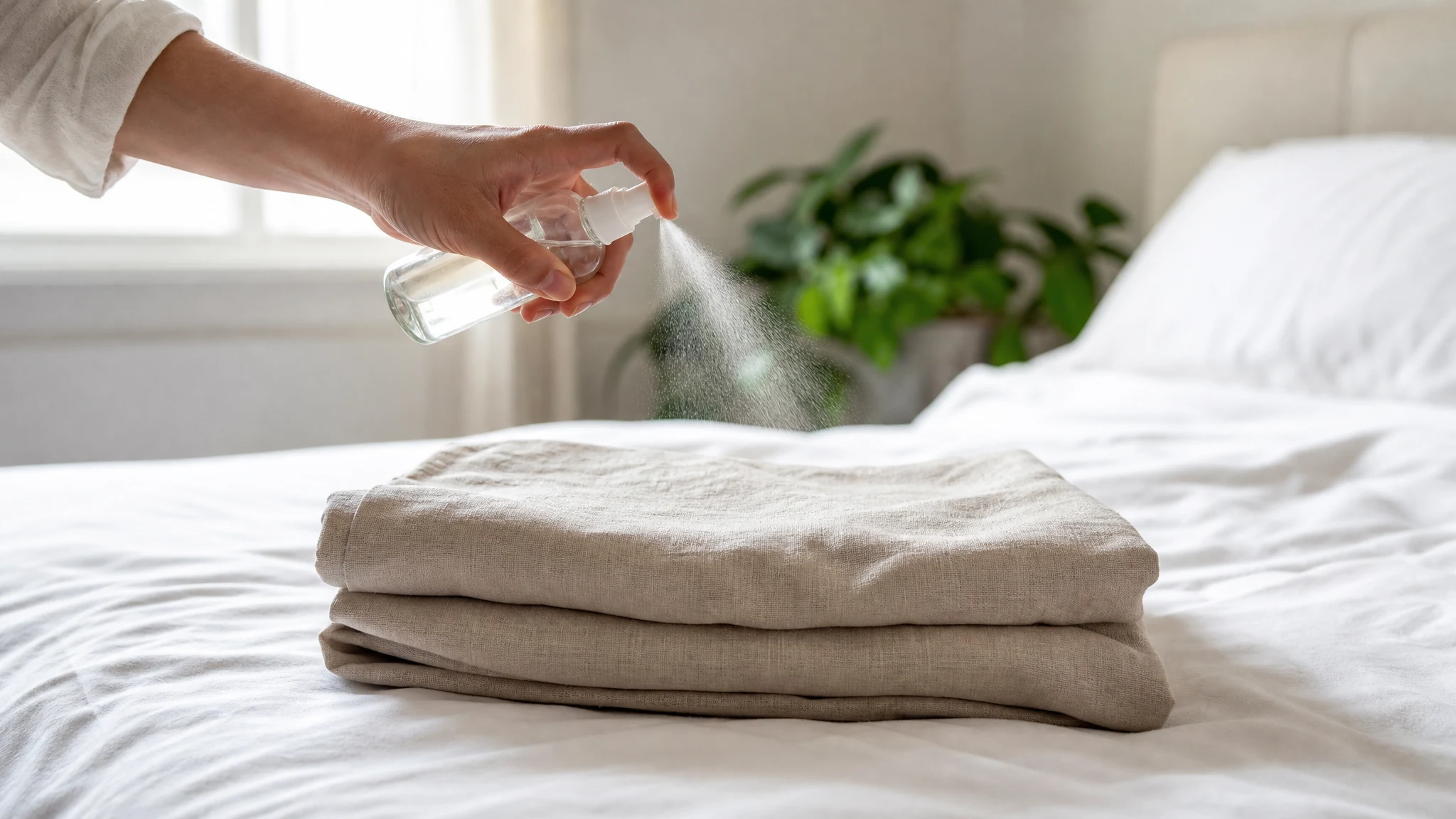
DIY Lemon Room Spray: Dispersion, Limits and Pet Cautions
Lemon oil and water do not mix, and a spray bottle of water grows things the oil will not stop. A lemon room spray therefore needs two partner materials we do not sell, a solubilizer to disperse the oil and a preservative to protect the water, and it needs an oil share well under the ceiling that IFRA sets for manual air freshener sprays. This page works a 100 g bottle out by weight at 1% oil, shows the grams and drops at other shares, and says what the sources do and do not cover. Nobody here has made or tested this formulation.
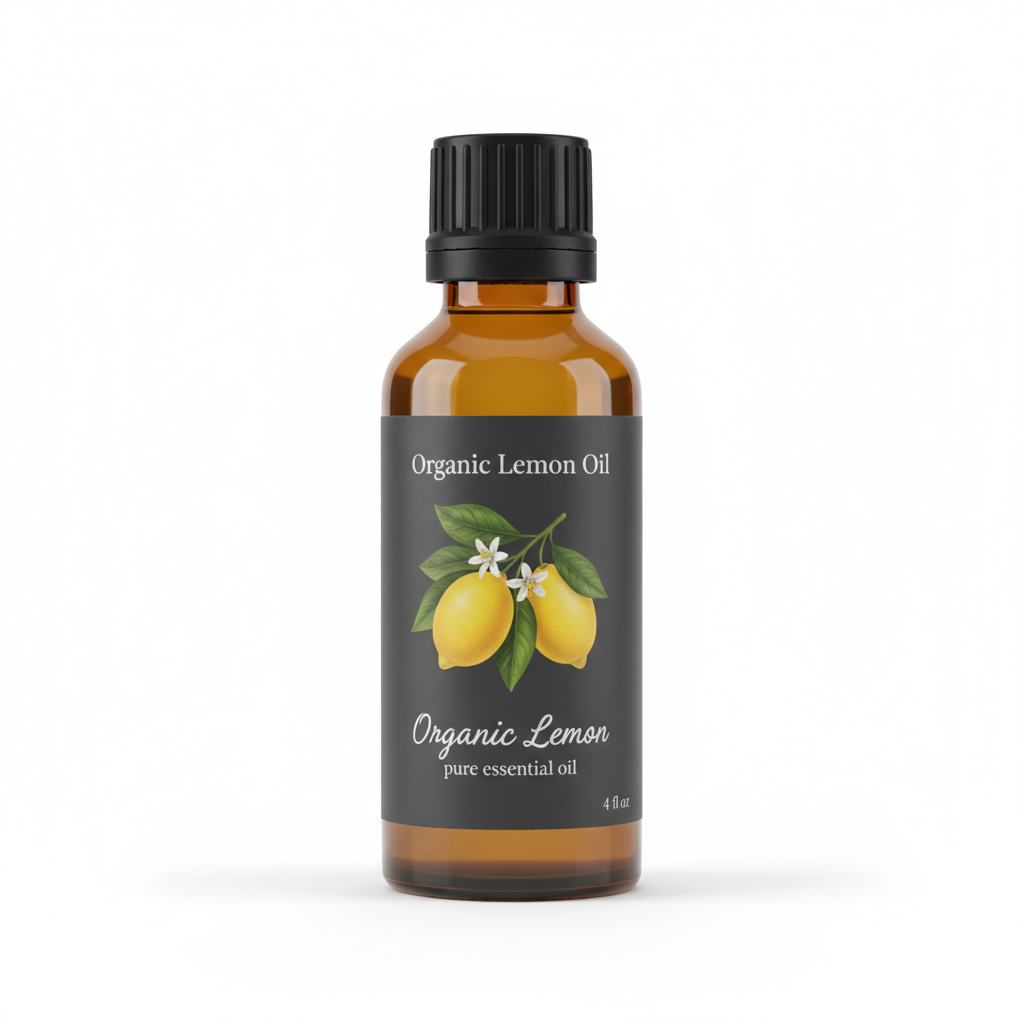
Organic Lemon Essential Oil
Our own Organic Lemon Essential Oil, in sizes from 0.5 oz to bulk.
From $15.99
Shop Now →Why a bottle of oil in water separates
Essential oil floats on water. Suppliers sell polysorbate 20 to get around that: Croda's product page calls its Tween 20 grade an "effective solubiliser for essential oils and perfumes" in aqueous and aqueous alcoholic systems (Croda Beauty, ECO Tween 20). One retailer lists it with an HLB of 16.7 and a use level of 1% to 20% but gives no oil ratio (Lotioncrafter, polysorbate 20). The ratio guidance that does exist comes from supplier pages, and it disagrees on the range:
- Makesy (February 2023): solubilizer to oil is "generally always within the range of 1:1 to 5:1", citrus oils are harder to solubilize, so start at 3:1 or higher, and a correct ratio gives a clear mix (Makesy, solubilizing fragrances).
- PureNature: "minimum recommended usage is at 1:1 ratio up to 10:1" of polysorbate 20 to oil, more depending on the oil, and usually in formulations with under 5% oil (PureNature, polysorbate 20).
Neither page tests lemon oil specifically, and Makesy's examples are body sprays, toners and shampoos rather than room sprays. Reasoning from the Makesy statement that citrus is harder, the practical consequence is to start at 3:1 or 4:1 by weight and move up if the mix turns milky. Cloudiness is information: it means the ratio is short for that bottle of oil.
Why the water needs a preservative
A 2018 review in Molecules says cosmetics need preservation against microbial contamination and describes water, their main constituent, as "an ideal growth factor for microorganisms." The same review says using essential oils as antimicrobials "is often discouraged due to their loss of activity in dilutions" (Halla et al., 2018). At 1% oil in a spray, the oil is not the preservative. FDA's cosmetics compliance program (January 2016) singles out products labeled "natural" or "no preservatives" as ones that may not be safe without appropriate testing (FDA, Program 7329.001). A room spray is not a cosmetic applied to skin, so that program is context rather than a rule for this bottle; the microbial point still stands.
The sources read for this page give no preservative dose, and we are not going to invent one. Buy a preservative sold for water-based products from a cosmetic-supply shop, check that its pH range fits your mix, and weigh it at the rate on the maker's data sheet applied to the 100 g total (a 1.0% rate would be 1.0 g). If no preservative is used, treat the bottle as perishable and do not keep it.
The limit, and the share chosen
IFRA's Guidance places "air freshener sprays, manual, including aerosol and pump" in Category 10B. The IFRA Standard for "Lemon oil cold pressed" sets 2.0% for Category 10B, with phototoxicity as the driver (IFRA Standards, 51st Amendment; IFRA Guidance). That is the same number as the top of our skin copy, and no lower authority figure was found for this category. IFRA treats concentrated metered air fresheners in a plug-in or closed device as Category 12, with no phototoxicity restriction, so the manual pump is the more cautious case because fingers and skin meet it. IFRA also files pillow sprays in their own category (Category 11), reasoning that a face may meet damp fabric, so this recipe is for air, not bedding.
The batch on our published COA has a relative density of 0.849, so 1 ml is about 0.849 g, and at about 20 drops per ml one drop is about 0.042 g. Droppers vary, so weigh if the scale allows.
| Oil share of 100 g spray | Grams of oil | Drops | Polysorbate 20 at 4:1 |
|---|---|---|---|
| 0.5% | 0.5 g | about 12 | 2.0 g |
| 1% (this page) | 1.0 g | about 24 | 4.0 g |
| 2% (IFRA 10B ceiling) | 2.0 g | about 47 | 8.0 g |
One percent is half the ceiling. It is a recommendation from reasoning, not a tested figure: room sprays are for scent only, and a lower share means less oil landing on skin, pets and surfaces.
The formulation, and what it has not been through
A small test batch comes first. Every figure here is arithmetic from the sources above.
- Weigh 4.0 g of polysorbate 20 into a clean glass container. Add 1.0 g (about 24 drops) of our oil and stir until uniform. Our oil is sold neat, so the dilution maths is yours.
- Weigh the preservative at the maker's stated rate on a 100 g total.
- Add distilled water slowly, stirring gently (Makesy notes cloudiness appears when the blend meets the base, so slow addition helps), until the total is 100 g.
- If it is milky, repeat with a higher polysorbate share; if it is clear, bottle it.
Where to buy: a cosmetic-supply or craft shop for polysorbate 20, preservative and distilled water; ask for each material's safety data sheet and read the hazards, since the partner materials have their own. We sell none of them.
Bottles, fabric and finishes
Limonene is a solvent for some plastics. A Matsushita patent describes d-limonene as having an "excellent ability for dissolving the polystyrene foam" and notes its flash point is 47 C (US 5,629,352), and a 2021 conference paper reported orange peel limonene oil mixed with ethanol and water at 1:1:2 destroyed several kinds of styrofoam waste (Hardjono et al., 2021). Both concern polystyrene and, in the second case, orange rather than lemon oil, so applying them to lemon oil is inference from limonene content. Neither covers varnish, rubber or other bottle plastics. The cautious choice is a glass spray bottle, or a bottle maker's chemical-resistance chart for the plastic in hand, and a spot test on a hidden corner of any fabric or finish. No source fetched quantifies staining.
Pets, children and the rest
Our own copy says to keep the oil away from eyes, children and pets, and not to take it internally. The ASPCA says concentrated essential oils "can absolutely be a danger for pets," that a diffuser in a secured area for a short time is "not likely to be an issue," and gives the Animal Poison Control Center number as (888) 426-4435 (ASPCA, 2022). Poison Help in the US says essential oils should be locked up out of the sight and reach of children and pets and gives 1-800-222-1222 for a swallowed product (National Capital Poison Center). Neither source tested a polysorbate-lemon spray. Questions about a specific animal belong with a veterinarian; the pet post sets out what the authorities say.
This page makes no claim that the spray cleans, purifies or removes odor; it is a scent. For surfaces, see the cleaning spray post and the spring cleaning plan, and the home use guide for other ideas.
A 1% room spray is about 24 drops of oil in 100 g, with the solubilizer keeping it mixed and the preservative, dosed from the maker's sheet, keeping the water from becoming a growth medium.
Organic Lemon Essential Oil
Organic Lemon Essential Oil from our own shop, in sizes from 0.5 oz to bulk.
From $15.99
Shop Now →Sources & Further Reading
- IFRA, 2024. IFRA Standards, 51st Amendment (Lemon oil cold pressed). ifrafragrance.org/ifra-standards---51st-amendment.pdf
- IFRA, 2023. Guidance for the use of IFRA Standards, 51st Amendment (category product lists). ifrafragrance.org/ifra-51st-amendment-guidance.pdf
- Croda Beauty. ECO Tween 20 product page. crodabeauty.com/4382-eco_1_tween_1_20
- Lotioncrafter. Polysorbate 20 product page. lotioncrafter.com/polysorbate-20
- Makesy, 2023. How to solubilize fragrances and essential oils for beauty products. makesy.com/how-to-solubilize-fragrances-essential-oils
- PureNature. Polysorbate 20 product page. purenature.co.nz/polysorbate-20
- Halla N et al., 2018. Cosmetics preservation: a review on present strategies. Molecules 23(7):1571. pmc.ncbi.nlm.nih.gov/PMC6099538
- FDA, 2016. Compliance Program 7329.001, Chapter 29, Colors and Cosmetics Technology. fda.gov/media/78441
- Shiino T, Nobuta K, Onishi H, 1997. Solvent for polystyrene, method for reducing volume of polystyrene foam and method for recycling polystyrene foam. US Patent 5,629,352. patents.google.com/US5629352
- Hardjono H et al., 2021. D-limonene from orange (Citrus maxima) peel extraction as destructive agent of styrofoam waste. IOP Conf Ser Mater Sci Eng 1073:012013. iopscience.iop.org/1757-899X/1073/1/012013
- ASPCA, 2022. The essentials of essential oils around pets. aspca.org/essentials-essential-oils-around-pets
- National Capital Poison Center. Essential oils. poison.org/articles/essential-oils