Lemon Essential Oil on Skin: Documented Risks and Limits
Lemon essential oil belongs on skin only as a fragrance ingredient with documented hazards, not as a skincare product with proven benefits, and the records back that framing. The fragrance industry's standards body caps cold-pressed lemon oil at 2.0% in leave-on products, and the reason it gives is phototoxicity. This article sets out the three documented skin risks, works the percentage into drops, and says where the evidence for any skin benefit stops. For a skin condition, the person to ask is a dermatologist.
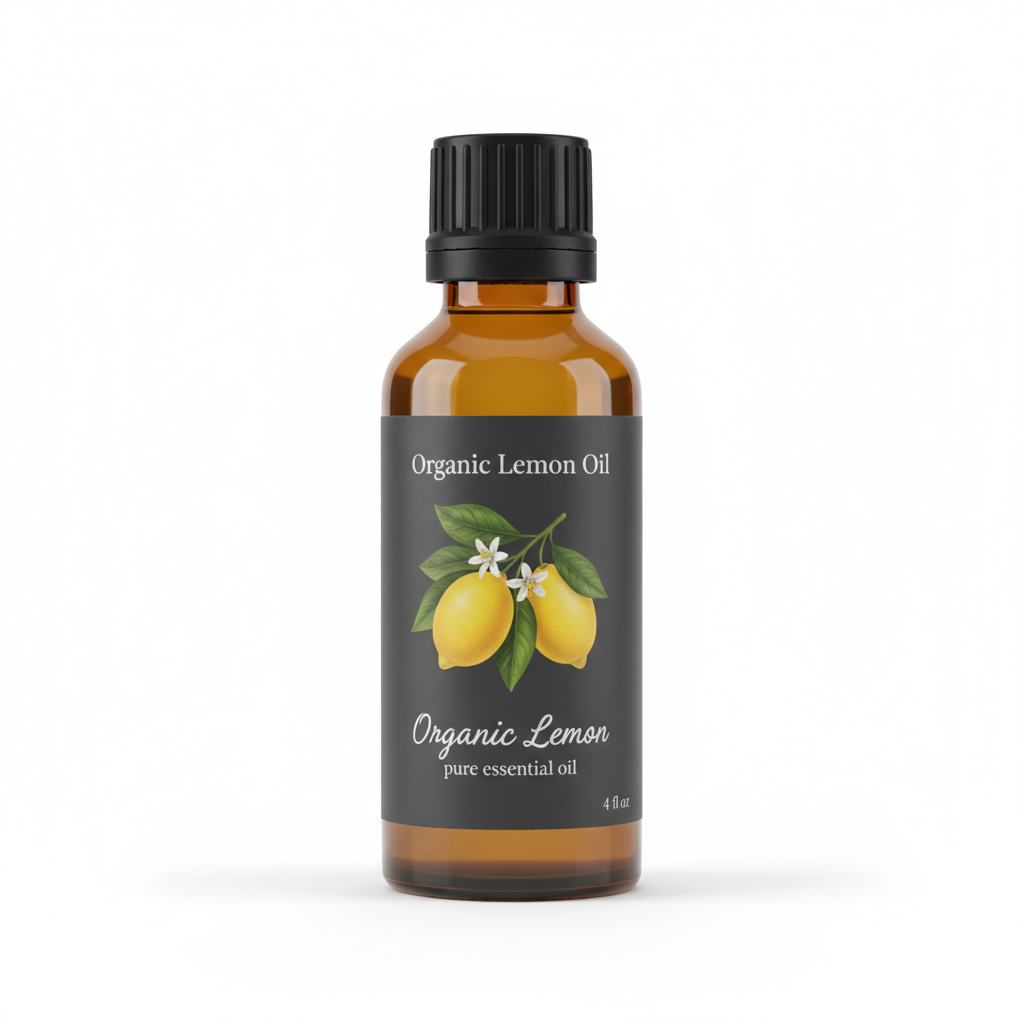
Organic Lemon Essential Oil
Our own Organic Lemon Essential Oil, in sizes from 0.5 oz to bulk.
From $15.99
Shop Now →Three documented risks, one missing benefit
| Risk | What the sources say | Material studied |
|---|---|---|
| Phototoxicity | IFRA's standard for cold-pressed lemon oil (Amendment 49, 2020) is set "due to the phototoxic effects" of the oil. DermNet describes the reaction as UVA acting on furanocoumarins left on skin: redness at about 24 to 48 hours, often blisters, and pigmentation afterwards that "can last several years". | Cold-pressed oil (IFRA); plant sap and fruit juice (DermNet) |
| Sensitisation | IFRA's limonene standard (Amendment 29, 1995) says limonene oxidation products, "especially hydroperoxides", are "potent sensitizers", and asks that limonene-rich natural products have a peroxide value under 20 millimoles per litre. | Limonene and limonene-rich oils, as a class |
| Irritation at strength | de Groot and Schmidt (2016) reviewed contact allergy to essential oils: nearly 80 oils had caused it, and most reactions came from applying undiluted oils or high-concentration products. | Essential oils generally, patch-test and case data |
The benefit column is the thin one. A systematic review of essential oils in skin-care products (Pezantes-Orellana et al., 2025) analysed 70 studies from the past decade, and its abstract names lavender, tea tree, chamomile, peppermint, hemp, eucalyptus and a few others as the oils with findings. Lemon is not on that list. A Europe PMC search run on 28 October 2026 for lemon oil or Citrus limon together with phototoxic, photodermatitis, pigment, contact dermatitis or allergic in the title returned 18 records. A title screen found mostly unrelated plant and food papers, one phytophotodermatitis review, one 1989 patch-test case report and no trial of lemon oil applied for a skin benefit. A title screen is a quick look, not a proof that nothing exists.
Where the 2% comes from, and what it does not say
The IFRA entry for cold-pressed lemon oil lists 2.0% as the maximum in the finished product for leave-on categories, including body lotion (5A), face moisturizer (5B), hand cream (5C), leave-on hair products (7B) and products applied with fingertips (3). Rinse-off body products (9) and non-skin-contact products such as candles (12) carry no restriction. The basis IFRA gives is a 1974 phototoxicity study, "its low bergapten content", and a no-effect level in an animal model (IFRA Standards, 51st Amendment, 2024).
Three details change how to read it. First, the standard says "if the level of furocoumarins is unknown, the restriction level specified in this IFRA Standard applies", so a bottle with no furocoumarin data is held to 2.0%, not to something higher. Second, the limit is a ceiling for the oil's phototoxicity, not a recommended amount: Tisserand's own page says the same of the 2% (Tisserand Institute, undated). Third, the standard covers fragrance mixtures in consumer products, and IFRA's guidance scope excludes "aromatherapy applications" (IFRA Guidance, 2023), so for homemade blends it is a reference point, not a certificate.
The same guidance says phototoxicity limits apply to products used on "body areas reasonably expected to be exposed to sunlight". That is the area to think about: a face, neck, forearm or leg in daylight.
Our copy against the authorities
Our own safety copy says to dilute to 0.5% to 2% in a carrier oil, roughly 3 to 12 drops per ounce of carrier, patch test first, and avoid sun on freshly applied areas. Set against the sources, the top of that range matches IFRA's lemon ceiling and exceeds Tisserand's generic range for the face. The drops below use 591 drops per ounce of oil as a rounding basis, so they are approximate; droppers vary.
| Figure | Source | Per 1 oz carrier |
|---|---|---|
| 0.5% to 2%, skin | Our copy | about 3 to 12 drops |
| 2.0% maximum, leave-on, all skin categories listed | IFRA, lemon oil cold pressed | about 12 drops |
| 0.5% to 1.2%, facial cosmetics | Tisserand Institute (generic range, not lemon-specific) | about 3 to 7 drops |
| 0.2% to 1%, sensitivity or impaired skin | Tisserand Institute (generic range) | about 1 to 6 drops |
So for the face the lower figure is 1.2%, and our recommendation is to stay at or below it, starting from the 0.5% end (about 3 drops per ounce). Where skin is blemished, broken, sunburned or already reacting, the Tisserand range drops to 1% or less, and the better answer is to leave the oil off. For the body, 2.0% is the ceiling and not a target. The Tisserand body-oil range of 1% to 3% runs past lemon's own cap at the top, which is the reason a lemon-specific figure beats a generic one.
Citrus oils also add up. IFRA's rule is that each furocoumarin oil's share of its own limit is summed and must not exceed 100. Lemon at 1% uses half of its 2.0%. Bergamot's limit is 0.40% and lime's 0.70% in the same categories, so adding 0.2% bergamot uses the other half. That is arithmetic on IFRA's published limits, not a tested blend.
The sun, and what a patch test misses
Tisserand advises keeping skin out of UV for at least 12 hours after a phototoxic amount is applied, and avoiding phototoxic oils entirely before sunbathing or a tanning bed (Tisserand Institute, undated). The source reports distilled lemon oil carrying 22 times less bergapten than an expressed one; distilled and cold-pressed lemon are different materials, and we do not offer a furocoumarin-free lemon, so none of that applies to our oil.
The severity is real in the case literature, although the exposure there was fruit juice. A 7-year-old squeezed lemon juice on her skin in hot Arizona sun and was admitted for four days with burn-like blisters on her face, neck, chest, arms and legs (Matthews et al., 2017). A juice case is not an oil case, but the mechanism is the same class of compound.
The AAD's patch-test advice for a new product is to use the inner forearm, twice a day for 4 to 5 days on one page (AAD, wrinkle remedies) and a quarter-sized patch daily for 7 to 10 days on another (AAD, eczema at home). The pages disagree, so the longer schedule is the cautious reading. Reasoning from how these tests work, a covered or indoor forearm test looks for allergy and irritation and says nothing about a sun reaction, which needs the light.
What counts as a drug claim
FDA says a product's intended use decides whether it is a cosmetic or a drug, and that intent can show up in label claims, advertising or web pages. Claims it lists as drug claims include products meant to "reduce cellulite" or to "increase or decrease the production of melanin" (FDA, content current as of 09/11/2024). That is why the shop makes no skin claim for this oil, and why the sibling articles on acne and dark spots only report what studies did.
When to stop and who to ask
The NHS advises seeing a GP for persistent, recurrent or severe contact dermatitis, and notes that darker skin can turn dark brown, purple or grey rather than red (NHS, reviewed May 2023). For sunburn with blistered or swollen skin, a very high temperature, dizziness or sickness, it advises an urgent GP appointment or NHS 111 (NHS, reviewed November 2025). A skin condition, a reaction that will not settle or a dark mark that appears after sun belongs with a dermatologist or physician. Pregnancy, children and pets have their own questions: see our safety basics and ask the relevant professional.
Our oil is sold neat, so the dilution maths is the buyer's. The COA we publish for its batch shows density, refractive index and optical rotation only, with no constituent data. A buyer who needs furocoumarin or peroxide figures should ask in writing before ordering and get the answer in writing. Carrier choice is covered in the carrier oil guide.
Organic Lemon Essential Oil
Organic Lemon Essential Oil from our own shop, in sizes from 0.5 oz to bulk.
From $15.99
Shop Now →Sources & Further Reading
- IFRA, 2024. IFRA Standards, 51st Amendment (Lemon oil cold pressed; Citrus oils and other furocoumarins; Limonene; bergamot and lime oil expressed). ifrafragrance.org/ifra-standards---51st-amendment.pdf
- IFRA, 2023. Guidance for the use of IFRA Standards (categories, phototoxicity policy, scope). ifrafragrance.org/ifra-51st-amendment---guidance
- Tisserand Institute, undated. Dilution for essential oils. tisserandinstitute.org/dilution-essential-oils
- Tisserand Institute, undated. Phototoxicity: essential oils, sun and safety. tisserandinstitute.org/phototoxicity-essential-oils-sun-and-safety
- DermNet, 2021. Phytophotodermatitis (Coulson). dermnetnz.org/topics/phytophotodermatitis
- de Groot and Schmidt, 2016. Essential Oils, Part IV: Contact Allergy. Dermatitis. europepmc.org/MED/27427818
- Pezantes-Orellana et al., 2025. Essential oils in skin care applications: a systematic review. Front Med. europepmc.org/MED/40917836
- Matthews et al., 2017. Lemons in the Arizona Sunshine. Wounds. europepmc.org/MED/29324427
- AAD. Wrinkle remedies; Eczema at home (patch-testing new products). aad.org/wrinkle-remedies
- FDA, 2024. Is it a cosmetic, a drug, or both? fda.gov/it-cosmetic-drug-or-both-or-it-soap
- NHS, 2023 and 2025. Contact dermatitis; Sunburn. nhs.uk/conditions/contact-dermatitis