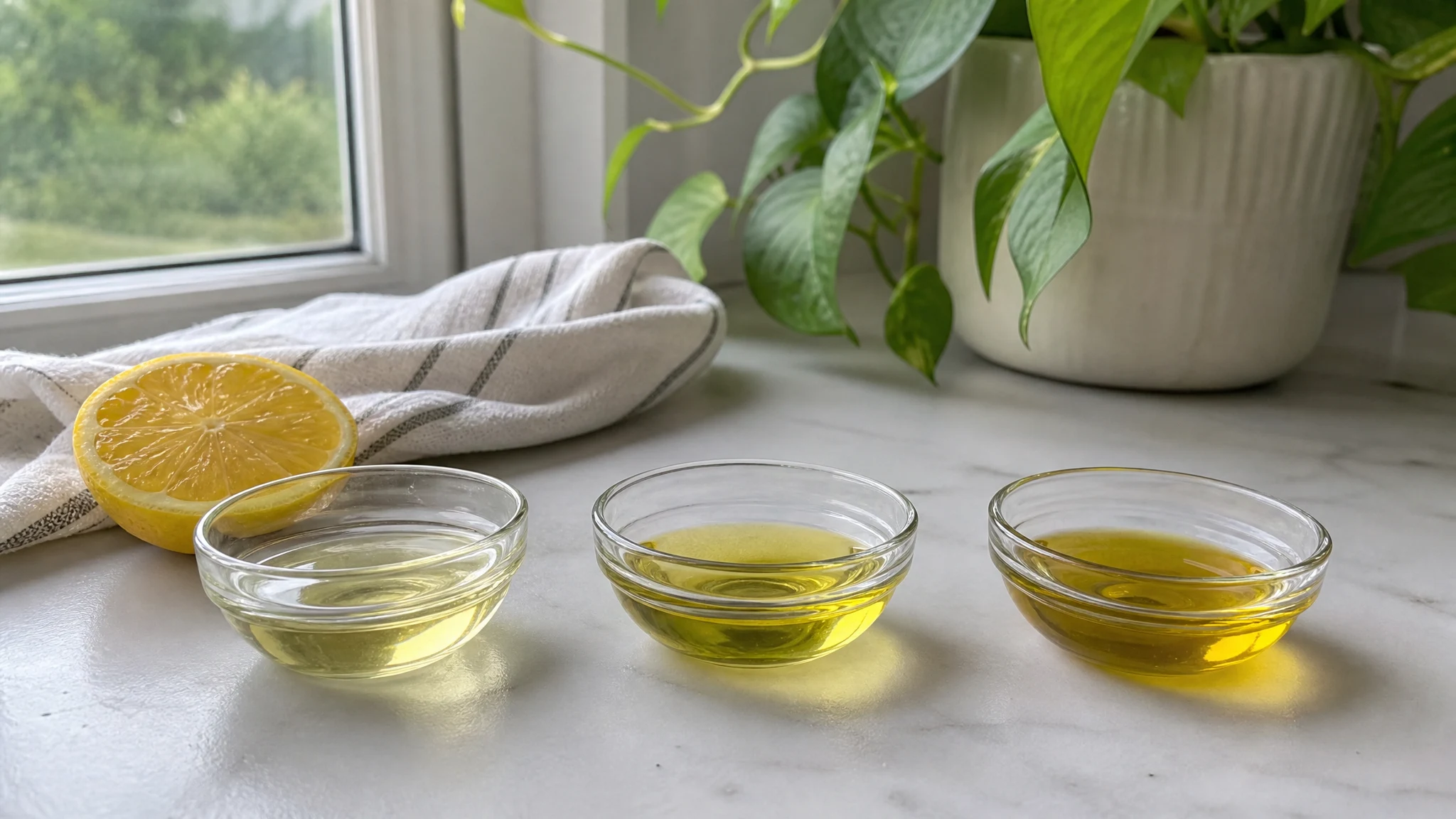
Best Carrier Oils for Lemon Essential Oil: What the Data Say
For cold-pressed lemon oil, the carrier you pick matters less for how it feels than for how fresh and stable it is, because the carrier is 98% or more of the bottle and the lemon oil in it already has an oxidation problem of its own. The sources fetched for this article support comparisons of stability, composition class and allergen status. They do not support claims about absorption speed or skin feel, so none are made here.
Organic Lemon Essential Oil
Our own Organic Lemon Essential Oil, in sizes from 0.5 oz to bulk.
From $15.99
Shop Now →Fix the lemon percentage first
Our oil is sold neat, so the dilution is yours to calculate. Our own copy says 0.5% to 2% in a carrier oil (roughly 3 to 12 drops per ounce of carrier), patch test first, and avoid sun on freshly applied areas. The published ceilings for the oil on skin are these: the IFRA Standard on lemon oil cold pressed (2020, Amendment 49, in the 51st Amendment compilation) allows 2.0% in the finished product for Categories 1 to 6, 7B, 8, 10B and 11B, which cover lip, underarm, face, fine fragrance, body lotion, face cream, hand cream and baby products, and sets no restriction for rinse-off hair and body products. The Tisserand Institute dilution chart says lemon oil should be used at no more than 2% to avoid phototoxicity. Neither figure is lower than the top of our range. A carrier choice does not move those limits.
| Target | Oil per 1 oz (29.57 ml) of carrier | Drops at about 20 per ml | Oil per 100 g of finished blend |
|---|---|---|---|
| 0.5% | about 0.15 ml | about 3 | 0.5 g (0.59 ml, about 12 drops) |
| 1% | about 0.30 ml | about 6 | 1 g (1.18 ml, about 24 drops) |
| 2% | about 0.59 ml | about 12 | 2 g (2.36 ml, about 47 drops) |
Two corrections to the drop arithmetic. First, droppers vary, so weigh the oil when the percentage matters. Second, volume and weight percentages differ slightly because lemon oil is lighter than most carriers: the batch on our published certificate has a relative density of 0.849, while the BASF data sheet for one caprylic/capric triglyceride gives 0.945 to 0.949 g/cm3. One ounce of that carrier weighs about 28 g, so 1% by weight is about 0.28 g of lemon oil, which is 0.33 ml, about 7 drops, not 6.
Why the carrier's age counts against the lemon oil
The IFRA Standard on limonene states that oxidation products of limonene, especially hydroperoxides, are potent sensitisers, and asks that limonene-rich natural products be kept below a peroxide value of 20 millimoles per litre. The Tisserand Institute's answer on oxidised oils says oxidation products tend to be slightly toxic and to increase the risk of adverse skin reactions, and that heat, light and moisture speed oxidation. Our own copy makes the same point about the oil: an old bottle is not simply flatter.
A carrier that has itself gone rancid does not remove that risk and adds its own. The one head-to-head laboratory study found on plant oils is Tsuchimoto, Sakai and Fukui (2022) in BPB Reports. It heated jojoba oil (a wax monoester), olive oil (a triglyceride) and squalene at 60 C for 60 days. Acid value did not change in jojoba but rose in olive oil and squalene, and peroxide and carbonyl values were lowest in jojoba. The authors concluded jojoba was the most stable of the three. That is an accelerated heating test of three materials, in a laboratory, not a shelf-life figure for any bottle, and it did not test sweet almond or coconut oil.
The candidates, with what a source says about each
| Carrier | What the fetched source reports | What it does not tell you |
|---|---|---|
| Fractionated coconut oil (INCI caprylic/capric triglyceride) | BASF's technical information for Myritol 318 (revision 1.0, valid since 2017): a triglyceride of saturated C8 to C10 fatty acids; iodine value at most 0.5 g I2/100 g; acid value at most 0.1 mg KOH/g; no preservatives or antioxidants present | One product's sheet, not every bottle sold under the name. A low iodine value means very few double bonds, the sites where oxidation attacks, which is inference from chemistry rather than a stated shelf-life promise |
| Jojoba | Lowest peroxide and carbonyl values after 60 days at 60 C among jojoba, olive oil and squalene (Tsuchimoto et al., 2022); the study also found oxidative stability varied among crude jojoba oils from different suppliers and years | Variation between lots, and refining lowered antioxidant activity: a data sheet for your lot matters more than the plant name |
| Sweet almond | FDA lists almonds among the tree nuts in the major food allergen group | No oxidation or composition figure was verified for this article. Ask the supplier for the peroxide value and date. Anyone with a tree-nut allergy should ask an allergist before putting it on skin |
| Olive oil | In 19 adult volunteers, four weeks of twice-daily olive oil on a forearm lowered stratum corneum integrity and caused mild redness; sunflower seed oil on the other forearm did not (Danby et al., 2013) | Small study of adult forearms. The authors discouraged olive oil for dry skin and infant massage; its effect with lemon oil added was not studied |
| Sunflower seed oil | Same study: kept stratum corneum integrity, no redness, improved hydration | The sources fetched give no stability data for sunflower oil, and it is not shown that the result carries to other sunflower oils or to a blend with lemon oil |
Two positions follow, and they are ours, not a source's. First, do not choose olive oil as the default carrier for a leave-on lemon blend on the strength of tradition when the one controlled study found here reported barrier damage with it. Second, when the choice is close, prefer the carrier whose supplier will give you a lot number, a date and a peroxide value in writing over the one with the better story. We do not sell carrier oils; a craft or soap-supply shop, or a cosmetic-ingredient supplier, is where they come from.
On allergens: the FDA allergen page applies to foods, and it states that cosmetics are excluded from that law's enforcement in most packaged products, so a carrier sold for skin may carry no allergen statement at all. Ask the seller directly, in writing, whether the oil is a tree nut or comes from one.
A worked blend, not a tested one
We have not made or tested this. It is arithmetic from the figures above, to be test-batched small and patch tested before anyone uses it. For a 1 oz (29.57 ml) bottle at 1%: fill most of the bottle with your chosen carrier, add about 6 drops (0.3 ml) of lemon oil, cap, and swirl. Label it with the date, the carrier's lot number and the percentage. Use the bottle within the carrier supplier's stated life, not ours, and discard it if the carrier smells off. Keep it out of the sun on the skin for at least 12 hours after use, the interval the Tisserand Institute gives for a phototoxic amount; our copy simply says to avoid sun on freshly applied areas. If the blend will sit in a bag or a car, heat is the variable the oxidation sources point to.
If you add another citrus oil, the ceiling is shared. IFRA requires furocoumarin-containing oils (lemon, bergamot, lime, grapefruit, bitter orange and others) to total no more than 100% of their individual limits. Lemon at 1% uses half. The Tisserand Institute's phototoxicity article gives a bergamot figure of 0.4% in the final product, so as an illustration, 1% lemon plus 0.2% bergamot is 50% plus 50%, and nothing is left for a third. We do not sell bergamot or any other oil.
The related guides cover storing the lemon oil itself, the photosensitivity basics, and the rinse-off scrub and shower melt where the carrier question is different. The chemistry behind limonene is in Inside Lemon Oil.
A stable, dated carrier and a fresh bottle of lemon oil do more for a blend than any claim about absorption, and a dermatologist is the person to ask if skin reacts.
Organic Lemon Essential Oil
Organic Lemon Essential Oil from our own shop, in sizes from 0.5 oz to bulk.
From $15.99
Shop Now →Sources & Further Reading
- IFRA, 2023. IFRA Standards, 51st Amendment (Lemon oil cold pressed, 2020; Citrus oils and other furocoumarins containing essential oils; Limonene). ifrafragrance.org/51st-amendment
- IFRA, 2023. Guidance for the use of IFRA Standards, 51st Amendment (category definitions). ifrafragrance.org/51st-amendment guidance
- Tisserand Institute, undated. Essential Oil Dilution Chart. tisserandinstitute.org/essential-oil-dilution-chart
- Tisserand Institute (R. Tisserand), undated. Phototoxicity: essential oils, sun and safety. tisserandinstitute.org/phototoxicity
- Tisserand Institute, undated. Is my bottle of essential oil oxidized or no longer good to use? tisserandinstitute.org/learn-more/oxidized
- Tsuchimoto S, Sakai H, Fukui K, 2022. Oxidative Stability and Antioxidant Activity of Crude Jojoba Oil. BPB Reports 5(6):121-124. jstage.jst.go.jp/bpbreports/5/6_121
- BASF, 2017. Technical Information: Myritol 318 (Caprylic/Capric Triglyceride), revision 1.0. promo.basf.com/Myritol 318
- Danby SG et al., 2013. Effect of olive and sunflower seed oil on the adult skin barrier: implications for neonatal skin care. Pediatric Dermatology 30(1):42-50. research.lstmed.ac.uk
- FDA, 2026. Food Allergies. fda.gov/food-allergies