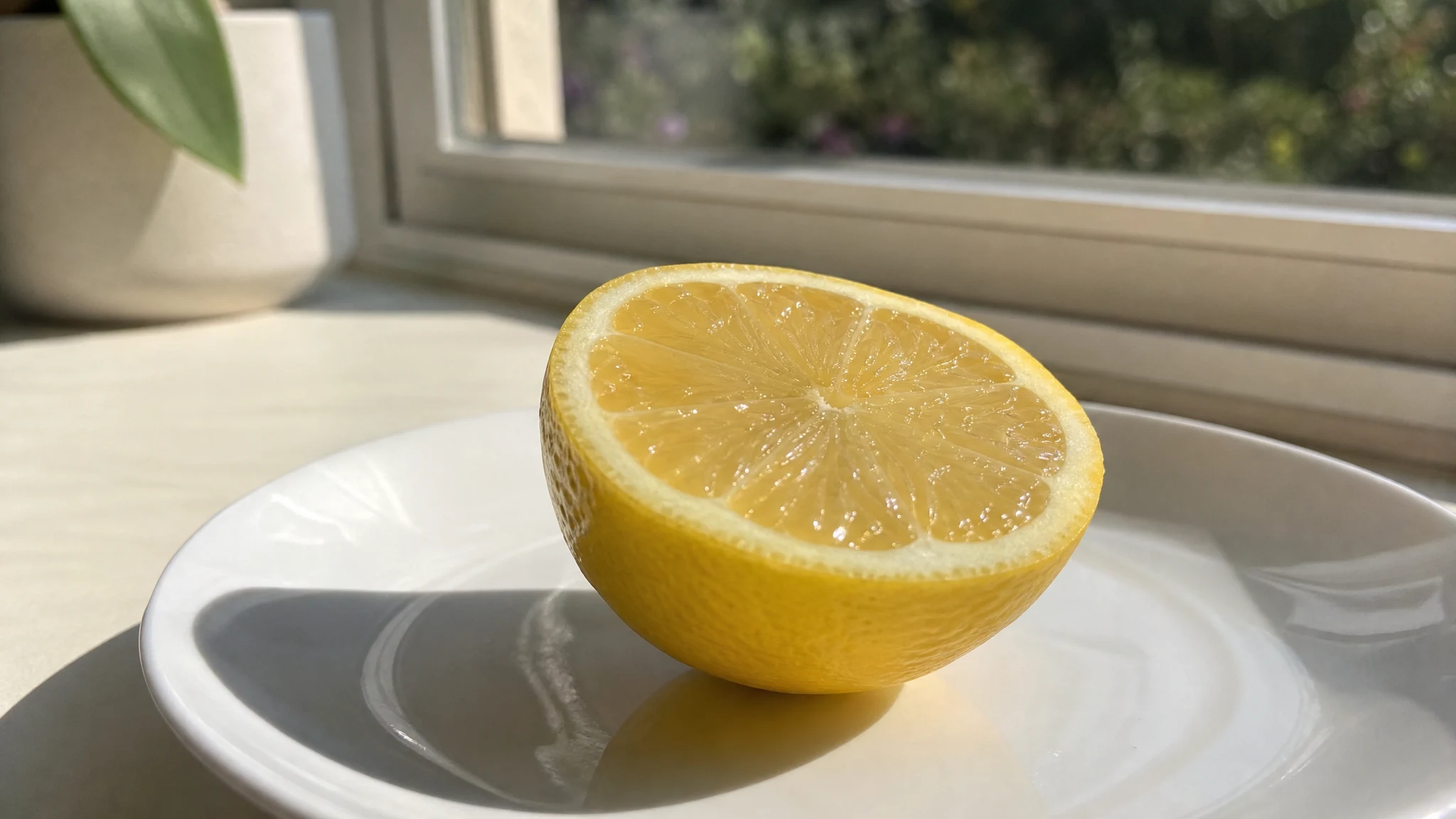
Lemon Oil and Dark Spots: It Can Cause the Mark
Lemon oil is the wrong tool for even skin tone, and the documented risk runs the other way: the furocoumarins in cold-pressed citrus oils plus UVA light can burn skin, and the burn can leave a brown mark that lasts years. No study found in the search shows lemon oil removing or fading pigment in people. This article follows the mechanism step by step, reports the case reports and what they cover, and ends with what the AAD says dark spots actually need.
Organic Lemon Essential Oil
Our own Organic Lemon Essential Oil, in sizes from 0.5 oz to bulk.
From $15.99
Shop Now →How a mark forms, in order
DermNet's page on phytophotodermatitis, written by a consultant dermatologist (DermNet, 2021), lays out the sequence. Plant sap or fruit juice containing furanocoumarins is smeared on skin. UVA then interacts with the furanocoumarin and damages cell membranes, a direct toxic effect, not an allergy. Redness appears about 24 to 48 hours after the sun exposure, often with blisters, sometimes in streaks or drip shapes. After healing comes post-inflammatory pigmentation, which "can last several years" and may be more intense in skin of colour.
A 2017 case report from the Arizona Burn Center calls this progression, erythema to blisters to hyperpigmentation, "a well-described clinical triad" (Matthews et al., 2017). Cold-pressed lemon oil is on IFRA's list of furocoumarin-containing oils, alongside bergamot, bitter orange, grapefruit, lime and others (IFRA Standards, 51st Amendment, 2024). Tisserand's page says that of furanocoumarins "even 0.1% can be phototoxic", and advises keeping skin out of UV for at least 12 hours after a phototoxic amount (Tisserand Institute, undated).
What the case reports cover, and what they do not
| Report | Exposure | Outcome |
|---|---|---|
| Matthews et al., 2017 (one child, 7 years) | Lemon juice squeezed on skin in hot sun | Pain, redness and blisters within 24 hours; admitted for 4 days with burn-like lesions on face, neck, chest, arms and legs |
| Cochran et al., 2024 (one adult, 34 years) | A lime margarita on the hand, then rubbed on the back at a beach | An irregular hyperpigmented patch on the back that was "asymptomatic"; the paper's point is that the history was needed to make the diagnosis |
| Abugroun et al., 2019 (one adult, 26 years) | Contact with lime, then sun | Phytophotodermatitis; the abstract gives no further outcome detail |
| Serrano et al., 1989 (one woman, 27 years) | Fragrances in a face powder | Dark brown facial pigmentation; patch tests were positive to lemon oil, geraniol and hydroxycitronellal; the pigment disappeared within 6 months of avoiding them |
Read the exposures carefully. Three of the four involve fruit or juice, not the oil, so they show the mechanism, not a rate for oil. The Serrano case is a different mechanism again: a patch-test-proven fragrance allergy, with no sunlight step, and a single patient, so it cannot say how often it happens. The sources are Matthews above, Cochran et al., 2024, Abugroun et al., 2019 and Serrano et al., 1989. None is a trial, and none measures how common the problem is.
For the oil itself, a Czech group tested orange, lemon and Litsea cubeba oils for phototoxicity in a chemical analysis, a cell test, a skin-model test and a photopatch test on a limited group of human volunteers. The abstract reports that the skin-model result "cannot be applied directly for human practice", because 3 of 8 tested oils evoked a phototoxic reaction in people at those concentrations, and recommends a safety factor of 10 (Kejlová et al., 2010). The abstract does not say which three, so the result cannot be pinned on lemon.
The arithmetic behind the 2% cap
IFRA caps cold-pressed lemon oil at 2.0% in the finished product for leave-on skin categories, resting on a 1974 phototoxicity study, the oil's "low bergapten content" and an animal no-effect level. A companion standard sets 0.0015% bergapten (15 ppm) in the finished product on UV-exposed skin, where bergapten has been measured. Working backwards, 2.0% oil that met the 0.0015% bergapten figure alone would need the oil to carry no more than 0.0015 divided by 0.02, which is 0.075% bergapten, or 750 ppm. That is arithmetic on IFRA's numbers, a way to see what the cap implies, and not a figure for any particular bottle. The standard also says that where a furocoumarin level is unknown, the per-oil limit applies. Our COA for its batch lists density, refractive index and optical rotation only, so it gives no bergapten figure, and a buyer who needs one should ask in writing before ordering.
Our own copy says 0.5% to 2% in a carrier oil, about 3 to 12 drops per ounce of carrier, a patch test first and no sun on freshly applied areas. The top of that range equals IFRA's ceiling. A patch test on a covered inner arm checks for allergy or irritation and, by reasoning, cannot reveal a reaction that needs sunlight to start. We do not offer a furocoumarin-free lemon, which is a different, differently scented material, so sun-exposed skin remains the place to avoid.
What the AAD says dark spots need
The AAD page on fading dark spots in darker skin tones says people get them when "something triggers their skin to make extra melanin": a healed pimple or injury, certain medications, irritating products and hormonal changes. Its advice is to use tinted sunscreen with iron oxide, and it states that "when a skin or hair care product irritates your skin, the product can cause dark spots on your skin", recommending gentler, fragrance-free products. If the treatment you are using is not working, it says, see a dermatologist (AAD, dark spots). The AAD's acne page adds that dark spots left after acne clears are a reason to make an appointment (AAD, adult acne). More on that side is in the acne evidence review.
A search of Europe PMC on 28 October 2026 for lemon oil or lemon essential oil with tyrosinase, melanin, depigmenting, skin lightening, whitening or melasma returned 75 records. A title screen found nanoemulsion papers on other agents, fruit-preservation papers and general review articles, and no study applying lemon oil to people's skin to change pigment. That is a title screen of one database, not proof that none exists.
The claim line
FDA lists claims that a product will "increase or decrease the production of melanin" among drug claims, and says intended use can be shown through labels, advertising and web pages (FDA, content current as of 09/11/2024). The shop makes no such claim for its oil, and nothing here suggests it. A blistering, sunburn-like reaction falls under the NHS sunburn advice: an urgent GP appointment or NHS 111 for blistered or swollen skin, a very high temperature, or feeling dizzy or sick (NHS, reviewed November 2025). The NHS also notes that on darker skin contact dermatitis can show as dark brown, purple or grey rather than red (NHS, reviewed May 2023), and the AAD's advice for a dark patch that is not responding is a dermatologist. The full limits and drops are in the skin guide and our safety basics.
If the goal is even skin tone, the sources point to sun protection and a dermatologist, and away from the kitchen counter and the essential oil shelf alike.
Organic Lemon Essential Oil
Organic Lemon Essential Oil from our own shop, in sizes from 0.5 oz to bulk.
From $15.99
Shop Now →Sources & Further Reading
- DermNet, 2021. Phytophotodermatitis (Coulson). dermnetnz.org/topics/phytophotodermatitis
- Matthews et al., 2017. Lemons in the Arizona Sunshine. Wounds. europepmc.org/MED/29324427
- Cochran et al., 2024. Phytophotodermatitis From Lime Margaritas on a Mexico Vacation. Cureus. europepmc.org/MED/38707750
- Abugroun et al., 2019. Lime-induced phytophotodermatitis. Oxf Med Case Reports. europepmc.org/MED/31844529
- Serrano et al., 1989. Riehl's melanosis: pigmented contact dermatitis caused by fragrances. J Am Acad Dermatol. europepmc.org/MED/2808836
- Kejlová et al., 2010. Phototoxicity of essential oils intended for cosmetic use. Toxicol In Vitro. europepmc.org/MED/20688147
- IFRA, 2024. IFRA Standards, 51st Amendment (Lemon oil cold pressed; Citrus oils and other furocoumarins). ifrafragrance.org/ifra-standards---51st-amendment.pdf
- Tisserand Institute, undated. Phototoxicity: essential oils, sun and safety. tisserandinstitute.org/phototoxicity-essential-oils-sun-and-safety
- AAD. How to fade dark spots in darker skin tones. aad.org/fade-dark-spots
- AAD. Adult acne treatment dermatologists recommend. aad.org/adult-acne-treatment
- FDA, 2024. Is it a cosmetic, a drug, or both? fda.gov/it-cosmetic-drug-or-both-or-it-soap
- NHS, 2025. Sunburn. nhs.uk/conditions/sunburn
- NHS, 2023. Contact dermatitis. nhs.uk/conditions/contact-dermatitis