Lemon Oil and Acne: What the Studies Did and Did Not Show
The one study that put lemon oil against an acne-associated bacterium did it in a dish, and the lemon oil needed a concentration that was also toxic to human cell lines in the same paper. No trial has been found that applied lemon oil to people with acne. That leaves a plain position: no evidence supports lemon oil for acne, the shop makes no acne claim, and this article gives no application advice. It reports what exists, what dermatologists recommend instead, and why a phototoxic oil on irritated skin is a poor idea.
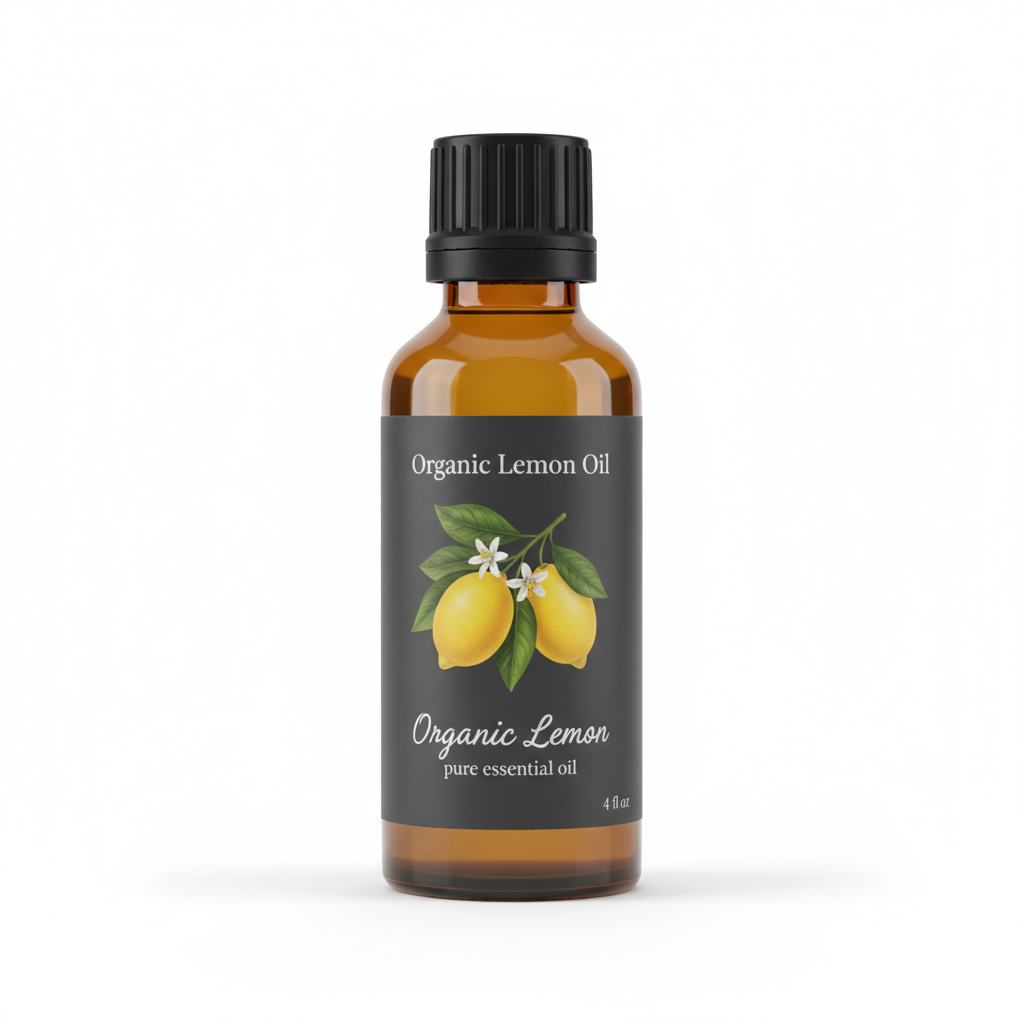
Organic Lemon Essential Oil
Our own Organic Lemon Essential Oil, in sizes from 0.5 oz to bulk.
From $15.99
Shop Now →The search
On 28 October 2026 a Europe PMC search for lemon oil, lemon essential oil or Citrus limon together with Cutibacterium acnes, Propionibacterium acnes or P. acnes returned 62 records. Screening titles turned up reviews of essential oils for acne, nanoparticle and formulation papers, and one study that tested lemon oil against the bacterium directly. No clinical trial of lemon oil on acne appeared in the titles. That is a title screen of one database, so it shows what is easy to find, not that nothing exists.
The one direct study: ten oils in a dish
Zu and colleagues (2010) tested ten essential oils against P. acnes strain CMCC 65002 and against three human cancer cell lines (Zu et al., 2010). Lemon was one of the ten, bought from a commercial supplier, and the paper reports no lemon composition. The figures that matter:
| Measure (percent by volume) | Thyme and cinnamon | Lemon |
|---|---|---|
| Minimal inhibitory concentration, broth microdilution | 0.016% | 0.250% |
| Minimal bactericidal concentration | comparable to MIC | 0.250% |
| Cell toxicity, IC50 on prostate (PC-3), lung (A549), breast (MCF-7) cancer cell lines, 72 h | thyme 0.010%, 0.011%, 0.030% | 0.083%, 0.061%, 0.143% |
Lemon oil needed about 16 times the concentration of thyme or cinnamon oil to inhibit the bacterium (0.250 divided by 0.016 is 15.6). In the time-kill test at 0.25%, the bacteria were killed within 30 minutes by grapefruit and lemon oils, a slower result than the faster-acting oils in the same paper. The abstract's own ranking of strongest oils names thyme, cinnamon, rose and lavender, not lemon.
Now the comparison the paper does not draw. Lemon's dish-toxicity figures (0.061% to 0.143%) are lower than the 0.250% that stopped the bacteria. In other words, in these assays the oil harmed the human cancer cells at a lower concentration than it took to kill the acne bacterium. Cancer cell lines in a dish are not human skin, and a dish is not a face, so this proves nothing about skin. What it does show is that an in-dish antibacterial number is not an acne result: the study never tested a pimple, a person or a skin product.
What the reviews add
Two review papers get cited whenever essential oils and acne come up. Nurzyńska-Wierdak and colleagues (2022) is a narrative review; the lemon passages read cite lab studies against other bacteria, a mouse inflammation study, and an MIC for isolated limonene (20 mL/L against Staphylococcus aureus), which is one constituent, not the oil, and not an acne bacterium (Nurzyńska-Wierdak et al., 2022). The passages read cite no human trial of lemon oil for acne. Bungau and colleagues (2023) lists lemon among oils with antimicrobial and antioxidant properties and then states "there is not yet sufficient medical data to fully characterize this interaction" (Bungau et al., 2023). A 2025 systematic review of essential oils in skin-care products, covering 70 studies, singles out tea tree oil for acne in its abstract and does not name lemon among the oils with findings (Pezantes-Orellana et al., 2025).
What dermatologists say instead
The American Academy of Dermatology's adult acne page names the over-the-counter ingredients dermatologists recommend for mild to moderate acne: adapalene, azelaic acid, benzoyl peroxide (starting at 2.5%) and salicylic acid. It advises sticking with one product for 6 to 8 weeks, says fewer breakouts may show in 4 to 8 weeks and full clearing may take about 16 weeks, and says to make an appointment if skin is not clear within a few months (AAD, adult acne). It also lists large, deep, painful pimples, acne that scars, and dark spots left after acne clears as reasons to go sooner. In a 2025 AAD release, a dermatologist warns that one viral hack, dandruff shampoo on the face, "can lead to dryness, irritation, and more breakouts if overused", and advises seeing a board-certified dermatologist before trying new online treatments (AAD, May 2025). Neither AAD page mentions lemon juice or essential oils, so neither is a verdict on them, only on the pattern.
Why a phototoxic oil is the wrong fit for blemished skin
Three published facts line up. IFRA caps cold-pressed lemon oil at 2.0% in leave-on products because of phototoxicity (IFRA Standards, 51st Amendment, 2024). The AAD says that "when a skin or hair care product irritates your skin, the product can cause dark spots" (AAD, dark spots). And DermNet reports that the pigmentation after a phototoxic reaction can last several years and may be more intense in skin of colour (DermNet, 2021). Putting them together is reasoning, not a study of lemon oil on pimples: inflamed skin is already at risk of marks, and an oil whose known hazard is a sun-triggered burn followed by brown pigment adds a second route to the same outcome. The 2.0% figure is worked through in the skin guide. It is a ceiling, not a target, and Tisserand's generic range for sensitive or impaired skin is 0.2% to 1% (Tisserand Institute, undated).
The same Tisserand page lists a generic "acne spot treatment" range of 2% to 10%. It is not lemon-specific, and 2% is already lemon's IFRA ceiling, so the generic range cannot be read as permission. Our own copy is 0.5% to 2% for skin with a patch test first, no sun on freshly applied areas, and never to be taken internally. For acne-prone or inflamed skin our recommendation is to leave the oil off and ask a dermatologist.
Lemon juice is a separate material, but its record is documented: a 7-year-old who squeezed lemon juice on her skin in strong sun was admitted to a burn centre for four days with blisters (Matthews et al., 2017).
The claim line
FDA says intended use decides drug status, and its page lists acne-directed cleansers among its drug examples (FDA, content current as of 09/11/2024). We sell one oil, neat, for fragrance and craft use, and make no claim of that kind. Our COA shows density, refractive index and optical rotation for its batch, nothing about microbes. Related reading: dark spots, safety basics and what lemon oil benefits honestly are.
For breakouts that are painful, scarring or lasting, the person to ask is a board-certified dermatologist, not a bottle.
Organic Lemon Essential Oil
Organic Lemon Essential Oil from our own shop, in sizes from 0.5 oz to bulk.
From $15.99
Shop Now →Sources & Further Reading
- Zu et al., 2010. Activities of ten essential oils towards Propionibacterium acnes and PC-3, A-549 and MCF-7 cancer cells. Molecules. PMC6263286
- Nurzyńska-Wierdak et al., 2022. Essential Oils in the Treatment of Various Types of Acne: A Review. Plants. PMC9824697
- Bungau et al., 2023. Emerging Insights into the Applicability of Essential Oils in the Management of Acne Vulgaris. Molecules. PMC10489792
- Pezantes-Orellana et al., 2025. Essential oils in skin care applications: a systematic review. Front Med. europepmc.org/MED/40917836
- AAD. Adult acne: what dermatologists recommend. aad.org/adult-acne-treatment
- AAD, 2025. Think that DIY acne trick is helping? aad.org/news/diy-acne-trick
- AAD. How to fade dark spots in darker skin tones. aad.org/fade-dark-spots
- DermNet, 2021. Phytophotodermatitis. dermnetnz.org/topics/phytophotodermatitis
- IFRA, 2024. IFRA Standards, 51st Amendment (Lemon oil cold pressed). ifrafragrance.org/ifra-standards---51st-amendment.pdf
- Tisserand Institute, undated. Dilution for essential oils. tisserandinstitute.org/dilution-essential-oils
- Matthews et al., 2017. Lemons in the Arizona Sunshine. Wounds. europepmc.org/MED/29324427
- FDA, 2024. Is it a cosmetic, a drug, or both? fda.gov/it-cosmetic-drug-or-both-or-it-soap