Food Grade vs Therapeutic Grade Lemon Oil: What Labels Mean
Neither "food grade" nor "therapeutic grade" on a bottle of lemon oil tells you that a neat essential oil is meant to be swallowed. One of those phrases has a regulatory home that is narrower than it sounds, and the other has none in any source read for this article. Our oil is labelled do not take internally, and we sell no food-grade or flavour lemon oil. What follows takes each label word in turn, from the text that defines it.
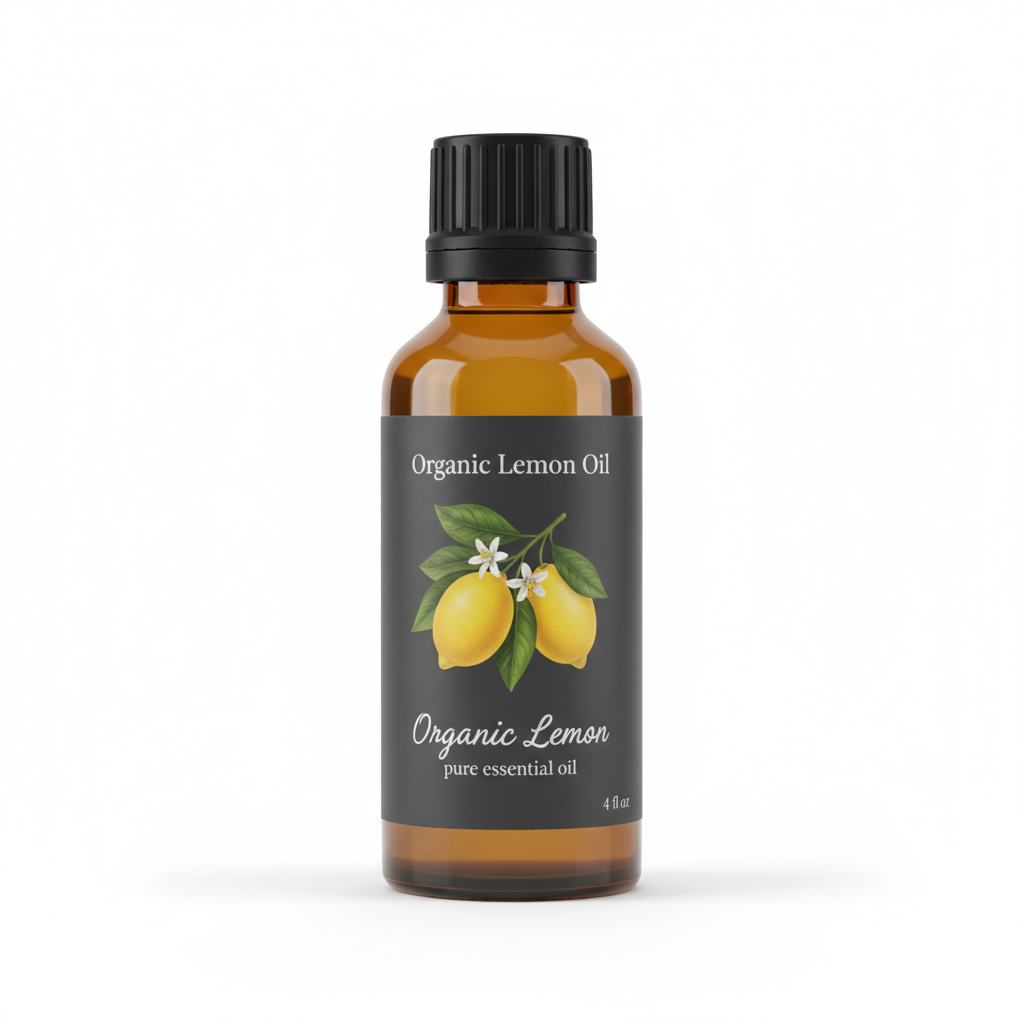
Organic Lemon Essential Oil
Our own Organic Lemon Essential Oil, in sizes from 0.5 oz to bulk.
From $15.99
Shop Now →The label words, decoded
| Label word | Where it is defined | What it does not tell you |
|---|---|---|
| "Therapeutic grade" | The FDA and FTC pages and the federal regulations read for this article contain no definition or grade scale for it. FDA says a product's category is set by its intended use, read from "claims made in the labeling" and similar material | Any measured quality. It is a phrase sellers use, and under FDA's reading it works as a claim about use |
| "Food grade" | 21 CFR 182.1(b): substances added to food should be "of appropriate food grade" and handled as food ingredients | That a given bottle meets it. The rule describes how a food ingredient is made and handled, not a status a seller can print on a skin-care oil |
| "GRAS" (generally recognized as safe) | 21 CFR 182.20 lists lemon, Citrus limon (L.) Burm. f., among essential oils, oleoresins and natural extractives generally recognized as safe "for their intended use" | Anything about swallowing a bottle of neat oil. The listing attaches to an intended use in food |
| "Organic" | 7 CFR 205.100: operations that produce or handle agricultural products "sold, labeled, or represented as" organic must be certified | A grade of flavour, a food-use status, or a safety level. It is a production-and-handling certification |
The FDA page on GRAS (current as of 10 August 2026) frames it this way: a substance added to food is a food additive requiring premarket approval unless it is "generally recognized, among qualified experts, as having been adequately shown to be safe", and that finding is tied to "the conditions of its intended use". The lemon listing exists because lemon oil is used at small levels as a flavouring. It is not a statement about the contents of a 0.5 oz or 16 oz bottle sold for aroma.
Why a bottle is a different thing from a flavouring
The distinction is concentration and intended use, and the first can be put in numbers from our own figures. A skin blend at the top of our range is 2% lemon oil; the bottle is 100%, fifty times that. One ounce is about 591 drops, and half an ounce about 296, of an oil that the IFRA Standard on lemon oil cold pressed caps at 2.0% in leave-on skin products because it is phototoxic. The same IFRA page adds a flavour requirement for lip and oral products (Categories 1 and 6): the material must comply with IFRA Standards and also be recognised as a flavouring ingredient under the IOFI Code of Practice. In other words, even the fragrance industry's own rulebook treats "fine for a lipstick" and "fine for a skin cream" as separate tests with separate paperwork, and does not read food status from either.
The National Capital Poison Center says some essential oils "can be poisonous if they are absorbed through the skin or swallowed", that swallowing can lead to aspiration into the lungs and pneumonia, and that children "have thin skin and immature livers, which might make them more susceptible to toxic effects than adults". Its page names pennyroyal, wintergreen and camphor, not lemon, so those are examples of the class, not a lemon-specific finding. If someone swallows an essential oil, it directs readers to its web tool or to poison control at 1-800-222-1222 (US), and says that where young children are around, old bottles are worth discarding safely and the rest must be locked up out of sight and reach of children and pets. Our copy says to keep the oil from children and pets.
What "therapeutic" is really doing on a label
FDA's cosmetic-or-drug page (current as of 11 September 2024) says whether a product is a cosmetic or a drug "is determined by a product's intended use". Its examples: a fragrance with assertions that the scent will help the consumer sleep or quit smoking meets the drug definition; a massage oil that only lubricates and scents the skin is a cosmetic, but one intended to relieve muscle pain is a drug. FDA's aromatherapy page (current as of 8 September 2023) adds that "many plants contain materials that are toxic, irritating, or likely to cause allergic reactions" and that all cosmetic ingredients "must meet the same safety requirement, regardless of their source."
The FTC's Health Products Compliance Guidance (December 2022) says health claims need "competent and reliable scientific evidence", generally "randomized, controlled human clinical testing", and that implied claims count: marketers should "consider what express and implied messages consumers are likely to take" from an ad. Reading those together is our inference, not a quoted rule: "therapeutic grade" has no grade scale behind it, yet it implies a health use, and a health use is exactly what FDA and FTC ask a seller to substantiate. That is why we do not use the phrase, and why our pages carry the statement that the oil is not intended to diagnose, treat, cure or prevent any disease.
What to check instead, in order
- The Latin name. Citrus limon on our product page and certificate. Lemon-scented oils from other plants (lemongrass, lemon balm, lemon eucalyptus) are different materials; see the look-alike comparison.
- The extraction. Cold-pressed from the peel is what our certificate lists. Distilled and furocoumarin-free lemon oils are separate materials, and we do not offer a furocoumarin-free lemon.
- The batch paperwork, and what it shows. The certificate of analysis we publish for one batch (LEMFBACLARO001A) lists botanical name, peel, appearance, a relative density of 0.849 (stated standard 0.840 to 0.855), refractive index 1.474 (1.473 to 1.477) and optical rotation +67.80 degrees (+57.0 to +78.0). It does not list a composition analysis, a residue panel, a peroxide value or any food-use data. A buyer who needs any of those should ask for it in writing before ordering and keep the answer in writing.
- The organic certificate. The shop describes the oil as certified organic. A buyer who needs that for a purchase should ask in writing for the certificate number before ordering; the organic certification article covers what the scheme does and does not mean.
- The intended-use statement. Ours says do not take internally. Whatever a label says, that statement is what the seller will stand behind.
If what you want is a lemon flavour in food or drink, that is a different product with its own label and a manufacturer that has accepted responsibility for that use, sold in grocery and baking-supply shops. It is not ours, and we give no instructions for using our oil that way; the ingestion article and the lemon-oil-in-water article take the question further. For a question about a medicine or a medical condition, ask a pharmacist or physician. For the dilution and sun rules on skin, see the safety basics.
A label word is a claim to be checked against paperwork and a stated intended use, and on our bottle the intended use is aroma and skin use at dilution, never swallowing.
Organic Lemon Essential Oil
Organic Lemon Essential Oil from our own shop, in sizes from 0.5 oz to bulk.
From $15.99
Shop Now →Sources & Further Reading
- US Code of Federal Regulations, 21 CFR 182.1. Substances that are generally recognized as safe. law.cornell.edu/cfr/text/21/182.1
- US Code of Federal Regulations, 21 CFR 182.20. Essential oils, oleoresins (solvent-free), and natural extractives (including distillates). law.cornell.edu/cfr/text/21/182.20
- FDA, 2026. Generally Recognized as Safe (GRAS). fda.gov/gras
- FDA, 2024. Is It a Cosmetic, a Drug, or Both? (Or Is It Soap?). fda.gov/cosmetics
- FDA, 2023. Aromatherapy. fda.gov/aromatherapy
- Federal Trade Commission, 2022. Health Products Compliance Guidance. ftc.gov/health-products-compliance-guidance
- US Code of Federal Regulations, 7 CFR 205.100. What has to be certified. law.cornell.edu/cfr/text/7/205.100
- IFRA, 2023. IFRA Standards, 51st Amendment (Lemon oil cold pressed, 2020, including its flavor requirements). ifrafragrance.org/51st-amendment
- National Capital Poison Center. Essential oils: Poisonous when misused. poison.org/articles/essential-oils