Can You Ingest Lemon Essential Oil? What GRAS Does Not Mean
No. Our oil is labelled not for internal use, and the sources read for this page give no reason to treat that label as over-cautious. The question comes up because two true statements sit close together: lemon oil appears on a US government list of flavouring substances, and lemon is an ordinary kitchen ingredient. Neither makes a neat bottle of essential oil something to swallow. This page reads the text behind the list, then what poison-centre data report, and ends with what to do after a swallow.
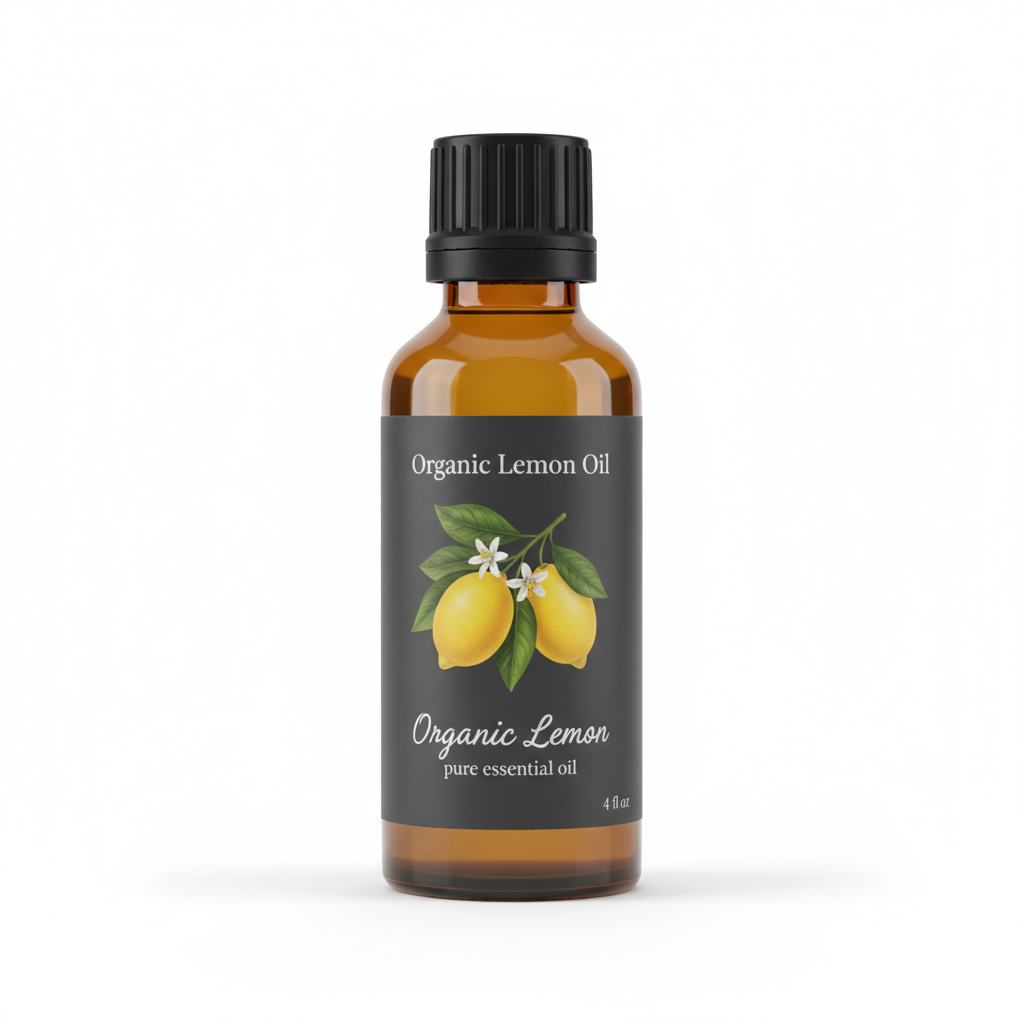
Organic Lemon Essential Oil
Our own Organic Lemon Essential Oil, in sizes from 0.5 oz to bulk.
From $15.99
Shop Now →What the flavouring list says, and what it does not
Title 21 of the Code of Federal Regulations, section 182.20, is headed "Essential oils, oleoresins (solvent-free), and natural extractives (including distillates)". Its opening sentence names substances that are "generally recognized as safe", qualified by the words "for their intended use", within the meaning of section 409 of the Act. The list includes an entry with the common name "Lemon" and the botanical name Citrus limon (L.) Burm. f. The source note shown on that page runs from 42 FR 14640 (15 March 1977) through amendments up to 50 FR 21043 (22 May 1985).
Two phrases carry the weight: "intended use" and "food". FDA's own GRAS page (current as of 10 August 2026 when read) says the safety finding applies "under the conditions of its intended use", and describes the basis as either scientific procedures or, for substances used in food before 1958, common use in food. The page makes no statement that a substance is acceptable in any amount or form. The general rule in section 182.1 goes further: good manufacturing practice includes that "the quantity of a substance added to food does not exceed the amount reasonably required" to accomplish its intended technical effect in food.
Read together, the entry means something narrow: lemon oil, used in food at a flavouring quantity, has this regulatory status. It is not a statement about a dropper of undiluted oil, about drinking it, or about any product sold for another purpose. Our own position follows from the label, not from a reading of the CFR: we sell no food-grade or flavour-labelled lemon oil, and our copy says not to take the oil internally. The planned post on what grade labels mean covers the label vocabulary.
The arithmetic of a bottle
A flavouring is a trace; a bottle is a stock. The batch on our published certificate of analysis has a measured relative density of 0.849 (stated range 0.840 to 0.855), so 1 ml weighs about 0.849 g. At about 20 drops per ml (droppers vary; weighing is more reliable), one drop is roughly 0.042 g, or 42 mg. A 0.5 oz bottle holds about 14.8 ml, or about 296 drops, which is about 12.6 g.
Why those numbers matter: the authors of an Australian poison-centre study (below) state that "as little as 5 mL" of essential oil can cause life-threatening toxicity in children. Using our density, 5 ml is about 4.2 g, or about 100 drops, roughly one third of a 0.5 oz bottle. That figure is from a study dominated by other oils (eucalyptus and tea tree), so it is a warning about the category and the container size, not a measured threshold for lemon oil. It is also the reason a small bottle on a low shelf is a real exposure risk, and the reason this page says to keep it from children, as our safety copy does.
| Quantity | Weight at 0.849 g/ml | Approximate drops |
|---|---|---|
| 1 drop | about 0.042 g | 1 |
| 1 ml | about 0.85 g | about 20 |
| 5 ml | about 4.2 g | about 100 |
| 0.5 oz (14.79 ml) | about 12.6 g | about 296 |
What poison-centre records report
The most useful dataset the search found is a research letter by Lee, Harnett and Cairns in the Medical Journal of Australia (2020; 212(3): 132-133, published online 9 December 2019). It is a retrospective review of calls to the NSW Poisons Information Centre between July 2014 and June 2018. It is Australian data and covers essential oils as a group. What it reported:
- 4,412 essential oil exposures; 1,387 callers (31%) had symptoms at the time of the call.
- 2,790 exposures (63%) involved people under 15; toddlers aged 1 to 4 accounted for 2,179 (49.4%).
- The most frequent oils were eucalyptus (46.4%), tea tree (17.0%), lavender (6.1%), clove (4.1%) and peppermint (3.5%). The article text read for this page does not mention lemon or citrus oils, so it says nothing specific about lemon.
- 580 cases (13%) were therapeutic errors, typically an oil mistaken for a liquid medicine; the most common mix-up was with cough liquid (84 cases).
- Hospital referral occurred in 365 cases (8.3%). The letter lists clinical effects from the background literature as vomiting, central nervous system depression or excitation, and aspiration pneumonitis.
- The authors counted 105 cases (2.4%) of misinformed misuse in the text, while their Box 2 lists 192 intentional exposures (4.4%). The two figures do not match in the letter as read, so both are given here.
What it did not show: it does not report a lemon-specific outcome, a dose-response relationship, or how many people swallowed versus got oil on skin. A call to a poison centre records an exposure, not a diagnosis. The letter's recommendations are practical: keep oils apart from oral medicines, and fit flow restrictors and child-resistant closures, noting that closures are only required above 15 mL.
The US Poison Control article on essential oils (undated page) adds a mechanism relevant to any thin oil: choking on a swallowed oil can send it into the lungs and cause pneumonia. Its named examples are pennyroyal, wintergreen and camphor, not lemon, and it gives no national call counts. It gives the US help line as 1-800-222-1222, described as free, confidential and open 24 hours.
Where the "take it internally" idea gets its footing
Marketing that pairs a bottle with an ingestion instruction is a regulatory question as well as a safety one. FDA's aromatherapy page (updated 8 September 2023) says how a product is regulated "depends mainly on how [it is] intended to be used", judged from labelling, websites and advertising. FDA gives claims about easing pain, depression, anxiety or sleep as examples of drug claims, and the page adds that coming from a plant does not stop an ingredient being regulated as a drug. The page does not discuss swallowing essential oils at all. That is why this page makes no claim that lemon oil does anything for the body when swallowed, and why our product pages carry the FDA statement and "We make no medical claims for it."
Studies on other materials are often borrowed into this argument, so it helps to keep them apart. Work on lemon juice, on isolated limonene in rodents, or on lemon fragrance inhaled in a room says nothing about swallowing a bottled essential oil. The detox fact check goes through what the literature search found on that point.
If someone has swallowed it
In the US, poison.org says to use its online tool or call 1-800-222-1222, both free and confidential, and to call 911 if the person "collapses, has a seizure, has trouble breathing or can't be awakened". Keep the bottle to hand to read out the label and size. In the UK, the NHS poisoning page (reviewed 12 June 2025) says to call 999 or go to A&E if someone may have swallowed something harmful, and to call 111 if unsure. It also says not to try to make someone sick (they could choke) and not to give them anything to eat or drink, and that symptoms may take a few hours or days to start. Elsewhere, use the national poison help line. A pharmacist can answer questions about a particular medicine; a physician decides about symptoms. This page cannot replace either.
What we recommend instead
Use the oil the way our copy describes: diluted in a carrier for the skin after a patch test, away from the eyes, children and pets, in a capped bottle in a cool, dark place. The safety basics post and the FAQ cover those points. Shoppers who want lemon flavour in food should buy a product labelled for food from a grocery or a baking supplier, and should not use a bottle of aroma oil as a substitute. If a seller asks you to swallow an essential oil, ask in writing which authority supports that use for that product.
The short version: the list entry is about flavouring in food, the study data are about what goes wrong with small volumes, and our bottle says not to take it internally. We hold to that.
Organic Lemon Essential Oil
Organic Lemon Essential Oil from our own shop, in sizes from 0.5 oz to bulk.
From $15.99
Shop Now →Sources & Further Reading
- US Code of Federal Regulations, Title 21, section 182.20 (Essential oils, oleoresins (solvent-free), and natural extractives). law.cornell.edu/cfr/text/21/182.20
- US Code of Federal Regulations, Title 21, section 182.1 (Substances that are generally recognized as safe). law.cornell.edu/cfr/text/21/182.1
- FDA, 2026 (page current at reading). Generally Recognized as Safe (GRAS). fda.gov/food/food-ingredients-packaging/generally-recognized-safe-gras
- FDA, 2023. Aromatherapy. fda.gov/cosmetics/cosmetic-products/aromatherapy
- Lee KAYR, Harnett JE, Cairns R, 2020. Essential oil exposures in Australia: analysis of cases reported to the NSW Poisons Information Centre. Med J Aust 212(3):132-133. mja.com.au/journal/2020/212/3
- Poison Control (poison.org), undated. Home page, when to call 911 and the help line number. poison.org
- NHS, 2025. Poisoning. nhs.uk/conditions/poisoning
- Poison Control (undated). Essential oils. poison.org/articles/essential-oils