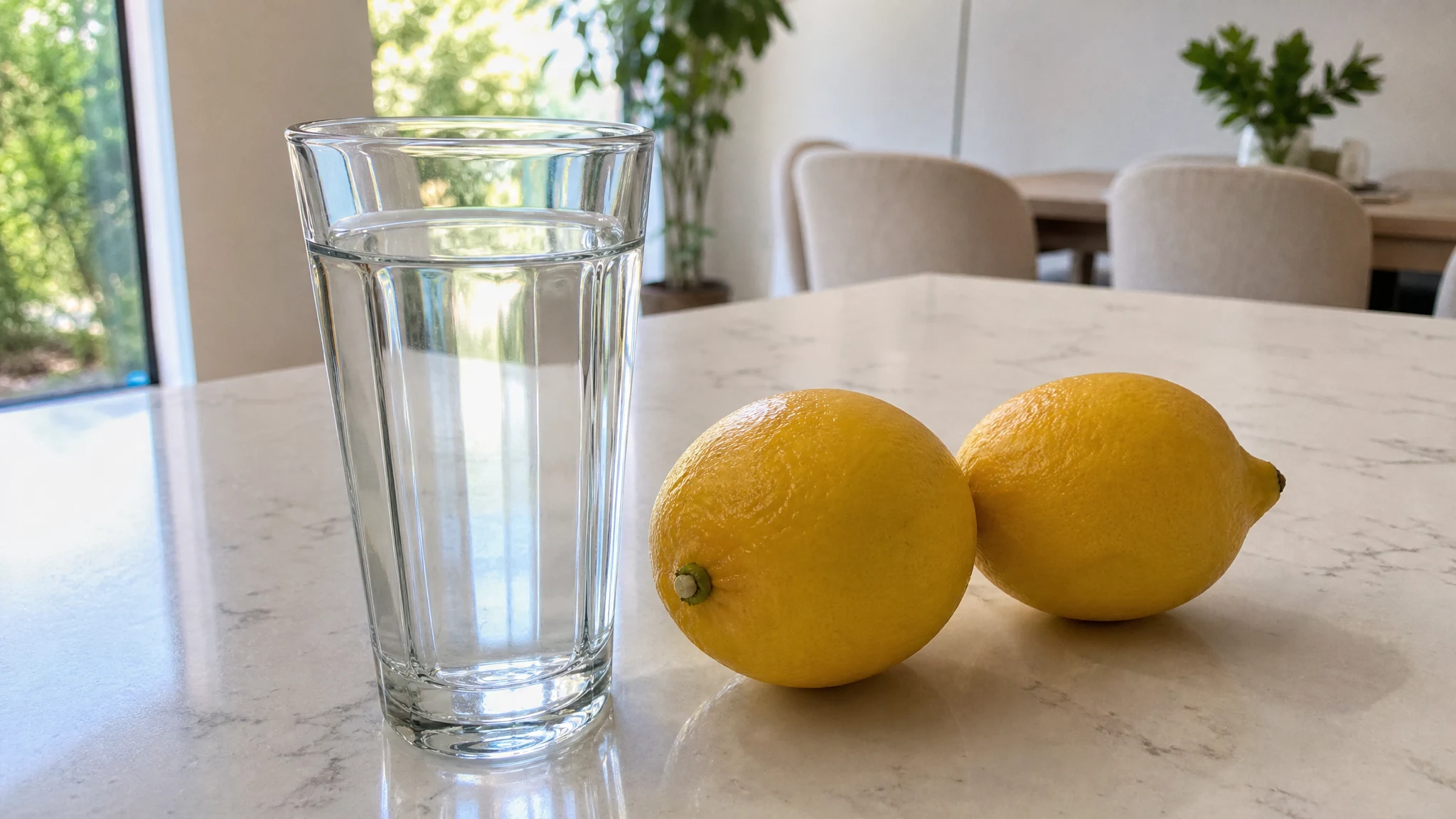
Lemon Essential Oil in Water: Why the Trend Does Not Work
Put a drop of lemon oil in a glass of water and it does not disappear into the water. It floats as a slick, and the first part of you it meets is your lips and mouth. That is the plain physical objection to the habit of dropping essential oil into drinking water, and it holds before any toxicology is brought in. Our oil is labelled not for internal use, and we do not suggest putting it in water or any drink.
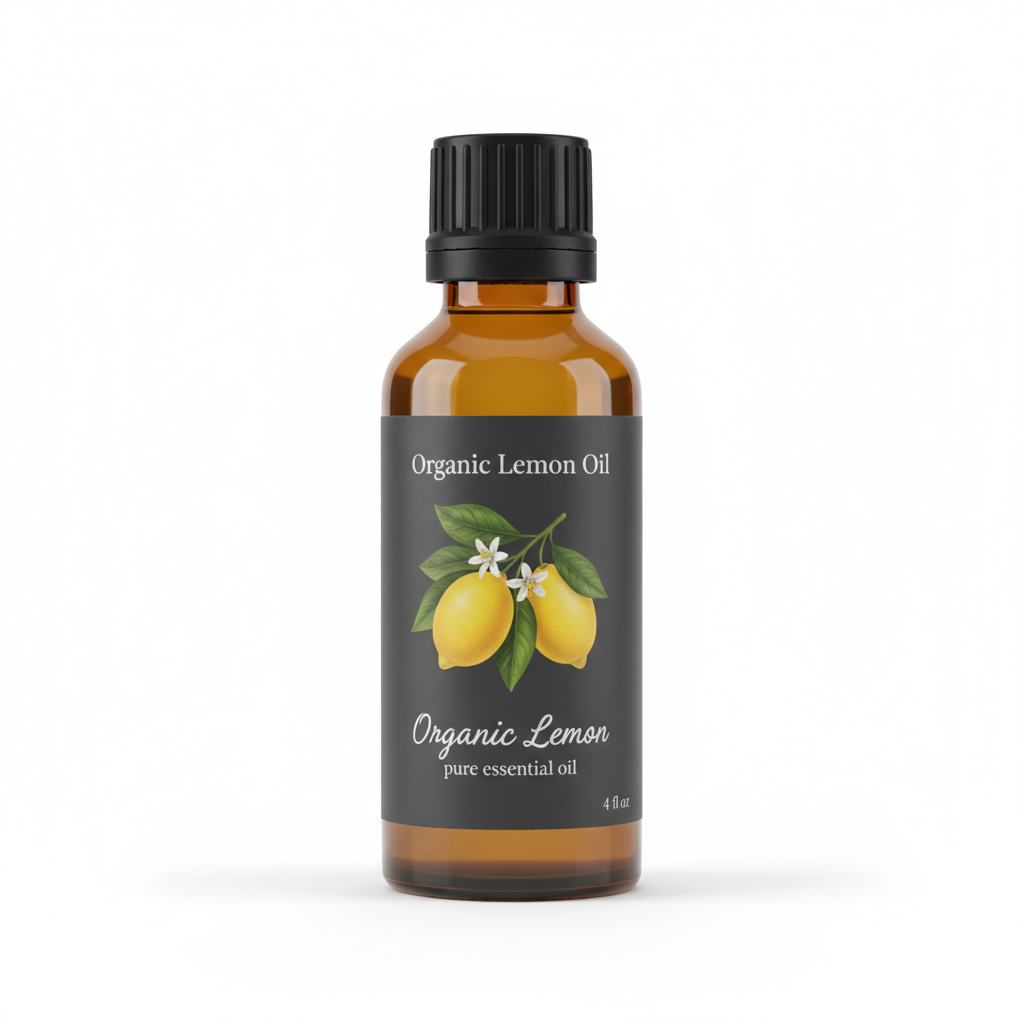
Organic Lemon Essential Oil
Our own Organic Lemon Essential Oil, in sizes from 0.5 oz to bulk.
From $15.99
Shop Now →What happens to one drop in one glass
Oil and water separate because lemon oil is mostly limonene, a hydrocarbon. The PubChem record for limonene, which cites a 2000 measurement by Miller and Hawthorne in the Journal of Chemical & Engineering Data, gives its solubility in water as 7.57 mg per litre at 25 C. That is the figure for pure limonene, used here as a stand-in for the main component of a mixture; other components of lemon oil dissolve to different degrees, so treat what follows as an order of magnitude, labelled reasoning, not a measurement of our oil.
The arithmetic. The batch on our published certificate of analysis has a relative density of 0.849 (stated range 0.840 to 0.855), below the 1.0 g/ml of water, which is why the oil floats. At about 20 drops per ml, one drop weighs about 0.042 g, or 42 mg. A 250 ml glass at the limonene saturation figure can hold at most 7.57 mg/L x 0.25 L = about 1.9 mg. If a drop were all limonene, then at most about 4.5% of it could dissolve (1.9 / 42). The rest stays as undissolved oil, in droplets or on the surface. Stirring breaks the oil into smaller droplets; it does not make it dissolve.
| Quantity | Figure | Basis |
|---|---|---|
| One drop of oil | about 42 mg | 0.849 g/ml at about 20 drops/ml (droppers vary) |
| Limonene dissolved at saturation in 250 ml water | about 1.9 mg at most | 7.57 mg/L at 25 C, PubChem |
| Share of one drop that could dissolve | about 4.5% at most | reasoning, if the drop were all limonene |
Why the mouth matters first
Robert Tisserand, co-author of the standard safety reference on essential oils, gave two reasons against drinking oil in water in a 2014 radio interview, transcript posted 9 August 2015. The first: oils do not dissolve in water, so they are unevenly dispersed. The second, as the transcript reads: droplets floating in the stomach can irritate its sensitive mucous membranes. This is a practitioner's statement in an interview, not a trial. The same interview says that oral essential-oil use by doctors exists in a small number of French practices. The distinction he draws is between clinician-directed oral use and drinking oil in water at home, and the source does not extend the first to the second.
Reasoning from the physics above, a floating slick is the part of the drink that touches the lips and mouth, and the oil has not been diluted by the water at that point. This is inference, with no direct study behind it in the sources read.
The foam cup claim, checked
The trend comes with a corollary: do not use a foam or plastic cup. Part of that has a documented basis. A Matsushita patent granted 13 May 1997 (US 5,629,352, inventors Shiino, Nobuta and Onishi) is titled "Solvent for polystyrene, method for reducing volume of polystyrene foam and method for recycling polystyrene foam". It describes d-limonene as having "an excellent ability for dissolving the polystyrene foam", and notes a low flash point of 47 C. Two limits apply. The patent gives no quantities for dissolving performance, and it concerns liquid d-limonene used as a recycling solvent, not drops of lemon oil in a drink. Whether a few drops marks or weakens a foam cup, and how fast, is not answered by anything the search found.
The search found no source on lemon oil and hard plastic drink bottles, so no claim is made about them. If you have a particular item (a bottle, a diffuser tank, a lacquered surface) the manufacturer's chemical-resistance chart for that exact plastic is the authority, not a forum.
What poison-centre data say about the category
Lee, Harnett and Cairns reviewed calls to the NSW Poisons Information Centre from July 2014 to June 2018 in the Medical Journal of Australia (2020; 212(3): 132-133). They counted 4,412 essential oil exposures, with 1,387 callers (31%) symptomatic, and 63% of exposed people under 15. The oils named most often were eucalyptus, tea tree and lavender; the letter as read does not mention lemon or citrus oils. The authors write that "as little as 5 mL" can cause life-threatening toxicity in children. At our density 5 ml is about 4.2 g, or about 100 drops. It is an Australian, all-oil figure, not a lemon-specific threshold. The letter lists vomiting, central nervous system effects and aspiration pneumonitis among clinical effects, and does not give a breakdown by route (swallowed or otherwise).
The US Poison Control article on essential oils (undated) warns that choking on a swallowed oil can send it into the lungs and cause pneumonia; it names pennyroyal, wintergreen and camphor, not lemon. A glass of water does not remove that mechanism: the oil layer is still the first thing to reach the mouth.
Why "a flavour-labelled product" is a different thing
People point out that lemon oil is on a US flavouring list. The companion post reads that text: FDA's GRAS page ties the finding to "the conditions of its intended use", which for a flavouring means a measured trace added to food. A bottle sold for aroma, cleaning or craft use has a different intended use and a different label. We sell no food-grade or flavour-labelled lemon oil. If you want lemon in a drink, buy something labelled for food and follow its label; an aroma bottle is not that product.
Claims attached to drinking oil raise a second question. FDA's aromatherapy page (updated 8 September 2023) says a product's regulatory category depends mainly on intended use, judged from labelling, websites and advertising, and that a plant origin does not keep an ingredient from being regulated as a drug. A seller who tells you to drink an oil for a health purpose is stepping outside the cosmetic and aroma category. Our pages make no such claim.
If it has happened
US readers: poison.org says to use its online tool or call 1-800-222-1222, and to call 911 if the person "collapses, has a seizure, has trouble breathing or can't be awakened". The NHS poisoning page (reviewed 12 June 2025) says to call 999 or go to A&E if someone may have swallowed something harmful, to call 111 if unsure, not to try to make the person sick, and not to give them anything to eat or drink. For questions about a specific medicine, ask a pharmacist; for symptoms, a physician.
For the skin and room uses our copy does describe, see the safety basics and the FAQ. The question of whether lemon oil does anything for detox is separate and has its own fact check.
In short: the oil does not dissolve, the first contact is the mouth, one source documents limonene dissolving polystyrene foam, and our label says not to take it internally.
Organic Lemon Essential Oil
Organic Lemon Essential Oil from our own shop, in sizes from 0.5 oz to bulk.
From $15.99
Shop Now →Sources & Further Reading
- PubChem, National Library of Medicine. Limonene (CID 22311), water solubility entry citing Miller DJ, Hawthorne SB, 2000, J Chem Eng Data 44:315-318. pubchem.ncbi.nlm.nih.gov/compound/22311
- Tisserand R, 2015 (transcript of a December 2014 interview). Robert Tisserand interviewed on ingestion, dilution and other safety issues. roberttisserand.com
- Shiino T, Nobuta K, Onishi H (Matsushita Electric Industrial), 1997. US patent 5,629,352, Solvent for polystyrene, method for reducing volume of polystyrene foam and method for recycling polystyrene foam. patents.google.com/patent/US5629352
- Lee KAYR, Harnett JE, Cairns R, 2020. Essential oil exposures in Australia: analysis of cases reported to the NSW Poisons Information Centre. Med J Aust 212(3):132-133. mja.com.au/journal/2020/212/3
- Poison Control (undated). Essential oils. poison.org/articles/essential-oils
- Poison Control (undated). Home page: when to call 911, help line. poison.org
- NHS, 2025. Poisoning. nhs.uk/conditions/poisoning
- FDA, 2026 (page current at reading). Generally Recognized as Safe (GRAS). fda.gov/food/food-ingredients-packaging/generally-recognized-safe-gras
- FDA, 2023. Aromatherapy. fda.gov/cosmetics/cosmetic-products/aromatherapy