
Lemon Oil for Stress and Anxiety: An Evidence Review
The search found four human trials of lemon oil with an anxiety outcome, and two reported lower anxiety while two did not. That is 222 participants in total across four very different settings, set against pooled reviews that cover dozens of trials and mostly other oils. This article goes through the trials one at a time, separates the orange and lavender dental-office work from lemon, labels the animal studies, and ends with the thresholds at which worry is a matter for a physician or licensed therapist. Nothing here is a stress or anxiety claim for this shop's lemon oil.
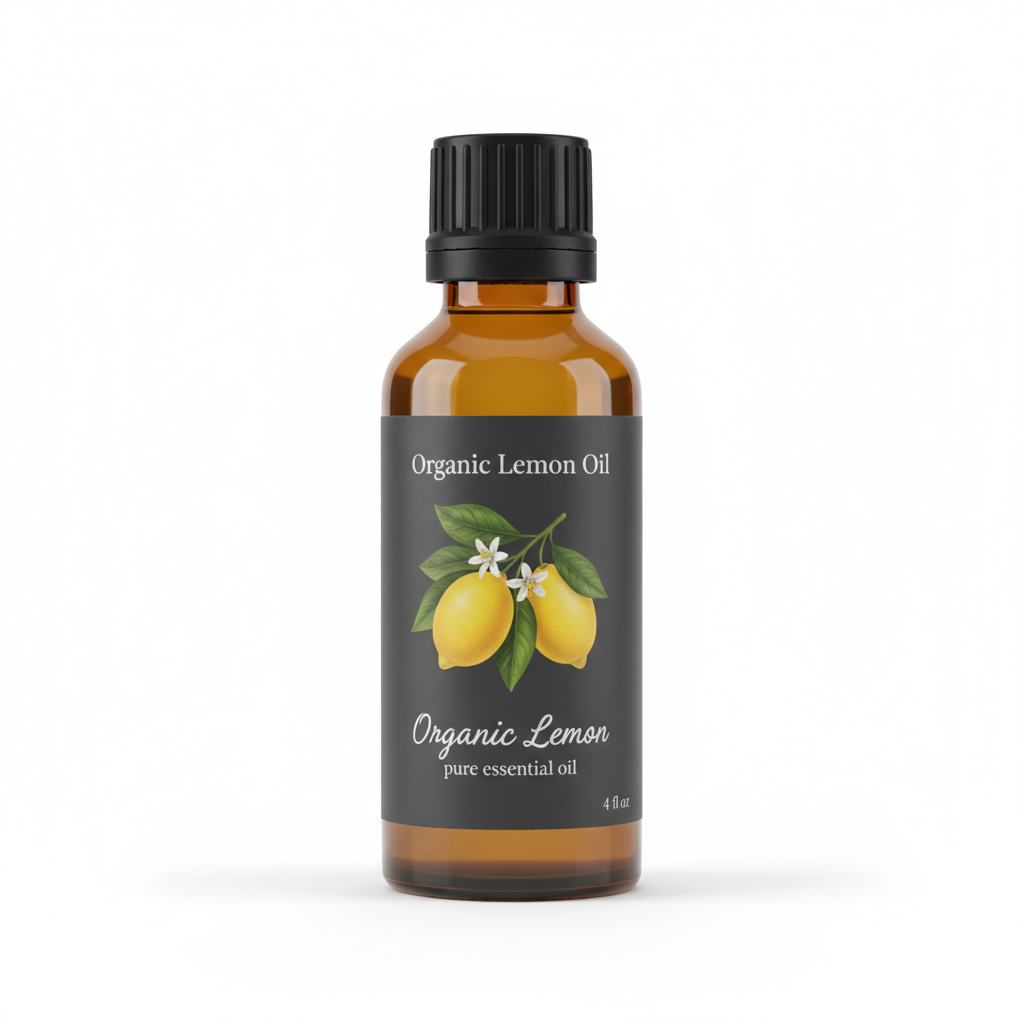
Organic Lemon Essential Oil
Our own Organic Lemon Essential Oil, in sizes from 0.5 oz to bulk.
From $15.99
Shop Now →The four lemon trials side by side
| Trial | Who and what | Anxiety result as reported |
|---|---|---|
| Johnson, 2019 | 31 nursing students; lemon oil inhaled through a personal nasal device around a high-stakes exam; Cognitive Test Anxiety Scale | No statistically significant change in either group (P = .19) |
| Rambod et al., 2020 | 100 patients with acute myocardial infarction; lemon inhalation for three days against a paraffin control; assessor-blinded | Anxiety and heart rate differed between groups on day 4; no p-values in the abstract |
| Özer et al., 2022 | 46 first-year nursing students (22 lemon, 24 control); 15 minutes of smelling the oil; two test-anxiety scales | Lower post-test scores than controls; authors state a 43.3% reduction without saying how it was calculated; between-group p-values not in the abstract |
| Sirkeci et al., 2023 | 45 first-time mothers in labor, 15 per group: lemon, ylang-ylang, control | No significant difference in state anxiety (P = 0.750 and 0.663) or trait anxiety (P = 0.094); labor pain was lower in both oil groups (P = 0.005) |
Sources: Johnson, 2019; Rambod et al., 2020; Özer et al., 2022; Sirkeci et al., 2023. The arithmetic is 31 + 100 + 46 + 45 = 222. The search was a title-keyword search of PubMed, so other lemon trials may exist, and the abstracts, which were what the search read, leave out details of blinding and analysis.
Look at what the positive ones cannot say. Özer's 43.3% is a relative reduction from a baseline, in 46 students, with the abstract not describing what the control group did during the 15 minutes. Rambod's design is stronger on blinding of the assessor, but the patients were having a heart attack, and only day 4 is named for the anxiety result. The null ones are just as small: Johnson's 31 students and Sirkeci's 15 per group could miss a modest effect. One honest reading is mixed, with low certainty either way. A second honest reading is that the setting (an exam, a heart attack, labor) changes the answer so much that four trials cannot be pooled by eye.
The dental-office studies are about orange and lavender
A common route to a "citrus calms anxiety" headline runs through Lehrner and colleagues (2005): 200 dental patients aged 18 to 77, four groups (ambient orange odor, ambient lavender odor, music, and a no-odor, no-music control), assessed while waiting for treatment. Compared with control, both orange and lavender reduced anxiety and improved mood (Lehrner et al., 2005). Lemon was not studied. Orange and lemon share a citrus label, but a different oil is a different material, and a different oil's result does not transfer.
What the pooled reviews cover
Lee and colleagues (2011) reviewed 16 randomized trials from 1990 to 2010 in people with anxiety symptoms; most reported anxiety-reducing effects, no adverse events were reported, and the authors asked for better methodological quality (Lee et al., 2011). Gong and colleagues (2020) meta-analyzed 25 articles covering 32 trials to October 2019 and reported a weighted mean difference of -5.16 on the state anxiety inventory (95% CI -5.78 to -4.55) and -2.85 on trait anxiety (95% CI -3.95 to -1.75), with the authors saying that the proper essential-oil dosage needs further research (Gong et al., 2020). Neither abstract names the oils, participant totals or a formal bias assessment, so neither can be read as a statement about lemon. In a pregnancy-focused meta-analysis, the oils named for the anxiety result were Citrus aurantium, rose, mint and orange blossom, and lemon was not among them (Mascarenhas et al., 2025).
The reasonable reading, labelled as reasoning: aroma as a category is associated with lower self-rated anxiety in many small trials, and the oil-specific evidence for lemon is thin and mixed. A pooled number across mixed oils is not a measurement of one bottle.
Physiology and animals are separate questions
Kiecolt-Glaser and colleagues (2008) gave 56 healthy adults lavender, lemon and water on three visits and found that lemon raised self-rated positive mood while salivary cortisol, IL-6, IL-10, heart rate and blood pressure showed no reliable change; norepinephrine stayed higher after the stressor with lemon (abstract). NCCIH, on a page updated in January 2020, summarizes it this way: lemon "had a positive effect on mood," but neither scent affected stress indicators (NCCIH, 2020). The mood results are on the mood and energy page.
In mice, Komiya, Takeuchi and Harada (2006) reported that lemon oil vapor had the strongest anti-stress effect of lavender, rose and lemon across three behavioral tests, with effects blocked by a benzodiazepine-receptor antagonist and a dopamine agonist (Komiya et al., 2006). In rats exposed to lemon oil odor for two weeks, Ceccarelli and colleagues (2004) reported less open-arm time on the elevated plus-maze, higher pain thresholds and lower corticosterone (Ceccarelli et al., 2004). Those are rodent studies with different exposures, and nothing in them concerns people smelling a room scent or using lemon oil on skin. The same goes for cell and lemon-juice studies, which are further removed still.
When worry needs a professional
NIMH describes anxiety disorders as anxiety that "does not go away, is felt in many situations, and can get worse over time," and says it can interfere with work, school and relationships. For generalized anxiety disorder, NIMH describes difficulty controlling worry on most days for at least 6 months, with at least three symptoms from a list that includes restlessness, fatigue, trouble concentrating, irritability, muscle tension and sleep problems, and says it is time to seek professional help when anxiety begins to cause problems in daily life (NIMH, GAD). The NHS gives no numeric cutoff: see a GP if you think you might have it or treatment is not helping, and adults in England can self-refer to NHS talking therapies; its page does not mention aromatherapy (NHS, GAD). NIMH's main page gives 988 (call or text) for anyone struggling or having thoughts of suicide, and 911 in a life-threatening situation (NIMH). The person to ask is a physician or a licensed therapist.
Where this shop stands
The FDA regulates aromatherapy products by intended use, judged from labeling, websites and advertising, and lists claims such as treating depression or anxiety among drug claims (FDA, aromatherapy). We sell one lemon oil, neat, as a scent material. We make no medical claim for it, we sell no remedy, and our copy says do not take it internally and keep it from children and pets. A bright citrus smell in a room is a pleasure some people enjoy; it is not a treatment for worry.
For a plain reading of every claim in circulation see benefits, honestly; for what the smell actually is, the smell guide; and for skin, children and sunlight, the safety article.
Organic Lemon Essential Oil
Organic Lemon Essential Oil from our own shop, in sizes from 0.5 oz to bulk.
From $15.99
Shop Now →Sources & Further Reading
- Johnson, 2019. Effect of inhaled lemon essential oil on cognitive test anxiety among nursing students. pubmed.ncbi.nlm.nih.gov/30747778
- Rambod et al., 2020. Lemon inhalation aromatherapy in acute myocardial infarction patients. pubmed.ncbi.nlm.nih.gov/32379635
- Özer et al., 2022. Effectiveness of lemon essential oil in reducing test anxiety in nursing students. pubmed.ncbi.nlm.nih.gov/35190270
- Sirkeci et al., 2023. The effect of ylang oil and lemon oil inhalation on labor pain and anxiety. pubmed.ncbi.nlm.nih.gov/37054616
- Lehrner et al., 2005. Ambient odors of orange and lavender reduce anxiety and improve mood in a dental office. pubmed.ncbi.nlm.nih.gov/16095639
- Lee et al., 2011. A systematic review on the anxiolytic effects of aromatherapy in people with anxiety symptoms. pubmed.ncbi.nlm.nih.gov/21309711
- Gong et al., 2020. Effects of aromatherapy on anxiety: a meta-analysis of randomized controlled trials. pubmed.ncbi.nlm.nih.gov/32663929
- Mascarenhas et al., 2025. Effectiveness of aromatherapy on physiological and psychological symptoms during pregnancy. pubmed.ncbi.nlm.nih.gov/41192533
- Kiecolt-Glaser et al., 2008. Olfactory influences on mood and autonomic, endocrine, and immune function. pubmed.ncbi.nlm.nih.gov/18178322
- NCCIH, 2020. Aromatherapy. nccih.nih.gov/health/aromatherapy
- Komiya, Takeuchi and Harada, 2006. Lemon oil vapor causes an anti-stress effect via modulating the 5-HT and DA activities in mice. pubmed.ncbi.nlm.nih.gov/16780969
- Ceccarelli et al., 2004. Effects of long-term exposure of lemon essential oil odor in male and female rats. pubmed.ncbi.nlm.nih.gov/14972656
- NIMH. Generalized anxiety disorder. nimh.nih.gov/health/publications/generalized-anxiety-disorder-gad
- NIMH. Anxiety disorders. nimh.nih.gov/health/topics/anxiety-disorders
- NHS. Generalised anxiety disorder in adults. nhs.uk/mental-health/conditions/generalised-anxiety-disorder
- FDA. Aromatherapy. fda.gov/cosmetics/cosmetic-products/aromatherapy