Lemon Oil for Cuticles: Dilution Math and a 10 g Oil
A cuticle oil is a carrier oil with, at most, a drop of lemon in it, and the lemon is the optional part. For 10 g of oil (about 0.35 oz), one drop of our oil works out to roughly 0.4%, which sits below the bottom of the 0.5% to 2% range in our own skin copy. The reason is that cuticles are on the hands, the most sun-exposed skin most people have, and cold-pressed lemon oil is phototoxic. This page does the arithmetic, reports what is and is not known about lemon oil on nails, and says when the problem is one for a dermatologist rather than a bottle.
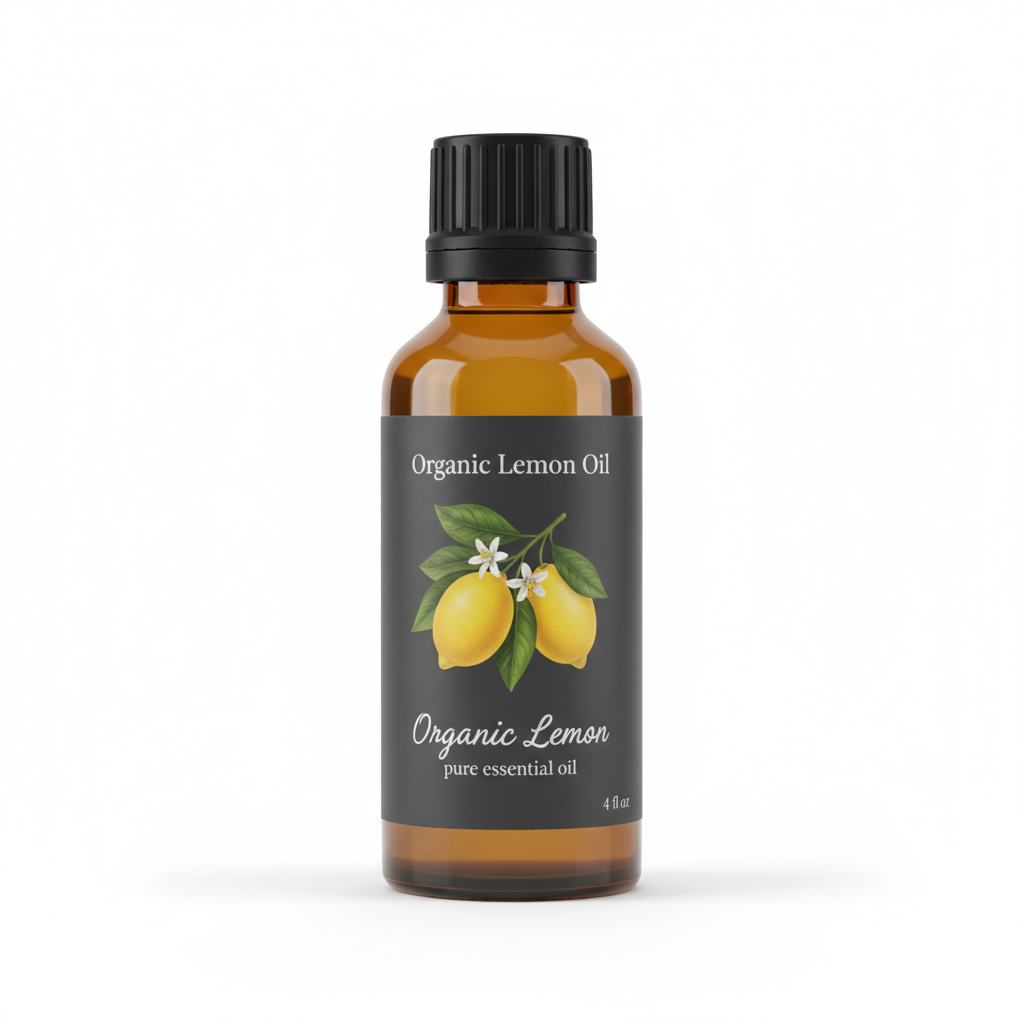
Organic Lemon Essential Oil
Our own Organic Lemon Essential Oil, in sizes from 0.5 oz to bulk.
From $15.99
Shop Now →Decide first: does the problem need an oil at all?
The American Academy of Dermatology (AAD) advises against removing the cuticle: "Do not bite fingernails or remove the cuticle," because doing so can damage the nail (AAD, 11 dermatologists' tips for healthy nails). Its manicure page goes further: to prevent infection, never cut or forcefully push back the cuticles, and if they must be pushed back, do it gently after a shower or bath (AAD, manicure and pedicure safety). The first fix for ragged cuticles is therefore to stop trimming them, not to buy anything.
The tips page also says to moisturize after hand washing. Nothing on the two pages read for this article calls for a particular oil, or for lemon. The same AAD tips page says that if nails change, swell or cause pain, the person should see a dermatologist, and that anyone with diabetes or poor circulation should be especially quick to seek care for any nail problem. A swollen, red or painful nail fold is outside what a home oil is for.
What exists on lemon oil and nails
A PubMed search run on 28 October 2026 for "lemon oil", "lemon essential oil" or "Citrus limon" in the title or abstract, combined with nail, nails or cuticle, returned six records. Reading their titles, none concerns human nails: they cover leaf gas exchange, a biomimetic coating for lemon fruit, a root-knot nematode, citrus leafminer feeding, and two 1993 plant-physiology papers on leaf cuticles. The plant cuticle is a different structure from the one on a finger. The honest summary is that no study found tests lemon oil on nails or on the skin around them, so there is no evidence on nail strength, growth or appearance to report, and this page makes no such claim. Under US law a product's intended use decides whether it is a cosmetic or a drug, and disease claims put it on the drug side (FDA, content current as of 11 September 2024), and we sell no nail product of any kind.
The limit, and why the recipe sits below it
The IFRA Standard for "Lemon oil cold pressed" (Amendment 49, 2020, carried in the 51st Amendment compilation) sets a maximum of 2.0% in the finished product for most leave-on categories, and the driver is phototoxicity. IFRA's Guidance lists "nail care products including cuticle creams" under Category 5C, so 2.0% is the ceiling for a cuticle oil (IFRA Standards, 51st Amendment; IFRA Guidance). The Standard adds that where the furocoumarin level is unknown the restriction applies as written. The Tisserand Institute repeats the 2% figure and calls it "the safe maximum, not a recommended amount" (Tisserand Institute, dilution).
That 2.0% equals the top of our 0.5% to 2% copy, so no authority figure found for cold-pressed lemon in this category is lower. Two other numbers are lower and matter here. Tisserand's generic dilution ranges give 0.2% to 1% for "sensitivity issues, impaired skin" and 0.5% to 1.2% for facial products. Cuticles that are cracked or recently trimmed are impaired skin, and the hands carry UV exposure all day. DermNet describes phytophotodermatitis as furanocoumarins on the skin meeting UVA, with reactions appearing about 24 to 48 hours after sun exposure and pigmentation that "may last for years"; it lists the hands and fingers among the sites (DermNet, phytophotodermatitis). Our recommendation is therefore the low end: about 0.4% or less.
The arithmetic uses the batch on the published COA: a relative density of 0.849 means 1 ml weighs about 0.849 g, and at about 20 drops per ml one drop is about 0.042 g. Droppers vary, so treat the drop count as approximate.
| Lemon oil in 10 g of carrier | Grams of oil | Drops | Where it sits |
|---|---|---|---|
| 0.2% | 0.02 g | about 0.5 | bottom of Tisserand's impaired-skin range |
| 0.42% (one drop) | 0.042 g | 1 | this page's recommendation |
| 0.5% | 0.05 g | about 1.2 | bottom of our skin copy |
| 0.85% (two drops) | 0.085 g | 2 | inside Tisserand's 0.2% to 1% range |
| 2% | 0.2 g | about 4.7 | IFRA Category 5C ceiling, top of our copy |
The formulation, and what it has not been through
Nobody here has made or tested this formulation. It is worked out from the figures above. Make a small batch, do a patch test first as our own copy says, and stop if the skin reacts.
- 10 g of jojoba oil, weighed on a kitchen scale into a small dropper bottle.
- 1 drop of our oil (about 0.042 g), which gives about 0.42% by weight. Leave it out entirely and the oil is still a cuticle oil.
- Cap, tilt to mix, label with the date, keep out of reach of children and pets, and keep it away from eyes.
Why jojoba: it is a liquid wax ester rather than a triglyceride, and a 2022 paper in BPB Reports reported that after 60 days at 60 C jojoba oil showed no change in acid value while olive oil and squalene rose, and that jojoba had the lowest peroxide and carbonyl values of the three (Tsuchimoto et al., 2022). That was a bench comparison of crude jojoba, not a test of a cuticle oil, and it matters because oxidation of the carrier is one of the ways a bottle goes off. Sweet almond oil is the other common choice, but almond is a tree nut and tree nuts are one of the nine major food allergens FDA lists (FDA, food allergies). That FDA list concerns food labels; whether topical use matters for a given person is a question for an allergist. For carrier choices more broadly, see the carrier oil guide.
We do not sell jojoba, bottles or droppers. A cosmetic-supply or craft shop will carry them; ask for plain jojoba oil with an ingredient list that names only jojoba, and read the supplier's safety data sheet and allergen statement before use.
What goes wrong
- Sun on the hands. Our own copy says cold-pressed citrus oils can raise skin's sensitivity to sunlight and to avoid sun on freshly applied areas. The Tisserand Institute's phototoxicity article, in its general advice, says to make sure the skin is not exposed to UV radiation for at least 12 hours (Tisserand Institute, phototoxicity). Reasoning from that, the sensible time to use a lemon cuticle oil is at night, and a lemon-free oil is the better choice before a day outdoors. The sun rules are covered in the safety basics post.
- An old bottle. IFRA's Limonene Standard says oxidation products of limonene, especially hydroperoxides, are potent sensitizers, and that natural products rich in it should have a peroxide value below 20 millimoles per liter. The COA we publish shows no peroxide value. Our copy gives shelf life as about 1 to 2 years unopened, and the date on the bottle or lot is what governs. A buyer who needs a peroxide figure should ask for it in writing before ordering. Storage is covered in the storage post.
- Using it to fix a nail problem. Lifting, thickened, discolored or painful nails, or a red swollen fold, are reasons to see a dermatologist, per the AAD page above. A cuticle oil is not an answer to them.
- Swallowing it. Our copy says do not take it internally. Hands that touch the mouth are a reason to wash after use.
A drop of lemon in a bottle of jojoba is a scent decision, not a nail decision, and the oil is fine without it. The broader skin picture is in the skin guide.
Organic Lemon Essential Oil
Organic Lemon Essential Oil from our own shop, in sizes from 0.5 oz to bulk.
From $15.99
Shop Now →Sources & Further Reading
- IFRA, 2024. IFRA Standards, 51st Amendment (Lemon oil cold pressed; Limonene; Linalool). ifrafragrance.org/ifra-standards---51st-amendment.pdf
- IFRA, 2023. Guidance for the use of IFRA Standards, 51st Amendment (category product lists). ifrafragrance.org/ifra-51st-amendment-guidance.pdf
- Tisserand Institute, undated. Dilution for essential oils. tisserandinstitute.org/dilution-essential-oils
- Tisserand Institute, undated. Phototoxicity: essential oils, sun and safety. tisserandinstitute.org/phototoxicity
- American Academy of Dermatology. 11 dermatologists' tips for healthy nails. aad.org/healthy-nail-tips
- American Academy of Dermatology. Manicure and pedicure safety. aad.org/manicure-pedicure-safety
- DermNet. Phytophotodermatitis. dermnetnz.org/topics/phytophotodermatitis
- Tsuchimoto S, Sakai H, Fukui K, 2022. Oxidative Stability and Antioxidant Activity of Crude Jojoba Oil. BPB Reports 5(6):121-124. jstage.jst.go.jp/bpbreports/5/6/5_121
- FDA, 2024. Is It a Cosmetic, a Drug, or Both? (Or Is It Soap?). fda.gov/cosmetics-laws-regulations
- FDA, 2026. Food allergies. fda.gov/food-allergies
- National Library of Medicine, searched 28 October 2026. PubMed query for lemon oil, lemon essential oil or Citrus limon with nail, nails or cuticle. pubmed.ncbi.nlm.nih.gov