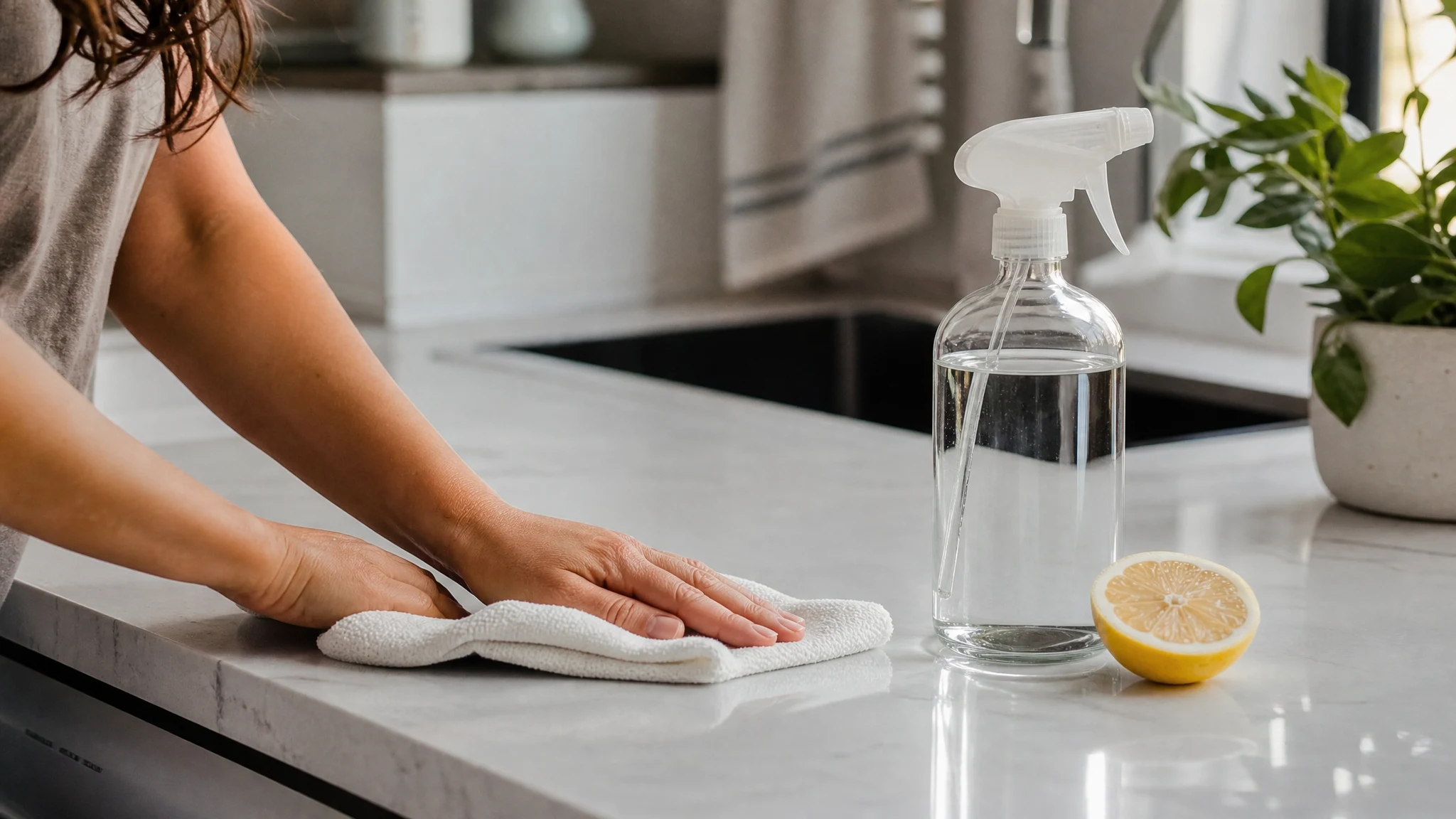
Lemon Oil and Vinegar Cleaners: Cleaning Is Not Disinfecting
A spray bottle of vinegar and lemon oil is a cleaner and, at best, a scent. It is not a disinfectant, and the evidence for treating it as one is thinner than the internet suggests. A controlled comparison of vinegar against household disinfectants found vinegar well short of them, and the published lemon oil figures come from broth tests at concentrations and contact times no kitchen counter sees. Our oil is a scent in a cleaner and makes no disinfection claim. Where a pathogen is a real concern, the answer is a product registered with the US Environmental Protection Agency (EPA), used according to its label.
Organic Lemon Essential Oil
Our own Organic Lemon Essential Oil, in sizes from 0.5 oz to bulk.
From $15.99
Shop Now →Three words that are not interchangeable
The Centers for Disease Control and Prevention (CDC) separates the steps. Cleaning uses soap or detergent and "removes most germs, dirt, and impurities from surfaces"; disinfecting is a stronger step that "kills most germs on surfaces and objects." The CDC says to clean first, because dirt can keep chemicals from reaching germs, then use an "EPA-registered disinfecting product" and keep the surface wet for the full contact time on the label (CDC, 31 January 2025).
The law draws the same line from the other side. EPA treats claims such as "sanitizes, disinfects or sterilizes" as pesticidal claims, while claims about removing dirt, soil, dust or debris are generally not (EPA, updated 6 July 2026). EPA says disinfectants are registered pesticides, defined as products that destroy or irreversibly inactivate bacteria, fungi and viruses, and that a surface must stay visibly wet for the entire contact time (EPA, updated 24 August 2026). A vinegar and lemon oil cleaner removes soil. That is a useful thing, and it is a different thing.
Essential-oil products have their own lane. EPA's conditions for minimum-risk pesticides say the label "cannot state or imply that the product can or will control or reduce organisms that pose a threat to human health" (EPA, updated 31 August 2026). The page defers to a separate list for which active ingredients are allowed; the page as read does not say whether lemon oil is on it.
What vinegar did when it was tested
Rutala and colleagues at UNC Hospitals tested natural products (vinegar, baking soda) against commercial household disinfectants using a quantitative suspension test at 30 seconds and 5 minutes of exposure, on Staphylococcus aureus, Salmonella choleraesuis, E. coli O157:H7 and Pseudomonas aeruginosa. Several commercial products eliminated 4 to more than 6 logs (each log is a tenfold reduction). Vinegar eliminated less than 3 logs of S. aureus and E. coli, and baking soda less than 3 logs of all test pathogens. The authors concluded the natural products were less effective than commercial household disinfectants (Rutala et al., 2000, Infection Control and Hospital Epidemiology). Two limits on reading that: it was published in 2000, and the abstract does not state the vinegar's strength. It tested vinegar alone, so it says nothing about vinegar with lemon oil added.
What lemon oil did, and how to read an MIC
A minimum inhibitory concentration (MIC) is the lowest concentration that stops visible growth in a test liquid. It is not a surface result. Two lemon oil papers show the pattern.
- Yazgan and colleagues (2019) compared a lemon oil nanoemulsion, 100% lemon oil and a 10% dilution against food-borne pathogens and fish spoilage bacteria in disc diffusion, MIC and bactericidal-concentration tests. Their oil was 52.85% d-limonene by GC-MS. The 10% oil had a bactericidal concentration of 25 mg/mL or more against the pathogens and spoilage bacteria (Yazgan et al., 2019, International Journal of Food Microbiology).
- Xiao and colleagues (2024) made a lemon oil nanoemulsion and reported an MIC of 6.25 mg/mL against E. coli, with significant killing after 5 hours at one times the MIC (Xiao et al., 2024, Food Microbiology).
Both are lab studies on food bacteria, in liquid, using engineered nanoemulsions or undiluted oil. Neither tested a surface, a vinegar mix, or the oil we sell.
The unit conversion shows the gap. 6.25 mg/mL is 6.25 g per litre, or 0.625% by weight per volume. The batch on our published COA has a relative density of 0.849, so 1 ml weighs about 0.849 g, and at about 20 drops per ml one drop is about 0.042 g (droppers vary). A 500 ml spray bottle at that concentration needs about 3.1 g of oil, roughly 74 drops, and a 250 ml bottle about 1.6 g, roughly 37 drops. Even then the figure came from a nanoemulsion in broth, where the 5 hour result is about time in contact with bacteria in liquid. Rutala's tests ran 30 seconds and 5 minutes, and EPA's rule is a surface visibly wet for the label's contact time. Loose oil in vinegar has not been shown to do that, and the oil floats unless something disperses it. The room spray post shows what dispersing it takes (a solubilizer and a preservative).
The other figure in the Yazgan abstract converts the same way: 25 mg/mL is 2.5 g per 100 ml, or 2.5% by weight per volume, about 59 drops in 100 ml of liquid. That is more than the 2.0% IFRA ceiling for lemon oil in leave-on categories, which governs skin exposure rather than germ activity, and well above the 0.5% to 2% our own copy gives for skin. A bottle that reached those concentrations would be a different product from the cleaner people have in mind, and nothing fetched shows it would work on a counter.
Mixing is a chemistry and safety question
The CDC's cleaning-with-bleach page says never to mix household bleach, or any disinfectants, with other cleaners or disinfectants, because it "can release vapors that may be very dangerous to breathe in" (CDC, 24 April 2024), and its home guidance says "Do not mix products or chemicals with each other." That page does not name vinegar. Reasoning from that rule, a home mixture of cleaners is a guess at chemistry, and a natural-sounding label on a cleaner does not change that. If someone has mixed products and is coughing or short of breath, Poison Help (1-800-222-1222 in the US) is the line the National Capital Poison Center gives for exposures (National Capital Poison Center); that page is about essential oils generally rather than mixtures.
The position on our side is narrow. Our oil is sold neat as a scent for cleaners, and our own copy says to keep it from children and pets and never to take it internally. We sell no disinfectant and make no claim that it removes germs. What a lemon-scented cleaner does for soil is covered in the cleaning post and the all-purpose spray post; the seasonal version is the spring cleaning plan.
When germs are the actual concern
- After raw meat, a stomach illness, or any situation where a pathogen is the point: clean with soap and water, then use an EPA-registered disinfectant exactly as the label says, including the wet contact time. EPA's page links its List N of products registered against SARS-CoV-2.
- For an illness, the person to ask is a physician or the local public health department, not a cleaning label.
- Vinegar can still be used as a cleaner; the Rutala paper tested it as a disinfectant, not as a cleaner.
Our oil is a scent for the cleaning step, and the label on an EPA-registered product governs any germ claim. For other insect and pest questions, see the repellent post.
Organic Lemon Essential Oil
Organic Lemon Essential Oil from our own shop, in sizes from 0.5 oz to bulk.
From $15.99
Shop Now →Sources & Further Reading
- CDC, 2025. When and how to clean and disinfect your home. cdc.gov/hygiene/when-and-how-to-clean-and-disinfect-your-home
- CDC, 2024. Cleaning and disinfecting with bleach. cdc.gov/hygiene/cleaning-and-disinfecting-with-bleach
- EPA, 2026. Determining if a cleaning product is a pesticide under FIFRA. epa.gov/determining-if-cleaning-product-pesticide-under-fifra
- EPA, 2026. Selected EPA-registered disinfectants. epa.gov/selected-epa-registered-disinfectants
- EPA, 2026. Conditions of minimum risk pesticides. epa.gov/conditions-minimum-risk-pesticides
- Rutala WA, Barbee SL, Aguiar NC, Sobsey MD, Weber DJ, 2000. Antimicrobial activity of home disinfectants and natural products against potential human pathogens. Infect Control Hosp Epidemiol 21(1):33-8. pubmed.ncbi.nlm.nih.gov/10656352
- Yazgan H, Ozogul Y, Kuley E, 2019. Antimicrobial influence of nanoemulsified lemon essential oil and pure lemon essential oil on food-borne pathogens and fish spoilage bacteria. Int J Food Microbiol 306:108266. pubmed.ncbi.nlm.nih.gov/31319195
- Xiao W et al., 2024. Lemon essential oil nanoemulsions: potential natural inhibitors against Escherichia coli. Food Microbiol 119:104459. pubmed.ncbi.nlm.nih.gov/38225037
- National Capital Poison Center. Essential oils. poison.org/articles/essential-oils