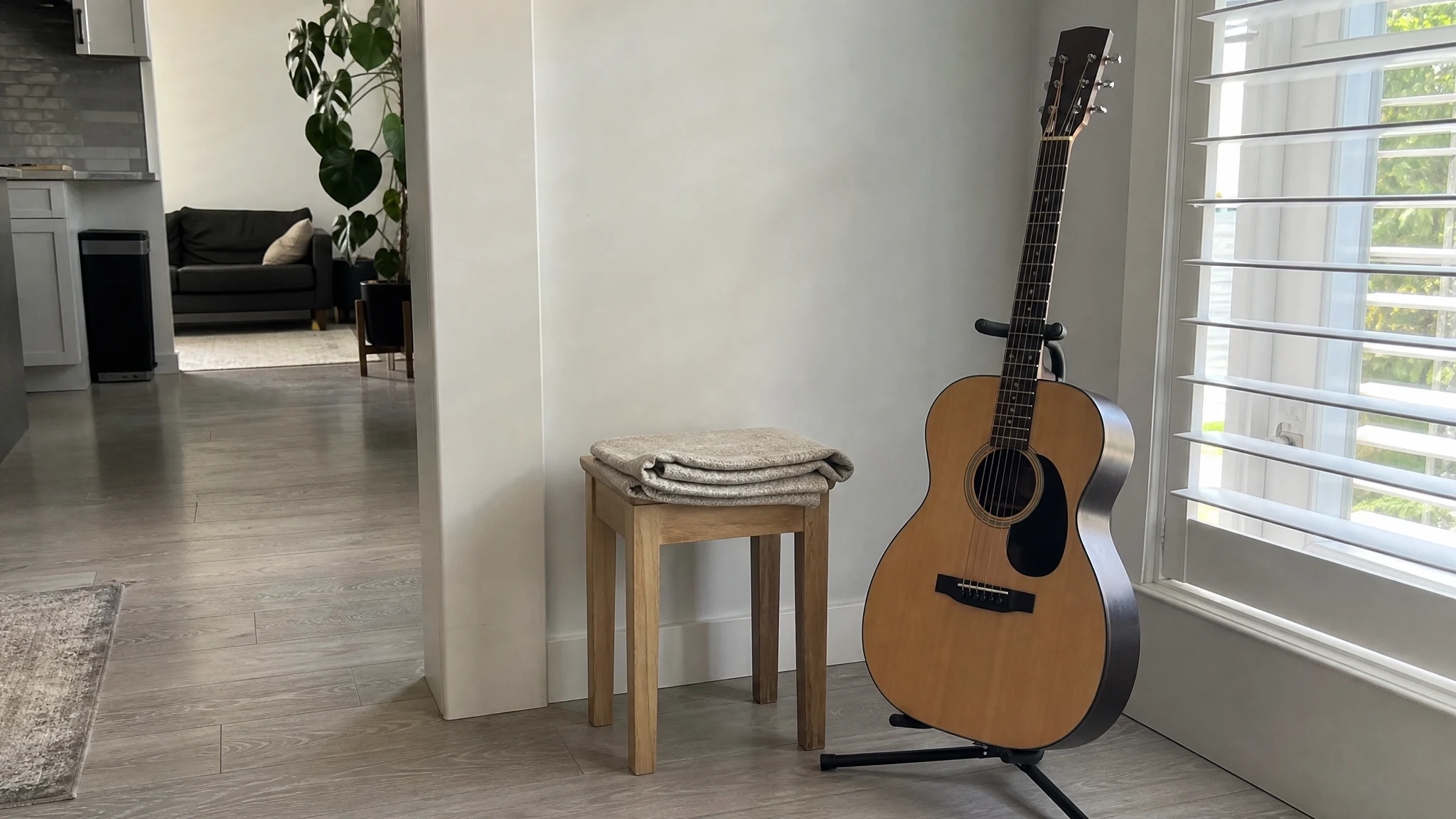
Lemon Oil for Guitar Fretboards: What Makers Actually Say
Do not put neat lemon essential oil on a fretboard. The "lemon oil" sold in music shops is a formulated product, and the one safety data sheet read for this article lists limonene at under 1% of it. Guitar makers also disagree about lemon oil on fingerboards, so the person to ask is the maker of your instrument, or a luthier. We sell one material, cold-pressed lemon essential oil, and it is not a fretboard conditioner.
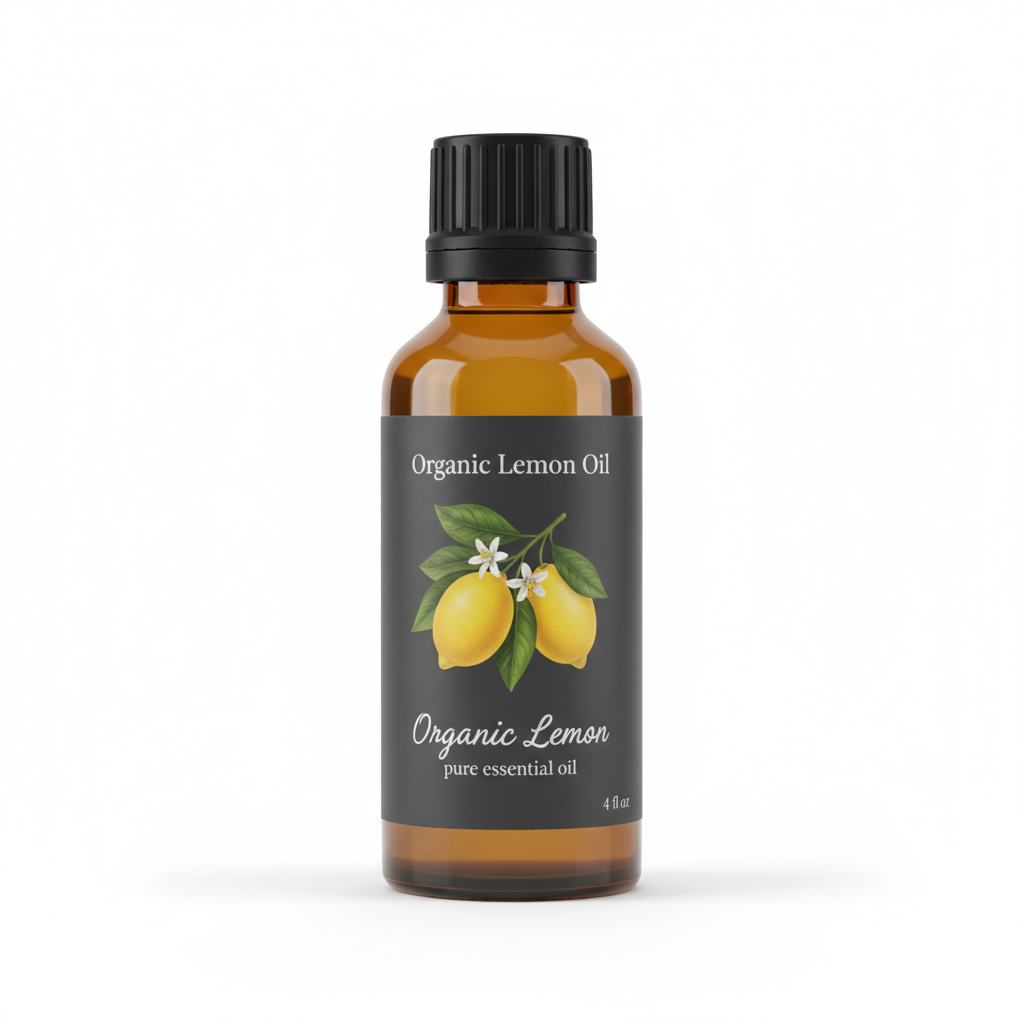
Organic Lemon Essential Oil
Our own Organic Lemon Essential Oil, in sizes from 0.5 oz to bulk.
From $15.99
Shop Now →Start with what the music-shop bottle contains
Dunlop's current US safety data sheet for Fretboard 65 Ultimate Lemon Oil (revision date June 15, 2023) is a useful reference because it is public and specific. It classifies the product as a skin sensitizer, Category 1, with the hazard statement "May cause an allergic skin reaction." In the composition section it names two components: (R)-p-mentha-1,8-diene, which is d-limonene, at 0.5 to under 1% by weight, and citral at 0.025 to under 0.25%. It then states that "the exact percentage/concentration is withheld as a trade secret." Other listed properties: yellow liquid, lemon odor, relative density about 0.85, immiscible in water, kinematic viscosity 70 mm²/s, no flash point data (Dunlop Manufacturing, SDS, 2023).
The arithmetic is short. Every 100 g of that product carries under 1 g of limonene and under 0.25 g of citral, so the two named components together are under 1.25 g. The sheet does not name the rest of the liquid. That is one maker's sheet for one product, and other brands may differ. What it shows is that a bottle labelled lemon oil is not necessarily lemon oil in the sense our shop uses the words, and a data sheet is the only reliable way to find out. Read it, and do not assume a lemon label means a lemon peel oil.
Guitar makers do not agree
Two makers, read directly, give opposite answers.
| Source | What it says |
|---|---|
| Martin Guitar, FAQ (undated as read) | "Martin Guitar does not recommend using lemon oil on the fingerboard." It gives two reasons: "The acids in lemon oil break down the finish of your guitar," and "It may also speed the corrosion of the frets and decrease the life of your strings." String changes are named as a good time for "cleaning and dressing the fret board." |
| Martin Guitar, care article, March 23, 2022 | Fingerboard and bridge can be conditioned "because there's no finish on them," one or two times a year depending on humidity. Products named: 3-In-1 Oil and Dr. Duck's Axe Wax. Lemon oil is not mentioned. |
| Taylor Guitars blog, Bob Taylor, March 29, 2013 | "I'd have no worries about using lemon oil on my fretboard. It's safe." He says to use it "only on the unfinished wood like the fretboard and bridge," lists linseed oil and mineral oil as alternatives, and adds that a board will not need oiling "more than twice a year, and eventually, once a year." |
The sources are Martin's FAQ, Martin's 2022 care article and Taylor's 2013 post. Martin's FAQ and Taylor's post cannot both be followed on the same guitar, and neither as read gives test data. The points they share are that conditioning, where used, goes on bare wood only, that it is occasional (one or two times a year at most), and that cleaning belongs at string changes. Neither page, as read, discusses maple or other finished boards, so a finished board is a question for the maker. A 2013 blog post and a 2022 article from different companies should not be averaged into one rule. The reader's own maker's guide wins.
Why neat essential oil is the wrong tool
It oxidises, and the oxidised product is the allergen. The NIH PubChem record for d-limonene, quoting its HSDB entry, says limonene "oxidizes to a film in air, oxidation behavior similar to that of rubber or drying oils," that "the oxidized form of d-limonene is a known skin sensitizer," and that patch testing of consecutive dermatitis patients in Sweden and Belgium found positive reactions in 1.5 to 2% of those tested with oxidized d-limonene (PubChem, CID 440917). A fretboard is touched by fingertips for hours at a time, which is a different exposure from a wipe-and-rinse. Our own copy says an old bottle "is not simply flatter" because limonene oxidises into hydroperoxides that are established skin sensitizers, and that is covered in the storage guide.
It is a solvent. PubChem lists d-limonene's uses as a solvent and wetting agent. A 2021 paper in a Brazilian university journal reports that expanded polystyrene dissolves in d-limonene on contact at room temperature, with a mean of 1.67 g dissolving in 3 ml, about 0.56 g per ml (UNIFACEAR electronic journal, 2021, in Portuguese). That is foam packaging polymer and isolated d-limonene, not a nut, binding, pickguard or lacquer, and it is a small bench study by two students and a professor. No data on guitar finishes or plastics was read, and that gap is the case against experimenting with a bottle of neat oil. Martin's statement about finish is the maker's own warning on the same point.
The dose is wrong for skin contact. Our copy says to dilute this oil to 0.5% to 2% in a carrier for skin, and it is sold neat. A neat application is 100% oil, which is 50 times the 2% top of that range. At 20 drops per ml and a relative density of 0.849 on the COA batch, one ounce is about 591 drops or about 25.1 g, and a 0.5 oz bottle is about 296 drops. Even the "few drops" a player might think of using are drops of an undiluted, phototoxic, sensitizing material, left on wood that hands then touch. Our copy also says to keep the oil from children and pets, and not to take it internally.
What to do instead, in order
- Find out what your fingerboard is. Bare rosewood or ebony and a finished maple board are different cases. The maker's care guide or a luthier will say which yours is.
- Follow the maker's own page. If the maker names a product, use that product. If two makers disagree, as Martin and Taylor do, the one that built your instrument decides.
- Ask for the data sheet of anything you buy. A conditioner sold in a music shop should have one. Check the hazard line, as the Dunlop sheet shows, and keep it off finished surfaces.
- Keep it occasional. The two makers' figures are one or two times a year (Martin) and twice a year tapering to once (Taylor). Wipe the board at string changes.
- Take cracks, lifting frets or a dry-looking board to a luthier rather than adding more oil.
This is a summary of cited guidance, not a procedure we have carried out. We have no fretboard tests, no luthier, and no instrument-maker input of our own, and the weight here is on the makers' pages.
Where our oil does belong
Lemon peel oil's natural place is scent in a room or on cleaning cloths. If the question is wooden furniture rather than instruments, the wood guide covers it, and the same caution about finishes and dilution applies there. For anything on your skin, the safety basics come first, and the FAQ answers the shorter questions.
Organic Lemon Essential Oil
Organic Lemon Essential Oil from our own shop, in sizes from 0.5 oz to bulk.
From $15.99
Shop Now →Sources & Further Reading
- Dunlop Manufacturing, 2023. Safety data sheet, Fretboard 65 Ultimate Lemon Oil (revision June 15, 2023). jimdunlop.com SDS
- Martin Guitar. Frequently asked questions (care and parts). martinguitar.com/faqs
- Martin Guitar, 2022. Guitar care and cleaning (From the Factory, March 23, 2022). martinguitar.com/blog
- Taylor B, 2013. Fretboard oil. Taylor Guitars blog, March 29, 2013. blog.taylorguitars.com/fretboard-oil
- NIH PubChem. D-Limonene, CID 440917 (includes HSDB excerpts). pubchem.ncbi.nlm.nih.gov/440917
- Silva JC, Freitas GV, Rocha JVS, 2021. Dissolucao do poliestireno expandido com o solvente D-limoneno. Revista Eletronica Multidisciplinar UNIFACEAR. revista.unifacear.edu.br